

TL;DR
A hobbyist has managed to run a simple web server on an AVR8-bit microcontroller using serial protocols instead of Ethernet. This showcases the microcontroller’s potential for ultra-low-power, minimal-hosting applications, though with significant limitations.
A hobbyist has successfully hosted a basic web server on an AVR64DD32 microcontroller, using serial communication protocols instead of Ethernet. This achievement highlights the microcontroller’s potential for ultra-low-power, minimal hosting applications, despite significant technical limitations.
The project involves an AVR64DD32 microcontroller, similar to the popular Arduino Atmega328, which features 8 KB of RAM, 64 KB of flash memory, and costs around $1. It is capable of running at 24 MHz but is limited in I/O speed, making standard Ethernet difficult to implement directly.
The developer opted for a serial line protocol (SLIP) over a USB-to-Serial connection, enabling the microcontroller to send and receive IP packets without external Ethernet hardware. The setup includes minimal external components, with the microcontroller drawing only a few milliwatts and running off a 5V power supply, making it highly energy-efficient.
The microcontroller’s implementation handles basic IP packet routing by swapping source and destination addresses, but it does not support TCP fully. The developer managed to implement a simplified HTTP response, which always returns a static webpage, suitable for a single URL site. However, the setup cannot serve multiple pages or handle complex web traffic.
Why It Matters
This development demonstrates that even very limited hardware like an 8-bit microcontroller can host a basic web interface, opening possibilities for ultra-low-power IoT devices and experimental projects. It also highlights the constraints of using serial protocols for networking, such as limited bandwidth and lack of full TCP/IP stack support, which restricts practical deployment.
For the broader internet, this underscores ongoing challenges with IPv4 address scarcity and the slow adoption of IPv6, which would simplify such projects. The project also illustrates how hobbyists can push the boundaries of microcontroller capabilities, but it remains impractical for production use or large-scale deployment.
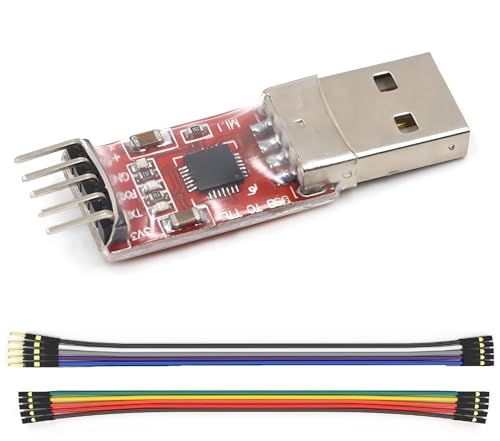
WWZMDiB Mini USB 2.0 to TTL Converter Serial Adapter 3.3V 5V Compatible with CP2102 Chip UART Programming
USB to TTL Serial Adapter: Commonly used in microcontrollers, IoT, automation, and supports UART interface communication
As an affiliate, we earn on qualifying purchases.
As an affiliate, we earn on qualifying purchases.
Background
Hosting a website on microcontrollers has traditionally been limited to Ethernet or Wi-Fi modules, which require additional hardware and power. The AVR64DD32, part of the AVR Dx line, is a low-cost microcontroller with modest resources, making it unsuitable for conventional web hosting. Previous efforts focused on minimal HTTP servers or networked sensors; this project is notable for attempting a complete web interface over serial protocols.
Serial communication protocols like SLIP have been used historically for dial-up modems and simple networking, but their use for web hosting is novel. The developer’s approach leverages the simplicity of IP packet routing and bypasses the need for complex TCP stack implementation, which is typically infeasible on such hardware.
“This setup proves that even the most limited microcontrollers can host a basic webpage, provided you work within their constraints.”
— the developer
“While impressive, this approach is mainly a proof of concept; it’s not suitable for production environments due to bandwidth and security limitations.”
— an embedded systems expert

ESP-WROOM-32 ESP32 ESP-32S Development Board 2.4GHz Dual-Mode WiFi + Bluetooth Dual Cores Microcontroller Processor Integrated with Antenna RF AMP Filter AP STA Compatible with Arduino IDE (3PCS)
2.4GHz Dual Mode WiFi + Bluetooth Development Board
As an affiliate, we earn on qualifying purchases.
As an affiliate, we earn on qualifying purchases.
What Remains Unclear
It remains unclear how stable or scalable this setup is under sustained or multiple connections. The developer has not tested extensive web traffic or complex interactions, and full TCP support is not implemented, limiting functionality. Additionally, the long-term reliability and security of such a minimal setup are unknown.

Hosyond 3Pcs ESP8266 ESP-12E CP2102 NodeMCU Lua Wireless Module Development Board for Arduino IDE/Micropython
Not only it is easy to program for this controller by using the CP2102-USB interface,but also unnecessary to…
As an affiliate, we earn on qualifying purchases.
As an affiliate, we earn on qualifying purchases.
What’s Next
The next steps include refining the IP routing implementation, exploring lightweight TCP solutions, and possibly integrating minimal security features. Further testing under real-world conditions and attempts to serve multiple pages or handle more complex web interactions are likely.

HiLetgo 51 AVR ATMEGA8 Programmer USBasp USB ISP 10 Pin USB Programmer 3.3V/5V with Cable
Main Chip:ATMega8A-AU.Support AVR and ASP chip.Support AT89S51/52 microcontroller.
As an affiliate, we earn on qualifying purchases.
As an affiliate, we earn on qualifying purchases.
Key Questions
Can this microcontroller host a real website accessible over the internet?
Not easily. It can host a static webpage accessible via a serial connection or through a proxy setup, but direct public access over the internet requires additional hardware and network configuration.
What are the limitations of hosting a website on such a device?
Bandwidth is extremely limited, full TCP/IP stack support is absent, and it cannot handle multiple requests or complex web applications. It’s mainly a proof of concept for simple static pages.
Why use serial protocols instead of Ethernet?
Ethernet hardware is more expensive and complex on such low-resource microcontrollers. Serial protocols like SLIP are simpler, require fewer external components, and are compatible with the microcontroller’s limited processing power.
Could this approach be scaled for practical IoT applications?
Currently, no. The limitations in bandwidth, security, and TCP support make it impractical for production use, but it offers interesting insights for ultra-low-power or specialized applications.