
🔍 Read the full analysis: What Ring’s Home Drone And Patrol Robot Reveal About AI And Privacy on ThorstenMeyerAI.com

Get business pricing on monitors, keyboards and dev gear
- Business-only prices and quantity discounts
- Tax-exempt purchasing
- Multiple users, one account, clear invoices
TL;DR
Amazon’s Ring announced Ring Robotics on Nov. 10, 2026, with an indoor drone and a wheeled patrol robot that can move toward alerts from other Ring devices. Ring describes privacy controls and TAKE encryption, but the drone still lacks required FCC authorization, and critics question whether Ring’s encryption protects users as strongly as end-to-end encryption.
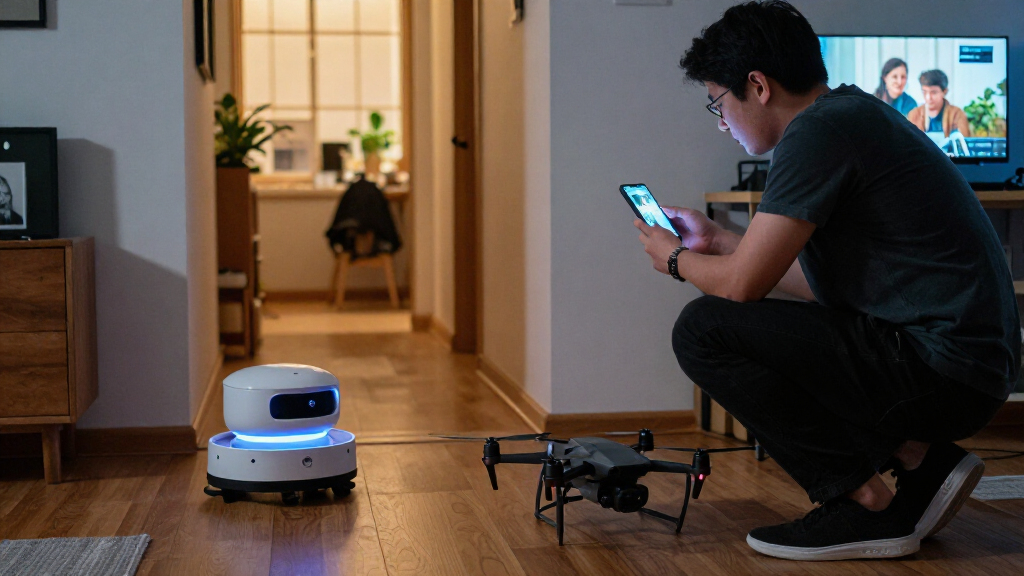
Amazon’s Ring announced two mobile security cameras on Nov. 10: an indoor drone for homes and a wheeled patrol robot for businesses. The devices use Ring’s AI Pilot system to patrol and investigate alerts from other Ring products. The announcement adds mobile cameras to Ring’s lineup and raises questions about how they record, process and store video.
Ring says its new Ring Robotics line launches with the Drone Cam, priced at $249.99, and the Rover Cam, priced at $999.99. The company lists U.S. shipping dates of Jan. 27, 2027, for the drone and Dec. 16, 2026, for the rover. Ring says scheduled patrols require a compatible Ring Protect plan.
According to Ring, both devices use AI Pilot to map spaces, suggest patrol points and steer around obstacles. They can also respond when another Ring camera, sensor or alarm is triggered. The drone flies around a home on scheduled routes or on demand; the rover is aimed at businesses and can patrol areas such as shops and offices.
Ring says the drone has a 148-degree field of view, 2K video and LED lights. The rover has a camera on an adjustable mast, two-way audio, a siren and a light tower. Ring says it streams and records up to 4K while moving or patrolling. Its announcement also says recording can begin when it detects motion, including while docked.
There is a regulatory caveat: Ring says the Drone Cam has not received authorization required under Federal Communications Commission rules and may not be sold until that approval is granted. The company has not provided an authorization date in the material available for this report.
Ring adds mobile cameras and new privacy questions
Ring’s indoor drone and business patrol robot can move toward alerts. Their launch brings surveillance beyond fixed cameras, while authorization and privacy details remain open.
Two devices, mobile patrol
Ring says AI Pilot can map spaces, suggest patrol points and respond to alerts from other Ring devices.
Drone Cam
Flies scheduled routes or responds on demand. Its camera is off while docked.
Rover Cam
Wheeled patrol robot with an adjustable camera mast, two-way audio and Sleep Mode.
What privacy controls mean
Ring describes visible recording indicators and device controls; how they work in everyday use remains to be assessed.
- Drone camera is off while docked.
- Rover Sleep Mode retracts the camera mast and turns off its microphone.
- TAKE supports cloud features, with keys temporarily accessed by Ring servers.
- How long footage is retained and who can access it.
- How reliably users can verify when mobile devices record.
- Whether TAKE protects recordings as strongly as end-to-end encryption.
Launch dates and approval
Ring lists U.S. shipping dates for both products, but the drone’s sale depends on regulatory approval.
Mobile Cameras Expand Ring’s Reach
Unlike fixed cameras, Ring’s new devices can move toward a location after an alert. This allows them to monitor areas beyond the places where cameras are installed. Their mobility also raises questions about when recording begins and how a device moves through a home or business.
Ring says the products are designed to be visible and audible, with indicators that show when they are recording. The drone’s camera is off while docked, and the rover offers a Sleep Mode that retracts its camera mast and turns off its microphone. These controls are intended to indicate or pause surveillance. Their effectiveness will depend on how the devices operate and whether users and others can identify when recording is active.
The products also rely on cloud-connected AI. The Verge reported that the drone’s processing depends on an internet connection; without Wi-Fi, it can land but cannot carry out its normal functions. Connectivity requirements, video access, storage and encryption are among the factors customers may consider.
Products Worth Considering

Bose QuietComfort Ultra Wireless Over-Ear Headphones with Spatial Audio and Noise Cancellation, Black

LG UltraGear 32-inch Curved QHD Gaming Monitor (2560×1440, 180Hz, 1ms, 1000R, HDR10)

Logitech MX Master 4 Ergonomic Wireless Mouse with Haptic Feedback, Graphite
As an affiliate, we earn on qualifying purchases.
Ring’s Earlier Drone and Privacy Record
The announcement builds on a product idea Ring has explored for years. The company previewed an indoor drone, then called the Always Home Cam, in 2020. The Verge reported that founder Jamie Siminoff said development began in 2016. Ring now presents the drone alongside a business-focused patrol robot, which it says draws on work from Amazon Astro.
Ring’s privacy assurances come against the backdrop of a 2023 Federal Trade Commission case. The FTC charged Ring with allowing employees and contractors to access customers’ private videos and with failing to implement basic privacy and security protections. Those were allegations in the agency’s complaint; the case is relevant to how customers may assess new products that collect and process video.
Ring announced its Throw Away the Key encryption (TAKE) in August 2026. The company says it is inspired by end-to-end encryption principles, but its description says Ring’s servers temporarily access encryption keys to provide cloud features such as smart alerts, then delete them. Full end-to-end encryption remains an optional setting. The Electronic Frontier Foundation said in September 2026 that TAKE is “still not even close to the privacy protections of end-to-end encryption.”
“For years, customers told us they wanted eyes in the places a fixed camera couldn’t reach, and peace of mind in the spots they’d never want one.”
— Jamie Siminoff, Ring founder and chief inventor, in Ring’s announcement
Approval and Privacy Details Remain Open
The clearest immediate uncertainty is whether and when the Drone Cam will receive FCC authorization. Ring says the device may not be sold before authorization, so its listed January shipping date is subject to that regulatory status.
Other operational details also remain limited. Ring’s announcement does not fully explain how long video is retained, who can access footage under different settings, or how customers can verify that mobile devices record only at the stated times. The Verge reported that the drone can fly for five to eight minutes on a charge and relies on an internet connection; these details came from reporting and a demonstration, rather than the announcement’s core product specifications.
Ring’s security assurances and critics’ concerns are not the same as an independent assessment of the new products. The available material does not establish how TAKE will protect recordings in every use case, or whether the devices’ indicators and privacy modes will prevent unwanted recording in homes and workplaces.
Watch for FCC Approval and Launches
The next concrete milestone is FCC authorization for Drone Cam, followed by any change to its planned U.S. shipping date. Ring lists Rover Cam for shipment beginning Dec. 16, 2026, and Drone Cam for Jan. 27, 2027, subject to the regulatory restriction on the drone.
As the products approach release, customers and businesses will be able to assess their battery life, connectivity, recording behavior and response to alerts. Additional information about Ring Protect plan requirements, privacy settings and video handling may also clarify how the products can be used.
The announcement establishes Ring’s product plans and stated safeguards. The devices’ performance in everyday use and the drone’s regulatory status remain to be determined.
Key Questions
What did Ring announce?
Ring announced Ring Robotics, a product line starting with an indoor flying camera called Drone Cam and a wheeled business patrol robot called Rover Cam.
When will the Ring cameras be available?
Ring lists Rover Cam for U.S. shipping from Dec. 16, 2026, and Drone Cam from Jan. 27, 2027. The drone may not be sold until it receives required FCC authorization.
What is Ring’s privacy approach for the devices?
Ring says the drone camera is off while docked, Rover Cam has a Sleep Mode, and both devices use its TAKE encryption. Ring says its servers temporarily access keys for cloud features; full end-to-end encryption remains an optional setting.
Does the Drone Cam have FCC authorization?
Not according to Ring’s announcement. The company says the Drone Cam has not been authorized as required by FCC rules and may not be sold until it is. No authorization date is specified in the source material.
Source: ThorstenMeyerAI.com