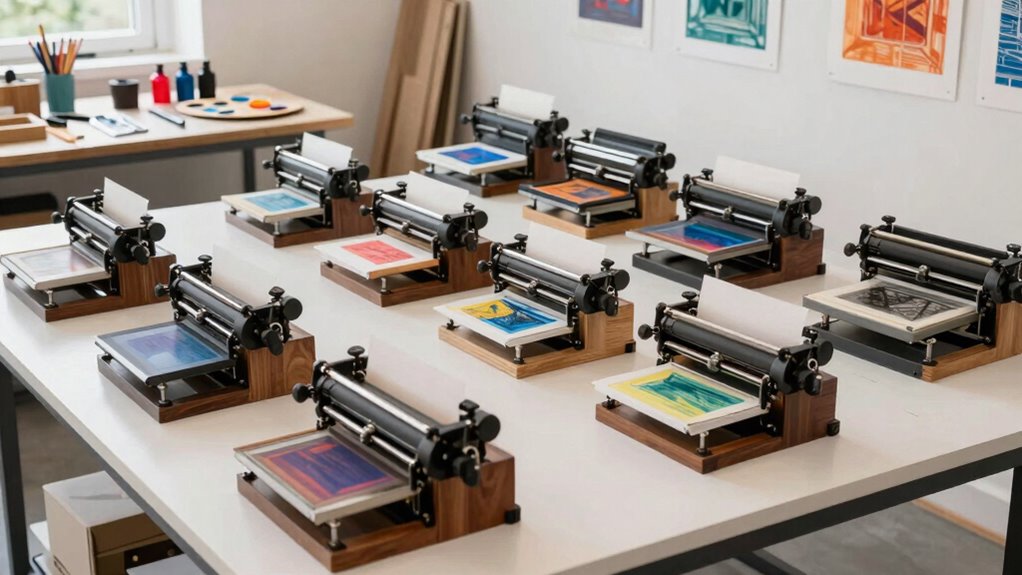

A printmaking press is the single biggest upgrade most relief and etching artists can make, but the right choice depends on what you print and how much pressure control you need. For most buyers, the TOPOWN Linocut Printing Hand Lever Press Machine stands out as the best overall pick because it balances lever pressure, bed size, and durability without overcomplicating the workflow. If you’re on a budget or short on space, the A4 Linocut Manual Printmaking Machine in Premium Beech Wood is a capable, beginner-friendly alternative, while the Basic Etching Press with Felt Pad & Base Plate is the better route if you want to work with metal plates and intaglio rather than relief blocks. The core tradeoff in this category is versatility versus simplicity: roller-style etching presses handle more techniques but cost more and demand more setup, while lever-style linocut presses are faster for relief work but limited to thinner, flatter materials. Keep reading for the full breakdown of all 11 presses and which one fits your studio.

Get monitors, keyboards and dev gear delivered free — and shop member deals
- Fast, free delivery on millions of items
- Access to Prime Big Deal Days deals on October 6–7
- Prime Video, Amazon Music and more included
Key Takeaways
- Lever-style linocut presses dominated this lineup, but only the TOPOWN full-size models delivered consistent pressure across an entire block without dead spots near the edges.
- Beech wood presses like the two A4 models were the clear value plays for beginners, but their fixed or limited pressure adjustment becomes a bottleneck once you move to thicker blocks or mixed materials.
- The two all-metal etching presses were the only options here capable of true intaglio work, thanks to roller pressure and included felt pads — every other pick is relief-only.
- Bed size was the most practical differentiator: the A3 press suits exhibition and edition work, Legal and A4 sizes handle most studio prints, and the A5 and Mini TOPOWN are really card- and proof-scale tools.
- Included accessories (felt pads, rollers, base plates) varied widely and changed the real cost of getting started — the etching presses and the A5 kit arrived ready to print, while several wood presses assumed you already owned a setup.
| Linocut Press Machine for Printmaking, A3 Size (16.5″ x 11.8″) Green |  | Best Overall | Max print size: A3 (11.8 x 16.5 in) | Also fits: A5, A4, and Legal paper sizes | Frame: Powder-coated steel | VIEW ON AMAZON | See Our Full Breakdown |
| TOPOWN Linocut Printing Hand Lever Press Machine |  | Best Value for A4 Work | Max paper size: A4 | Max block thickness: Approx. 25 mm | Frame: Powder-coated alloy steel | VIEW ON AMAZON | See Our Full Breakdown |
| TOPOWN Mini Linocut Press, Printing Hand Lever Press Machine for Linocut |  | Best Compact Pick | Max paper size: A5 | Max block thickness: Approx. 25 mm | Pressure adjustment: Adjustable print thickness | VIEW ON AMAZON | See Our Full Breakdown |
| A4 Linocut Manual Printmaking Machine Premium Beech Wood |  | Best for Beginners and Teens | Max paper size: A4 | Max block thickness: 25 mm | Pressure settings: 3 adjustable levels | VIEW ON AMAZON | See Our Full Breakdown |
| A4 Linocut Press Machine Premium Beech Wood, Adjustable Print Thickness |  | Best Premium Build | Max paper size: A4 | Max block thickness: 25 mm | Pressure settings: 3 adjustable levels | VIEW ON AMAZON | See Our Full Breakdown |
| Basic Etching Machine, All-Metal Structure Printing Press |  | Best Multi-Technique Workhorse | Construction: All metal | Print Size: 11 x 10 inches | Overall Dimensions: 11 L x 10 W x 7.2 H inches | VIEW ON AMAZON | See Our Full Breakdown |
| Lanties Linocut Hand Lever Press Machine with Rollers and Felt Pads (A5) |  | Best Family-Friendly Starter Kit | Print Size: A5 | Overall Dimensions: 12.99 x 8.66 inches (33 x 22 cm) | Frame Material: Iron with wear-resistant coating | VIEW ON AMAZON | See Our Full Breakdown |
| Basic Etching Press with Felt Pad & Base Plate |  | Best Benchtop Etching Value | Max Print Size: 9 x 15 inches | Dimensions: 9.75 x 12.375 x 6.75 inches | Material: Heavy-duty steel | VIEW ON AMAZON | See Our Full Breakdown |
| Linocut Press Machine for Printmaking, Legal Size (14″ x 8.7″) Green | | Best Format Flexibility for Relief Printing | Print Size (this model): Legal — 22 x 35 cm (8.7 x 14 inches) | Available Sizes: A5, A4, Legal, A3 | Frame: Powder-coated steel | VIEW ON AMAZON | See Our Full Breakdown |
| Lounsweer Block Printing Press Linocut Hand Letterpress Machine, Adjustable |  | Best Portable Press for Classes and Travel | Max Print Size: 6 x 8 inches | Weight: 6 pounds | Construction: Ultra-strong steel | VIEW ON AMAZON | See Our Full Breakdown |
| TOPOWN Linocut Printing Hand Lever Press Machine, Linocut Press Machine |  | Best Budget Bundle for Family Workshops | Press Type: Manual hand lever | Max Block Thickness: Approx. 25mm (3-level adjustment) | Paper Compatibility: A4 size printing, felt, and art papers | VIEW ON AMAZON | See Our Full Breakdown |
| printmaking press | Frame | Included accessories |
|---|---|---|
| Linocut Press Machine for Prin | Powder-coated steel | 6 cm rubber brayer, felt sheet |
| TOPOWN Linocut Printing Hand L | Powder-coated alloy steel | — |
| TOPOWN Mini Linocut Press | Powder-coated alloy steel | — |
| A4 Linocut Manual Printmaking | Thickened 304 stainless steel, rust-proof coating | — |
| A4 Linocut Press Machine Premi | Thickened 304 stainless steel, rust-proof coating | — |
| Basic Etching Machine | — | None (felt and base plate sold separately) |
| Lanties Linocut Hand Lever Pre | — | Roller, felt pad |
| Basic Etching Press with Felt | — | Felt pad, base plate |
| Linocut Press Machine for Prin | Powder-coated steel | 6 cm rubber brayer roller, felt sheet |
| Lounsweer Block Printing Press | — | — |
| TOPOWN Linocut Printing Hand L | — | Rubber roller, felt pad, rubber pad, wrenches |
More Details on Our Top Picks
Linocut Press Machine for Printmaking, A3 Size (16.5″ x 11.8″) Green
Among tabletop lever presses, bed size is the single biggest differentiator, and this A3 model offers the largest print area of the bunch. Most lever presses here stop at A4 or even A5, which means larger relief blocks are off the table. The powder-coated steel frame paired with beech wood handle gives it a more planted feel than the compact TOPOWN Mini, and the varnished plywood plates help distribute pressure evenly across the full A3 span — a real benefit when printing wide woodcuts where edge-to-edge consistency matters. The bundled brayer and felt mean you can start printing without buying accessories separately. The tradeoff for that generous bed is footprint and weight: it demands more bench space than the A4 beech wood models, and like every press in this lineup, it’s still limited to relief techniques rather than intaglio.
Pros:- Largest print area in this lineup (A3, 11.8 x 16.5 in)
- Even pressure distribution from coated plywood plates
- Brayer and felt included out of the box
- Solid steel frame stays stable under firm lever pressure
Cons:- Larger footprint demands serious bench space
- Relief printing only — no etching or intaglio capability
- Plywood plates are less premium than the solid beech on the B0HC1WMSNZ
Best for: Relief printmakers working at A3 or larger who want the biggest bed in a manual tabletop press
Not ideal for: Artists with cramped workspaces or anyone wanting intaglio/etching capability — the flat plate design is relief-only
- Max print size:A3 (11.8 x 16.5 in)
- Also fits:A5, A4, and Legal paper sizes
- Frame:Powder-coated steel
- Handle:Solid beech wood
- Plates:Varnished plywood, upper and lower
- Included accessories:6 cm rubber brayer, felt sheet
- Techniques:Linocut, woodcut, rubber block, relief
Our verdict“The pick if print size is your priority — nothing else in this batch handles A3 blocks.”
TOPOWN Linocut Printing Hand Lever Press Machine
This A4 lever press from TOPOWN is the workhorse choice when you want full-size paper handling without paying for premium materials. Compared with the beech wood A4 model from the same family, the high-density plywood plate is a step down in finish, but the powder-coated alloy steel frame is equally rigid, and the effort-saving lever geometry means even younger printmakers can pull clean impressions. The package is generous: roller, felt pad, rubber pad, and wrenches all ship in the box, whereas several competitors make you source those separately. It accepts blocks up to 25 mm thick, matching the beech models, and covers linocut, woodcut, letterpress, and even flower pressing. The honest downside is refinement — the plywood construction and fixed pressure feel less precise than the 3-level adjustment on the B0HC1WMSNZ.
Pros:- Full A4 paper capacity at an accessible position in the lineup
- Complete accessory kit including roller, pads, and wrenches
- Sturdy alloy steel frame resists flexing
- Light lever action suitable for kids and beginners
Cons:- Plywood plate and handle feel less refined than solid beech alternatives
- No adjustable pressure settings
- Blocks not included, despite the extensive accessory bundle
Best for: Hobbyists and classroom settings that need A4 printing capacity on a modest budget
Not ideal for: Printmakers who want fine pressure control for delicate blocks — there’s no multi-level adjustment here
- Max paper size:A4
- Max block thickness:Approx. 25 mm
- Frame:Powder-coated alloy steel
- Plate and handle:High-density plywood
- Power source:Manual lever
- Included:Rubber roller, felt pad, rubber pad, wrenches
- Techniques:Linocut, woodcut, letterpress, rubber, cork, flower pressing
Our verdict“The sensible default for A4 relief printing if you don’t need premium wood or pressure adjustability.”
TOPOWN Mini Linocut Press, Printing Hand Lever Press Machine for Linocut
Sharing its sibling’s frame and lever design, this mini version shrinks the working area to A5 paper, and that constraint is exactly why it earns a spot. For artists printing cards, small editions, or stamps, the A4 TOPOWN model simply wastes bench space. The adjustable print thickness is a welcome surprise at this size — you can tune for thin rubber blocks or chunkier lino up to 25 mm — and the included felt pad does double duty protecting blocks and improving ink transfer. It’s light enough to move between a desk and a shelf, which none of the larger presses can claim. The cost of that portability is real, though: any block wider than A5 is impossible, and heavy woodcut blocks can challenge the smaller leverage ratio compared with the full-size A4 lever press.
Pros:- Smallest footprint in the roundup — fits on a crowded desk
- Adjustable print thickness up to 25 mm blocks
- Same sturdy steel frame as the larger TOPOWN model
- Felt pad and roller included
Cons:- A5 limit rules out most edition printing
- Less leverage for dense woodcut blocks than full-size models
- Plywood plate is utilitarian rather than refined
Best for: Card makers, stamp artists, and small-space printmakers working at A5 or smaller
Not ideal for: Anyone printing A4 or larger editions — the bed physically can’t accommodate them
- Max paper size:A5
- Max block thickness:Approx. 25 mm
- Pressure adjustment:Adjustable print thickness
- Frame:Powder-coated alloy steel
- Plate and handle:High-density plywood
- Included:Rubber roller, felt pad, rubber pad, wrenches
- Color:Black
Our verdict“Buy it for small-format work and portability; skip it the moment your blocks exceed A5.”
A4 Linocut Manual Printmaking Machine Premium Beech Wood
Where the A4 TOPOWN prioritizes value, this press prioritizes build quality and ease of use. The natural beech pressure plate and handle are burr-free and odor-free, and the 304 stainless steel frame with rust-proof coating outclasses the alloy steel used on both TOPOWN models — a meaningful difference for classrooms where humidity and rough handling are facts of life. Its standout feature is the 3-level pressure adjustment, which lets a beginner dial in the right force instead of guessing, while the upgraded shaft sleeve keeps lever pulls smooth without jamming. At 13 pounds it’s noticeably heavier and steadier than the mini press, so it won’t slide across a desk mid-pull. The tradeoffs: the wooden aesthetic and steel frame push it upmarket, and at 13.5 inches tall it needs clearance that compact desks may lack.
Pros:- 3-level pressure adjustment removes guesswork for newcomers
- Premium beech wood plate resists warping and prints flat
- 304 stainless steel frame is rust-proof and classroom-durable
- Smooth shaft sleeve prevents lever jamming over time
Cons:- Heavier and taller than compact alternatives
- Premium materials place it above the value-tier TOPOWN A4
- A4 bed limit shared with cheaper rivals
Best for: Beginners, teens, and classroom use where forgiving controls and durable build matter most
Not ideal for: Printmakers needing A3 or larger output, or those with very limited vertical desk clearance
- Max paper size:A4
- Max block thickness:25 mm
- Pressure settings:3 adjustable levels
- Plate and handle:Natural solid beech wood
- Frame:Thickened 304 stainless steel, rust-proof coating
- Dimensions:13 W x 13.5 H x 7.8 D inches
- Weight:13 lb
- Techniques:Linocut, woodcut, letterpress, rubber, flower pressing
Our verdict“The easiest lever press here to learn on, with the sturdiest frame for frequent, shared use.”
A4 Linocut Press Machine Premium Beech Wood, Adjustable Print Thickness
This model shares nearly everything with the beginner-focused beech press — the solid beech plate, 304 stainless frame, 3-level pressure gears, and wear-resistant shaft sleeve — but positions itself toward artists rather than first-timers. The distinction is intent: where the B0HC1WMSNZ is tuned for forgiving classroom use, this version’s even, repeatable pressure output suits small edition work where consistency across pulls matters. The crack-resistant beech surface keeps paper flat and edges crisp under repeated runs, something plywood plates like those on the A3 green press can’t guarantee over years of use. It’s equally capable across linocut, woodcut, letterpress, and rubber printing. Still, the compromises are familiar: the A4 ceiling is restrictive next to the A3 green machine, and the 13-pound steel-framed body is overkill if you only print occasionally.
Pros:- Solid beech plate delivers consistent, non-deforming pressure across editions
- Premium 304 stainless steel frame built for frequent long-term use
- 3-level pressure gears for repeatable results
- Smooth shaft sleeve extends service life under regular printing
Cons:- Overbuilt for occasional craft use
- A4 bed limits edition size compared with the A3 press
- Wood-and-steel construction is among the heaviest in this lineup
Best for: Intermediate printmakers producing small A4 editions who value long-term build quality
Not ideal for: Casual hobbyists who’d be equally served by the cheaper value-tier presses, or anyone needing larger-than-A4 output
- Max paper size:A4
- Max block thickness:25 mm
- Pressure settings:3 adjustable levels
- Plate and handle:Natural solid beech wood, crack-resistant
- Frame:Thickened 304 stainless steel, rust-proof coating
- Dimensions:13.5 L x 13 W x 7.87 H inches
- Weight:13 lb
- Color:Black
Our verdict“The durability-first A4 choice for artists who print often and want their press to outlast the hobby.”
Basic Etching Machine, All-Metal Structure Printing Press
Among the etching-focused options in this lineup, this model stands out for its all-metal construction and unusually broad technique coverage — etching, embossing, block printing, and monochrome work all fit within its 11 x 10 inch bed. Compared with the Basic Etching Press with Felt Pad, this machine trades the rotating handle convenience for a more rigid frame, which matters when you’re pulling detailed intaglio prints where any flex in the press shows up as uneven pressure. The generous bed size also outclasses the Lounsweer hand letterpress, which tops out at 6 x 8 inches. That said, the controls take some getting used to, and the single-gear pressure system means more cranking effort on dense blocks than lever-style presses require. This pick makes the most sense for artists who want one press for several disciplines rather than a dedicated relief tool.
Pros:- All-metal body holds consistent pressure across repeated etching passes
- Handles etching, embossing, and block printing on a single bed
- 11 x 10 inch print area accommodates medium-scale plates
- Robust build suited to daily studio use
Cons:- Crank operation demands more physical effort than lever-style presses
- No included felt pad or base plate, so accessories add to the setup
- Pressure adjustment requires trial and error for beginners
Best for: Mixed-media printmakers who switch between etching, embossing, and block printing and need one durable benchtop machine
Not ideal for: Artists focused purely on large linocut runs — the crank mechanism and 11-inch bed width slow down high-volume relief work
- Construction:All metal
- Print Size:11 x 10 inches
- Overall Dimensions:11 L x 10 W x 7.2 H inches
- Supported Techniques:Etching, embossing, block printing, monochrome printing
- Power Source:Manual
- Included Accessories:None (felt and base plate sold separately)
Our verdict“A solid single-press investment for artists juggling intaglio and relief techniques who prioritize frame rigidity over speed.”
Lanties Linocut Hand Lever Press Machine with Rollers and Felt Pads (A5)
This A5 lever press earns its place through sheer accessibility. The eccentric-shaft lever design means even children can pull prints without straining, and the bundled roller and felt pad make it a genuine one-box start. Where the Linocut Press Machine in Legal Size targets larger paper formats, this Lanties unit is deliberately small — about 13 x 9 inches of footprint — which is exactly its appeal for a kitchen-table craft setup. The iron frame with a wooden base gives it more stability than the plastic-bodied competition, though the wear-resistant coating is thinner than what the heavy-duty steel presses in this guide carry. Prints max out at A5, so anyone producing cards, tags, or small art prints will be satisfied; anyone dreaming of A3 posters will outgrow it within months.
Pros:- Labor-saving lever design usable by children with supervision
- Complete kit includes roller and felt pad out of the box
- Compact and light enough to store in a drawer
- Iron frame on a wooden base stays put during pulls
Cons:- A5 print ceiling is the smallest in this roundup
- Less clamping force than crank-driven etching presses
- Coating may show wear with heavy daily use
Best for: Families, kids’ craft time, and hobbyists making greeting cards and small prints at home
Not ideal for: Artists printing beyond A5 or pulling dense woodblocks — the compact lever lacks the pressure depth for thick stock
- Print Size:A5
- Overall Dimensions:12.99 x 8.66 inches (33 x 22 cm)
- Frame Material:Iron with wear-resistant coating
- Base:Thick wood
- Mechanism:Manual lever on eccentric shaft
- Included Accessories:Roller, felt pad
- Color:Black
Our verdict“The friendliest entry point here for casual, family-oriented printing — just accept the small format from day one.”
Basic Etching Press with Felt Pad & Base Plate
This press carves out a middle position between the entry-level lever presses and full-size studio machines. Its 9 x 15 inch capacity is the widest bed in this batch, and the 360° rotating L-handle lets you crank from whichever angle your bench allows — a genuine comfort advantage over the fixed-arm all-metal etching machine earlier in this guide. Unlike that model, it arrives with a felt pad and base plate, so the first print can happen the same afternoon. The heavy-duty steel rollers deliver even pressure across monotype and lithography work, techniques that punish any roller inconsistency. The tradeoffs are real, though: 9 x 15 inches still caps ambitious projects, and long print runs become a workout since every pass is hand-cranked. Compared with the Legal Size linocut press, you give up nothing on width but gain genuine intaglio capability.
Pros:- 9 x 15 inch bed is the largest print area in this batch
- 360° rotating handle reduces wrist strain during cranking
- Felt pad and base plate included for immediate use
- Heavy-duty steel rollers maintain even pressure across mixed techniques
Cons:- Print size still caps at 9 x 15 inches
- Manual crank fatiguing for high-volume editions
- Benchtop footprint demands a stable, dedicated work surface
Best for: Home-studio printmakers who want true etching capability with a ready-to-run package on day one
Not ideal for: Artists producing editions of 50+ prints — the manual crank becomes exhausting on large runs
- Max Print Size:9 x 15 inches
- Dimensions:9.75 x 12.375 x 6.75 inches
- Material:Heavy-duty steel
- Handle:360° rotating L-shaped handle
- Included Accessories:Felt pad, base plate
- Supported Techniques:Etching, embossing, block printing, monotype, lithography, relief printing
Our verdict“The most complete etching package in this price tier for serious hobbyists who want to print the day it arrives.”
Linocut Press Machine for Printmaking, Legal Size (14″ x 8.7″) Green
What separates this press from the other lever machines here is the range of size options — A5 through A3 — which means you can match the press to your actual paper rather than trimming paper to fit the press. The Legal-size version reviewed here handles 8.7 x 14 inch sheets, comfortably wider output than the Lanties A5 press and comparable width to the benchtop etching press at a lighter, more portable weight. The powder-coated steel frame paired with a solid beech handle gives a more refined grip than the all-black stamped units, and the varnished plywood plates help distribute pressure evenly across blocks. The catch is that plywood plates, while gentle on blocks, lack the dead-flat rigidity of steel beds — very dense woodcuts can show pressure falloff at the edges. The bundled 6 cm brayer is also small for wide inking passes.
Pros:- Available in four sizes from A5 to A3 to match your paper stock
- Powder-coated steel frame with solid beech wood handle
- Varnished plywood plates aid even pressure distribution
- Includes rubber brayer and felt sheet for a complete start
Cons:- Plywood plates are less rigid than steel beds on dense blocks
- Included 6 cm brayer is undersized for legal-width inking
- Relief techniques only — no etching or intaglio capability
Best for: Relief printmakers who print cards, book pages, and mid-size linocuts and want to choose their exact paper format
Not ideal for: Intaglio or lithography work — this is a relief-only machine with no etching pressure capability
- Print Size (this model):Legal — 22 x 35 cm (8.7 x 14 inches)
- Available Sizes:A5, A4, Legal, A3
- Frame:Powder-coated steel
- Handle:Solid beech wood
- Printing Plates:Plywood with protective varnish coating
- Included Accessories:6 cm rubber brayer roller, felt sheet
- Compatible Materials:Linoleum, woodcut, rubber blocks
Our verdict“A smart pick for dedicated relief printers who value paper-format choice and a refined handle over raw pressing power.”
Lounsweer Block Printing Press Linocut Hand Letterpress Machine, Adjustable
At 6 pounds, the Lounsweer is the most portable press in this roundup, and its adjustable height mechanism lets it bite into everything from thin lino to 25 mm-thick wood substrates — a flexibility the fixed-gap lever presses like the Lanties A5 can’t match. The pull-handle operation is intuitive enough for classroom rotation, and the ultra-strong steel frame punches above its weight class on durability. The obvious cost of that portability is the 6 x 8 inch print ceiling, the smallest etching-capable footprint here; even the A5 lever presses feel roomier in practice because they accept full sheets for positioning. The manufacturer’s advice to place a rubber or carpet mat underneath hints at another truth: light presses walk across smooth tables during pulls. For teachers, workshop leaders, and traveling artists, those compromises are acceptable; for studio-based makers, they aren’t.
Pros:- 6-pound weight makes it genuinely portable for classes and events
- Adjustable height accommodates both soft and thick substrates
- Ultra-strong steel construction despite the compact size
- Simple pull-handle operation suits beginners and group settings
Cons:- 6 x 8 inch print area is very restrictive for finished artwork
- Light weight means it slides on smooth surfaces without a mat
- Limited pressure for dense woodblocks compared with crank presses
Best for: Teachers, workshop leaders, and traveling artists who need a press that fits in a tote bag
Not ideal for: Studio printmakers with fixed workspaces — the 6 x 8 inch bed and light weight limit serious production
- Max Print Size:6 x 8 inches
- Weight:6 pounds
- Construction:Ultra-strong steel
- Adjustment:Adjustable height model
- Operation:Manual pull-handle
- Applications:Ink block printing, woodcut, linocut, letterpress
- Setup Note:Rubber or carpet mat recommended underneath
Our verdict“The grab-and-go choice for educators and mobile makers, as long as small formats are the plan rather than a compromise.”
TOPOWN Linocut Printing Hand Lever Press Machine, Linocut Press Machine
This TOPOWN lever press earns its spot as the most complete starter package in the lineup — unlike the A4 beech wood presses, it arrives with a rubber roller, felt pad, rubber pad, and wrenches, so a beginner can start pulling prints without piecing together accessories. The 3-level pressure adjustment handles blocks up to about 25mm thick, which matches the thicker-block flexibility of the TOPOWN Mini but in a full A4 format. Its powder-coated steel frame feels sturdier than the purely wooden alternatives in this roundup, and the included felt cushioning protects soft lino blocks from cracking under pressure.
The tradeoff is precision: compared with the All-Metal Basic Etching Machine, this lever design delivers adequate but not gallery-grade pressure consistency, and the plywood pressure plate may warp over time. A4 paper capacity also falls short of the A3 green press for larger compositions.
Pros:- Complete accessory bundle includes roller, felt pad, rubber pad, and wrenches
- 3-level thickness adjustment fits blocks up to about 25mm
- Durable powder-coated alloy steel frame outlasts all-wood builds
- Effort-saving lever operation simple enough for kids to use
- Versatile across linocut, woodcut, letterpress, cork, and flower pressing
Cons:- Plywood pressure plate is less durable and less warp-resistant than metal alternatives
- A4 print size is restrictive compared with A3 presses
- Lever pressure is less consistent than roller-style etching presses for fine editions
Best for: Families, teachers, and hobbyists who want an all-in-one relief printing kit for lino, woodcut, and rubber stamp projects right out of the box
Not ideal for: Artists producing large-format work or fine letterpress editions — the A4 bed and consumer-grade lever mechanism limit both size and pressure consistency
- Press Type:Manual hand lever
- Max Block Thickness:Approx. 25mm (3-level adjustment)
- Paper Compatibility:A4 size printing, felt, and art papers
- Frame Material:Powder-coated alloy steel
- Pressure Plate Material:High-density plywood
- Included Accessories:Rubber roller, felt pad, rubber pad, wrenches
- Suitable Techniques:Linocut, woodcut, letterpress, rubber, cork, flower pressing
Our verdict“A sensible pick for anyone who wants to start relief printing with zero extra purchases, provided they stick to A4-scale projects.”

How We Picked
I evaluated each press against four buyer-relevant criteria: pressure consistency, bed size and material compatibility, build quality, and out-of-the-box usability. Pressure consistency matters most because uneven pressure produces patchy transfers — the most common complaint with cheap lever presses. I favored presses that either adjust for block thickness or include roller and felt systems that distribute force evenly across the whole bed.
Build quality separated the metal etching presses from the wooden and hybrid models: steel rollers and bases tolerate higher torque and last through heavy editioning, while beech wood bodies are lighter and crack-resistant but flex under extreme pressure. Finally, I weighted fit for purpose over raw features — a compact A5 kit with rollers and felt pads ranks highly for card makers even though it can’t match an A3 press for output size. The ranking reflects a blend of versatility, durability, and who each press actually serves, with the caveat that no single model wins every category.
| printmaking press | Frame |
|---|---|
| Linocut Press Machine for Prin | Powder-coated steel |
| TOPOWN Linocut Printing Hand L | Powder-coated alloy steel |
| TOPOWN Mini Linocut Press | Powder-coated alloy steel |
| A4 Linocut Manual Printmaking | Thickened 304 stainless steel, rust-proof coating |
| A4 Linocut Press Machine Premi | Thickened 304 stainless steel, rust-proof coating |
| Basic Etching Machine | — |
| Lanties Linocut Hand Lever Pre | — |
| Basic Etching Press with Felt | — |
| Linocut Press Machine for Prin | Powder-coated steel |
| Lounsweer Block Printing Press | — |
| TOPOWN Linocut Printing Hand L | — |
Factors to Consider When Choosing Printmaking Press
Before choosing a press, it helps to understand the broader landscape — the most expensive press isn’t automatically the right one, and the cheapest one can end up costing you in wasted paper and frustration.Press Type: Relief Lever vs. Roller Etching
The first decision is mechanical. Lever presses press a flat plate down onto your block in one motion — fast, simple, and ideal for linocut and woodblock, but pressure is applied unevenly unless the mechanism is well-tuned. Roller (etching-style) presses pass the entire bed between two rollers, delivering the even, high pressure needed for intaglio, drypoint, and letterpress. A common mistake is buying a lever press expecting to etch copper or zinc plates; the pressure simply isn’t there, and you’ll need to upgrade later. If you even suspect you’ll try intaglio within a year, the roller route saves you from buying twice. If you’re strictly a relief printer, a lever press is faster and easier to maintain.
Bed Size and Print Scale
Bed size dictates your maximum paper and block dimensions, and it’s the one spec you can’t upgrade later. A3 (about 16.5 by 11.8 inches) covers most fine art prints and small editions; A4 and Legal sizes handle greeting cards, zines, and typical studio proofs; A5 and mini formats are best treated as proofing or travel tools. Buyers routinely underestimate the extra margin they need — you want at least an inch of bed beyond your paper on all sides for even pressure and clean pull-off. Also check the maximum block thickness: presses that accept blocks up to 25 mm open up woodblock and mounted linoleum, while thinner beds limit you to unmounted lino and rubber. Matching bed size to your actual output, not your aspirational output, is where most of the value decision lives.
Pressure Adjustment and Thickness Range
Fixed-pressure presses are cheaper, but they lock you into one material thickness and one paper weight. Adjustable pressure lets you fine-tune for thin Japanese washi versus heavy cotton rag, and it’s what allows a single press to handle soft rubber blocks, hard linoleum, and mounted woodblocks. On lever presses, look for a calibrated adjustment screw or spring system rather than a simple bolt — the difference shows up as consistent impressions across an edition. Roller presses adjust at both ends of the roller, which also lets you compensate for slight bed warp over time. If you plan to print editions of any size, adjustable pressure isn’t a luxury; it’s what keeps print number 50 looking like print number 1.
Build Materials and Longevity
All-metal construction tolerates repeated high torque and usually outlives wooden frames, which is why the etching presses carry their premium. That said, premium beech wood is a legitimate middle ground — it’s rigid, crack-resistant under normal pressure, and dramatically lighter, which matters if you print at a shared table or store the press between sessions. The real failure points are the pivot hardware and pressure screws, not the frame itself, so check whether those are steel regardless of the body material. Avoid presses with plastic pressure components entirely; they strip under load and can’t be re-tightened reliably. A well-built press should last decades, so weight the frame and hardware quality as heavily as the print size.
Included Accessories and Hidden Costs
What comes in the box changes your real starting cost. Felt pads are required for etching and improve relief prints too, yet not every press includes them — buying them separately adds up. Base plates, spare rollers, and adjustment tools also vary by listing, and cheap presses sometimes arrive without the hex keys you need for assembly or calibration. Before comparing presses on price alone, tally the accessories you’d need to buy to start printing the way you intend. A mid-priced press bundled with felt, base plate, and tools can undercut a cheaper bare unit once everything is added. This is also where kits aimed at teens and beginners earn their keep, since they assume you own nothing.
Who’s Actually Using It
Match the press to the user, not the technique alone. Beginners and teens benefit from wood-frame lever presses with straightforward mechanics and forgiving pressure, while a heavy metal etching press can be intimidating and physically demanding to crank. Classrooms and workshops need durable, adjustable machines that survive many hands and mixed skill levels. Card makers and small-format crafters get more value from compact A5 or mini presses than from an oversized bed they’ll never fill. And if you print professionally or in editions, the extra cost of a roller press pays for itself in consistency and reduced wasted stock. The wrong-user mistake is more common than the wrong-spec mistake in this category.
Frequently Asked Questions
Can a linocut lever press also be used for etching or intaglio?
Generally no, and this is the most common misconception in the category. Intaglio printing requires the paper to be pressed into the recessed lines of a metal plate, which demands the sustained, evenly distributed pressure that only a roller system provides. Lever presses apply downward force at a single point that spreads outward, leaving edges under-pressed even on relief blocks. The two etching presses in this lineup include felt pads and adjustable rollers specifically because those components are what make intaglio possible. If you want to experiment with drypoint or etching occasionally, choose a roller press from the start — relief printing works fine on an etching press, but the reverse is not true.
Is an A4 press big enough, or should I step up to A3?
It depends on your print output, not your ambition alone. A4 comfortably covers greeting cards, artist trading cards, zine pages, and single-block relief prints up to about 8 by 11 inches, which is what most hobbyists actually produce. A3 becomes worthwhile if you print fine art editions, sell at markets, or work with multi-block color registrations that need extra bed realignment space. Remember you also need margin around your paper for even pressure, so the usable area is slightly smaller than the stated bed size. If budget forces a choice, a well-built A4 with adjustable pressure beats a flimsy A3 every time — you can always print smaller, but you can’t fix inconsistent pressure.
Are wooden presses durable enough compared to metal ones?
For relief printing, yes — premium beech wood is rigid enough to handle linocut pressure for years, and the crack-resistant treatment on the A4 models in this lineup addresses the traditional weakness of wood frames. The parts that actually wear out are the pressure screws, pivots, and adjustment hardware, so check whether those are metal regardless of the frame material. Wood frames do flex slightly under maximum pressure, which is why they’re not suitable for intaglio work, and they’re sensitive to humidity swings if stored in a garage or damp studio. Metal construction earns its premium mainly through higher torque tolerance and longevity under heavy daily use. For a beginner or weekend printer, a good wood press is a sensible, lighter-weight choice.
What does maximum block thickness actually mean for my printing?
It determines which materials you can print from, and it’s a spec buyers often overlook until a block won’t fit. Unmounted linoleum and rubber carving blocks are usually 3 to 8 mm thick, which nearly any press handles, but mounted blocks — lino glued to wood or MDF — can reach 20 to 25 mm and will simply not pass through or clamp properly in a thin-bed press. Presses with a 25 mm maximum, like the adjustable A4 model here, also give you room for woodblocks and experimental materials like collaged surfaces. Thicker capacity usually correlates with a more robust clamping mechanism, so it’s a decent proxy for overall build quality. If you only ever carve unmounted lino, thickness range is a nice-to-have; if you want flexibility, it’s a must-have.
Do I need felt pads, or can I print without them?
For etching and intaglio, felt is non-negotiable — it’s what cushions the paper into the plate’s recessed lines, and printing without it produces flat, incomplete transfers. For relief printing, felt is optional but beneficial: it evens out small pressure inconsistencies and protects your paper from plate marks. Several presses in this roundup bundle felt pads, and those bundles tend to be better value than sourcing pads separately, since correct felt density and thickness matter and generic craft felt underperforms. If your press doesn’t include pads, factor the cost in before comparing prices. Over time, felt compresses and needs replacing, so having a spare set keeps your edition consistent.
Conclusion
After comparing all 11 presses, the right pick comes down to what you print and how far into printmaking you plan to go. For best overall, the TOPOWN Linocut Printing Hand Lever Press Machine delivers the most reliable balance of pressure, capacity, and durability for everyday relief work. For best value, the A4 Linocut Press Machine in Premium Beech Wood with adjustable thickness up to 25 mm punches well above its price with real flexibility for block materials. The Basic Etching Press with Felt Pad & Base Plate and its all-metal counterpart take the best premium spot for anyone serious about intaglio, letterpress, or monochrome etching — nothing else here can do that work. For beginners and teens, the A4 Linocut Manual Printmaking Machine in Beech Wood is approachable, crack-resistant, and forgiving of first mistakes. Specific needs round out the lineup: the A3 green press for larger-format editions, the A5 kit with rollers and felt pads for card makers who want accessories included, the Mini TOPOWN for travel and proofing, and the Lounsweer adjustable press for crafters who want flexibility in a compact footprint. Choose based on your actual output today with a little room to grow, and you won’t outgrow the press in six months.
Fall Picks
fall essentials
As an affiliate, we earn on qualifying purchases.