
When searching for a laser triangulation 3d scanner, you’re looking for precision, versatility, and ease of use. The Revopoint MetroX Pro stands out as the best overall choice, offering advanced scanning capabilities for professional applications. The Creality CR-Scan Raptor is a strong contender for those needing high accuracy and fast speeds, especially in industrial or detailed inspection tasks. However, these scanners often involve tradeoffs between price, complexity, and portability. Keep reading to explore how these options compare and which one suits your specific needs best.

Get business pricing on monitors, keyboards and dev gear
- Business-only prices and quantity discounts
- Tax-exempt purchasing
- Multiple users, one account, clear invoices
Key Takeaways
- Precision and speed are the most significant differentiators among these scanners, impacting workflow efficiency.
- Cost varies widely; high-end models offer more features but come at a premium price, while entry-level options prioritize simplicity.
- Portability is a key factor for outdoor or on-site scanning, with wireless features becoming more common.
- Compatibility with different software and operating systems influences ease of integration into existing workflows.
- Build quality and durability are vital for industrial or outdoor use, affecting long-term reliability.
| Revopoint MetroX Pro 3D Scanner, Blue Laser Scan for 3D Printing, Advanced |  | Best Overall for Industrial Precision and Versatility | Single-frame precision: 0.01 mm | Single-frame accuracy: 0.02 mm | Volumetric accuracy: 0.02 mm + 0.04 mm × L (m) | VIEW ON AMAZON | See Our Full Breakdown |
| Creality 3D Scanner Wireless Pika with 7-Line Blue Laser and NIR Light |  | Best for Wireless Flexibility and Outdoor Use | Light sources: 7-line blue laser + infrared structured light | Scanning speed: Up to 110 fps | Accuracy: 0.03 mm | VIEW ON AMAZON | See Our Full Breakdown |
| Revopoint MetroY Pro 3D Scanner, Blue Laser, 5 Modes for 3D Printing |  | Best for Versatile 3D Printing and Reverse Engineering | Scanner type: 3D Scanner | Connection type: USB, Wi-Fi 6 | Resolution: 0.05 mm | VIEW ON AMAZON | See Our Full Breakdown |
| Creality 3D Scanner CR-Scan Ferret Pro for 3D Printing |  | Best for Beginners and Quick Full-Color Scans | Scanner type: 3D | Connection type: Wi-Fi | Resolution: 0.1 mm | VIEW ON AMAZON | See Our Full Breakdown |
| Revopoint INSPIRE 2 3D Scanner, Outdoor Scan, for 3D Printing, Standard |  | Best for Outdoor and Challenging Surface Scans | Scanner type: 3D Scanner | Connection type: USB Type-C, Wi-Fi | Resolution: 0.1 mm | VIEW ON AMAZON | See Our Full Breakdown |
| Creality Sermoon S1 3D Scanner with Wireless Scanning and High-Precision Blue Laser | 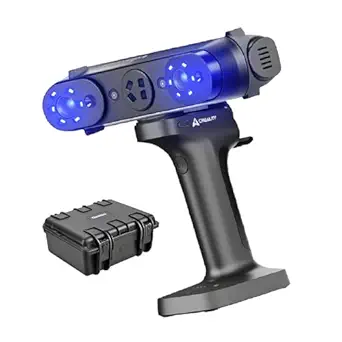 | Best Overall for Precision and Outdoor Use | Laser Modes: Blue 7-line, 34-line, 1-line lasers | Scanning Speed: 4,600,000 points/sec | Maximum Measurement Range: up to 4.6 million measurements/sec | VIEW ON AMAZON | See Our Full Breakdown |
| Creality Sermoon S1 3D Scanner for Engineering and Printing |  | Best for Versatile Handheld Scanning in Engineering | Laser Modes: 34 crossed, 7 parallel, single-line | Scan Range: 5mm to 4m | Accuracy: 0.02mm | VIEW ON AMAZON | See Our Full Breakdown |
| 3DMakerpro Fox Entry-Level Medium-Format 3D Scanner for 3D Printing |  | Best Budget-Friendly for Beginners and Hobbyists | Accuracy: 0.07mm | Resolution: 0.10mm | Scan Speed: 10 FPS | VIEW ON AMAZON | See Our Full Breakdown |
| Creality CR-Scan Raptor 3D Scanner, 60fps Blue Laser & NIR, 0.02mm Accuracy, 24-Bit Color, Scans 5-2000mm Objects, Anti-Shake Tracking for Windows & macOS |  | Best for Industrial and Large Object Precision | Scanning Speed: 60fps (blue laser), 20fps (NIR) | Accuracy: 0.02mm | Scan Volume: 5×5×5 mm to 2000×2000×2000 mm | VIEW ON AMAZON | See Our Full Breakdown |
| Revopoint MetroY Ultra 3D Scanner for Industrial Inspection |  | Best for Portable Industrial Inspection and Metrology | VIEW ON AMAZON | See Our Full Breakdown |
| laser triangulation 3d scanner | Weight |
|---|---|
| Revopoint MetroX Pro 3D Scanne | 14.82 pounds |
| Creality 3D Scanner Wireless P | 9.1 ounces |
| Revopoint MetroY Pro 3D Scanne | 450 g |
| Creality 3D Scanner CR-Scan Fe | 105g |
| Revopoint INSPIRE 2 3D Scanner | 190 g |
| Creality Sermoon S1 3D Scanner | — |
| Creality Sermoon S1 3D Scanner | — |
| 3DMakerpro Fox Entry-Level Med | — |
| Creality CR-Scan Raptor 3D Sca | 8.48 pounds |
| Revopoint MetroY Ultra 3D Scan | — |
More Details on Our Top Picks
Revopoint MetroX Pro 3D Scanner, Blue Laser Scan for 3D Printing, Advanced
The Revopoint MetroX Pro stands out for its industrial-grade accuracy, reaching 0.01 mm precision, making it ideal for high-precision measurement and detailed modeling. Compared with the MetroY Pro, it offers superior accuracy and multi-mode scanning, but at the cost of heavier weight and limited platform compatibility, as it only supports Windows. Its high-speed scanning up to 7 million points per second and real-time color capture provide a comprehensive workflow, though the device’s bulkiness and premium price may deter portability and casual use. This pick makes the most sense for professionals needing maximum precision and versatility in industrial environments.Pros:- Exceptional 0.01 mm single-frame precision for detailed measurements
- Multiple scanning modes adaptable to different surfaces and objects
- Real-time streaming and full-color capture enhance workflow
Cons:- Heavy weight (14.82 pounds) limits portability
- Requires Windows OS and additional paid software for advanced features
Best for: Industrial designers, engineers, and quality control specialists requiring high accuracy and automation.
Not ideal for: Hobbyists or small-scale creators seeking a lightweight, portable scanner without high-end precision needs.
- Single-frame precision:0.01 mm
- Single-frame accuracy:0.02 mm
- Volumetric accuracy:0.02 mm + 0.04 mm × L (m)
- Scanning speed:up to 7 million points/second
- Color capture:Yes
- Weight:14.82 pounds
Our verdict“This scanner is best suited for professionals who prioritize accuracy and automation over portability.”
Creality 3D Scanner Wireless Pika with 7-Line Blue Laser and NIR Light
The Creality Pika combines dual light sources—blue laser and infrared structured light—to deliver fast, detailed scans of various objects, even outdoors. Its wireless connectivity and Wi-Fi 6 enable easy, cable-free operation, making it ideal for on-site scanning tasks. While its 0.03 mm accuracy is slightly less refined than the MetroX Pro, it compensates with simplicity and mobility, especially for users who need quick results without complex setups. However, it’s not a standalone device—it requires a smartphone or PC—and may be less suitable for tiny or highly detailed objects like jewelry. This device is perfect for professionals on the move needing reliable outdoor scanning.Pros:- Wireless operation with Wi-Fi 6 for fast data transfer
- Dual laser and infrared sources for versatile scanning environments
- High accuracy of 0.03mm with AI-enhanced texture processing
Cons:- Requires external device (smartphone or computer) for operation
- Setup complexity may challenge less tech-savvy users
Best for: Surveyors, field engineers, and outdoor product designers who need portability and ease of use.
Not ideal for: Studio-based professionals requiring ultra-high precision or detailed small-object scans, such as jewelers.
- Light sources:7-line blue laser + infrared structured light
- Scanning speed:Up to 110 fps
- Accuracy:0.03 mm
- Display:3-inch touch screen
- Connectivity:Wi-Fi 6, USB 3.0
- Weight:9.1 ounces
Our verdict“This scanner is ideal for field professionals who prioritize mobility and outdoor scanning capability.”
Revopoint MetroY Pro 3D Scanner, Blue Laser, 5 Modes for 3D Printing
The Revopoint MetroY Pro offers up to 0.01 mm accuracy and five scanning modes, making it well-suited for reverse engineering, metrology, and detailed 3D printing tasks. It’s lighter and more portable than the MetroX Pro, at just 450 grams, and supports wireless connectivity via Wi-Fi 6, enabling quick data transfer. Unlike the MetroX Pro, it’s designed for users with high-performance hardware and software needs, including Windows and macOS systems, which can be a barrier for casual users. Its fast scanning speeds and marker-free operation streamline complex workflows, though its hardware demands and paid software for advanced features limit its accessibility for hobbyists.Pros:- High precision of 0.01 mm for detailed modeling
- Multiple scanning modes for different applications
- Wireless streaming and marker-free scanning enhance efficiency
Cons:- Requires high-end hardware and paid software for full functionality
- Limited to Windows and macOS platforms
Best for: Engineers, product developers, and professional makers who need high accuracy combined with flexible, fast scanning.
Not ideal for: Casual users or hobbyists without high-spec hardware or who prefer free software solutions.
- Scanner type:3D Scanner
- Connection type:USB, Wi-Fi 6
- Resolution:0.05 mm
- Weight:450 g
- Minimum system requirements:macOS M2 Pro, Windows i7 13th Gen
Our verdict“This device suits professionals requiring a portable, high-accuracy scanner with versatile modes and fast throughput.”
Creality 3D Scanner CR-Scan Ferret Pro for 3D Printing
The Creality CR-Scan Ferret Pro prioritizes ease of use with its lightweight, handheld design and full-color, high-precision scanning at 0.1 mm resolution. Its wireless connectivity and included accessories, such as a tripod and power bank, make it highly portable and suited for DIY creators and newcomers. Compared to the MetroX Pro, it offers less precision but excels in simplicity and speed for objects ranging from 50mm to 2000mm. Its performance on reflective or dark surfaces can be inconsistent, and it’s not designed for very tiny or highly detailed objects like jewelry. This device is ideal for those starting out or doing quick scans of larger objects in varied environments.Pros:- Very lightweight and portable at only 105g
- Easy to operate with wireless, full-color scans
- Includes accessories for versatile indoor and outdoor use
Cons:- Limited for small, highly detailed objects like jewelry
- Surface conditions like reflectivity can affect scan quality
Best for: Hobbyists, educators, and DIY enthusiasts needing quick, colorful scans without complex setup.
Not ideal for: Professionals requiring ultra-high precision or detailed small-object scans such as jewelry designers.
- Scanner type:3D
- Connection type:Wi-Fi
- Resolution:0.1 mm
- Color depth:24 bits_per_pixel
- Object size range:50mm to 2000mm
- Weight:105g
Our verdict“This scanner is best for beginners and casual users seeking quick, colorful outdoor or indoor scans for larger objects.”
Revopoint INSPIRE 2 3D Scanner, Outdoor Scan, for 3D Printing, Standard
The Revopoint INSPIRE 2 is tailored for outdoor applications and challenging surfaces, featuring dual scanning modes and high accuracy of 0.1 mm. Its lightweight 190 g design and wireless Wi-Fi 6 enable remote, flexible operation, making it well-suited for fieldwork. Unlike indoor-focused scanners like the CR-Scan Ferret Pro, it effectively handles reflective and dark surfaces without spray, thanks to its advanced sensors. Its versatility comes with a higher price point and software dependency—full workflow requires paid software, and system compatibility can be restrictive without specific hardware. This model is ideal for professionals who need reliable outdoor scans in variable conditions.Pros:- Wireless Wi-Fi 6 facilitates remote scanning and streaming
- Effective on reflective and dark surfaces without spray
- High accuracy with detailed color capture
Cons:- Requires paid software for full functionality
- Limited system compatibility without specific hardware
Best for: Surveyors, outdoor inspectors, and environmental researchers needing durable, portable scanning.
Not ideal for: Indoor hobbyists or those scanning small, detailed objects requiring ultra-high precision.
- Scanner type:3D Scanner
- Connection type:USB Type-C, Wi-Fi
- Resolution:0.1 mm
- Object size range:Varies
- Weight:190 g
- Minimum system requirements:macOS M1 Pro/Max/Ultra, Windows i7 13th Gen
Our verdict“This device is best suited for outdoor professionals needing durable, reliable scans in challenging environments.”
Creality Sermoon S1 3D Scanner with Wireless Scanning and High-Precision Blue Laser
This model stands out for its exceptional 0.02mm accuracy, making it ideal for detailed reverse engineering and cultural relic digitization. Compared with the Creality CR-Scan Raptor, it offers superior outdoor performance and color texture mapping, but requires a powerful CPU and is heavier, which can challenge beginners. Its wireless capability and multiple laser modes enhance flexibility, especially in complex environments. However, setup complexity and weight are tradeoffs for its high precision and outdoor resilience.
Pros:- High-precision scanning with 0.02mm accuracy
- Wireless connectivity for flexible operation
- Supports multiple laser modes for diverse applications
- Excellent outdoor performance with resistance to ambient light
Cons:- Requires a high-end CPU (≥8 cores, ≥16 threads) for best performance
- Relatively heavy at nearly 8 pounds, less portable for fieldwork
Best for: Professionals needing high-precision scans in variable lighting conditions, including outdoor environments.
Not ideal for: Casual hobbyists or beginners who lack a high-performance PC or prefer simple setups.
- Laser Modes:Blue 7-line, 34-line, 1-line lasers
- Scanning Speed:4,600,000 points/sec
- Maximum Measurement Range:up to 4.6 million measurements/sec
- Color Reproduction:RGB fill lights supporting high-quality color mapping
- Operational Environment:Indoor & outdoor, up to 100,000 lux ambient light
- Supported Systems:Windows, macOS
Our verdict“This scanner is best suited for professionals who need detailed outdoor scanning with high accuracy and are prepared for a complex setup.”
Creality Sermoon S1 3D Scanner for Engineering and Printing
This scanner excels at capturing detailed objects ranging from jewelry to large models, thanks to its flexible triple laser modes and 0.02mm accuracy. Compared with the Fox Entry-Level Scanner, it offers faster frame rates (90 FPS) and a broader scan range, making it more suitable for professional workflows. Its AI-assisted software streamlines large or complex scans, but it demands a relatively powerful computer and can be challenging for beginners. Its price reflects its versatility, but novices may find setup complex.
Pros:- High accuracy with 0.02mm precision
- Triple laser modes for detailed and deep hole scanning
- Fast 90 FPS frame rate for efficient data capture
- Supports large objects and complex geometries
Cons:- Requires a powerful computer (Windows i7-Gen10, 32GB RAM) for optimal use
- Setup may be complex for beginners
Best for: Engineers and professionals needing precise, flexible handheld scanning for large or complex objects.
Not ideal for: Casual users or hobbyists with limited hardware or looking for a simple, plug-and-play device.
- Laser Modes:34 crossed, 7 parallel, single-line
- Scan Range:5mm to 4m
- Accuracy:0.02mm
- Frame Rate:90 FPS
- Dimensions:13.7 x 6.45 x 12.28 inches
- System Compatibility:Windows (i7-Gen10, 32GB RAM), macOS (M1/M2/M3, 16GB RAM)
Our verdict“This scanner is designed for professionals who need high flexibility and speed in detailed object capture, often with robust hardware support.”
3DMakerpro Fox Entry-Level Medium-Format 3D Scanner for 3D Printing
The Fox offers a straightforward, markerless AI visual tracking system suitable for newcomers and hobbyists. Its 0.07mm accuracy and 0.10mm resolution are sufficient for hobbyist 3D printing and basic inspection, making it a good entry point. Compared with more advanced scanners like the Creality Sermoon S1, it sacrifices some precision and speed but remains accessible and easy to use. Its future availability and unclear hardware compatibility may pose concerns, but it provides a simple entry into 3D scanning.
Pros:- Decent accuracy for entry-level use
- Markerless AI visual tracking simplifies scanning
- Built-in software for editing and optimization
- Lightweight and portable at 2.39 pounds
Cons:- Limited to entry-level performance, not suitable for professional tasks
- Future release date may be a concern for immediate needs
Best for: Hobbyists or beginners seeking an affordable, easy-to-use scanner for basic 3D printing and modeling.
Not ideal for: Professionals requiring high accuracy and detailed color mapping or industrial-grade performance.
- Accuracy:0.07mm
- Resolution:0.10mm
- Scan Speed:10 FPS
- Item Weight:2.39 pounds
- Dimensions:9.06 x 8.98 x 3.46 inches
- First Available:July 21, 2026
Our verdict“This scanner offers an accessible, cost-effective option for beginners, but may fall short for demanding professional applications.”
Creality CR-Scan Raptor 3D Scanner, 60fps Blue Laser & NIR, 0.02mm Accuracy, 24-Bit Color, Scans 5-2000mm Objects, Anti-Shake Tracking for Windows & macOS
The CR-Scan Raptor combines high-precision blue laser and NIR modes, enabling detailed scans of objects from tiny to quite large—up to 2000mm. Compared to the Sermoon S1, it emphasizes speed with 60fps blue laser scanning, making it suitable for industrial environments. Its 0.02mm accuracy and color capture support detailed inspections and quality control, but it demands high-end hardware and comes at a premium cost. Safety considerations with blue laser are also relevant, but the scanner’s speed and versatility justify its professional focus.
Pros:- Exceptional 0.02mm accuracy for detailed captures
- Fast 60fps scanning for efficiency
- Supports a wide object size range up to 2000mm
- Combines blue laser and NIR modes for versatility
Cons:- High-performance PC required for optimal operation
- Potential blue laser safety concerns for inexperienced users
- Price point may be prohibitive for casual buyers
Best for: Industrial engineers and professionals needing fast, accurate, large-object scanning with detailed color info.
Not ideal for: Casual users or those with limited hardware budgets, due to its high system requirements and price.
- Scanning Speed:60fps (blue laser), 20fps (NIR)
- Accuracy:0.02mm
- Scan Volume:5×5×5 mm to 2000×2000×2000 mm
- Laser Lines:7 parallel blue laser lines, each 0.1mm thin
- Safety Class:Class 1 blue light
- Weight:8.48 pounds
Our verdict“This scanner delivers industrial-grade performance for large, detailed, and color-rich scans but demands substantial hardware investment.”
Revopoint MetroY Ultra 3D Scanner for Industrial Inspection
The MetroY Ultra emphasizes speed and versatility, with 90 FPS scanning and wireless control via Wi-Fi 6, making it highly suitable for real-time industrial inspection. Unlike the Sermoon S1 or CR-Scan Raptor, it excels in outdoor environments and on shiny or dark surfaces without spray, thanks to its high brightness laser scanning. Its high system requirements and lightweight design make it portable, but it relies heavily on powerful hardware, limiting its accessibility for some users. Overall, it offers a blend of speed, outdoor usability, and precision for on-the-go industrial metrology.
Pros:- High scanning speed up to 90 FPS
- Wireless control for flexible operation
- Outdoor capable with high brightness laser
- Lightweight at 450 g for portability
Cons:- High system requirements (Windows 10/11, high RAM and GPU)
- Heavy hardware dependence may limit user accessibility
Best for: Industrial inspectors and metrologists needing fast, portable, and outdoor-capable scanning solutions.
Not ideal for: Casual hobbyists or users with limited hardware who do not require high-speed industrial features.
Our verdict“Designed for industrial environments where speed, portability, and outdoor usability are priorities, but requires advanced hardware to perform optimally.”

How We Picked
These products were evaluated based on a combination of performance metrics, usability, build quality, and value for money. Priority was given to accuracy, scanning speed, ease of setup, and compatibility with popular software platforms, as these factors directly impact user experience. We also considered the versatility of each scanner, such as their ability to handle different object sizes and environmental conditions. The ranking reflects a balance between professional-grade features and accessibility for different user levels, ensuring that both advanced and entry-level buyers find suitable options.Factors to Consider When Choosing Laser Triangulation 3d Scanner
Choosing the right laser triangulation 3D scanner involves understanding several key factors. While price is often a primary consideration, other aspects like accuracy, speed, and ease of use can significantly influence your overall satisfaction. This guide highlights what to look for in a scanner to ensure it aligns with your specific application, whether for industrial inspection, 3D printing, or hobbyist projects.Accuracy and Resolution
Accuracy determines how precisely the scanner captures object details, which is crucial for high-fidelity applications like engineering or quality control. Resolution impacts the level of detail, especially for complex surfaces. Higher accuracy and resolution typically come with increased cost and data processing demands. Buyers should match their needs with the scanner’s specifications, avoiding overspending on features that won’t be used if working on simple models.
Speed and Scan Rate
Fast scanning reduces the time spent on each object, boosting productivity, especially for batch or industrial workflows. Some models can scan at 60 fps or higher, making them suitable for real-time applications. However, faster scan rates may sometimes compromise detail or require more powerful hardware to process data efficiently. Consider your typical workload volume and whether speed or detail takes priority.
Ease of Use and Setup
Intuitive interfaces, quick calibration, and straightforward software are essential for minimizing downtime and learning curves. Entry-level models often feature plug-and-play setups, while professional-grade scanners may require more technical knowledge. Think about your experience level and whether you prefer a portable, wireless device or a more robust system that might need dedicated calibration routines.
Compatibility and Software Support
Ensure the scanner integrates seamlessly with your existing 3D modeling or inspection software. Compatibility with Windows, Mac, or Linux can influence your workflow, especially if you rely on specific tools. Some scanners come with proprietary software, which can affect flexibility and data export options. Investing in a device with broad compatibility can save frustration down the line.
Build Quality and Durability
For outdoor or industrial environments, rugged build quality and protective features are essential to withstand dust, moisture, and impact. Lightweight, portable options are convenient but may sacrifice some durability. Balance your need for portability with robustness, especially if the scanner will be used in demanding conditions over time.
Frequently Asked Questions
How accurate does a laser triangulation 3D scanner need to be for professional engineering work?
For professional engineering and quality control, a scanner with an accuracy of at least 0.02mm is recommended. Higher accuracy ensures precise measurements and detailed surface capture, which are critical for prototypes, inspections, and CAD modeling. Keep in mind that increased accuracy often requires more advanced hardware and longer processing times, so consider your project timelines and budget when choosing.
Can I use a laser triangulation scanner outdoors or in bright sunlight?
Many laser triangulation scanners perform best in controlled environments, especially indoors. Bright sunlight or outdoor lighting can interfere with laser detection, reducing data accuracy. Some models feature NIR or infrared capabilities designed for outdoor use, but it’s essential to verify the specifications. For frequent outdoor scanning, look for scanners explicitly rated for such conditions to avoid data quality issues.
Is a more expensive scanner always better for my needs?
Not necessarily. While higher-end scanners offer greater accuracy, speed, and durability, they also come with increased costs that may not be justified for casual or hobbyist use. If your work involves simple models or occasional scanning, a mid-range or entry-level device could provide sufficient performance at a better value. Assess your specific needs and choose a model that balances features with your budget.
How important is software compatibility in choosing a laser triangulation 3D scanner?
Software compatibility is vital because it affects your ability to efficiently process, edit, and utilize scanned data. A scanner that supports common formats like STL, OBJ, or PLY, and integrates well with popular CAD or inspection tools, saves time and reduces frustration. Proprietary software can sometimes limit options or add extra costs, so consider the ecosystem around the scanner before buying.
What should I consider if I want to use a scanner for large objects?
For large objects, look for scanners with a wide scan volume, longer range, and high accuracy at extended distances. Some models offer multiple scanning modes or adjustable settings to accommodate different object sizes. Portability and ease of repositioning also matter, as larger objects may require multiple scans from different angles. Balancing range, accuracy, and ease of use will ensure better results for sizable projects.
Conclusion
The best overall choice for most users is the Revopoint MetroX Pro, offering an excellent blend of precision, speed, and versatility. For those seeking the best value, the Creality CR-Scan Raptor provides impressive accuracy at a more accessible price point. Beginners will appreciate the simplicity of entry-level options like the 3DMakerpro Fox, while professionals needing industrial-grade performance should consider the Revopoint MetroY Ultra. Ultimately, your selection should align with your specific scanning needs, environment, and budget to achieve the best results in 2026.