
📊 Full opportunity report: Best Quiet Case Fans + the Airflow Setup That Actually Works on ThorstenMeyerAI.com — validation score, market gap, and execution plan.

Get business pricing on monitors, keyboards and dev gear
- Business-only prices and quantity discounts
- Tax-exempt purchasing
- Multiple users, one account, clear invoices
TL;DR
This article identifies the best quiet case fans for 2026, emphasizing larger, slower-moving fans for optimal airflow and minimal noise. It also explains the airflow setup that ensures efficient cooling without noise, crucial for high-performance AI workstations.
In 2026, the most effective way to build a quiet, high-performance AI workstation involves using larger, slower fans combined with a carefully planned airflow setup, according to recent expert analysis.
Leading experts and product reviews agree that larger fans, such as 140mm models, moving air at lower RPMs, produce significantly less noise while providing comparable cooling to smaller, faster fans. The Noctua NF-A12x25 and NF-A14 are highlighted as the top-performing fans for their engineering, airflow, and durability, though they come at a premium price. For budget-conscious builders, Arctic P12 Pro and P14 fans offer nearly comparable performance at a fraction of the cost.
Additionally, the article emphasizes the importance of matching fan types to their roles: airflow fans (open blades) are ideal for case intake and exhaust, while static-pressure fans (closed blades) are best for radiators and dense heatsinks. Proper configuration—using large, slow fans for general airflow and pressure-optimized fans for radiators—can create a cooling environment that is both effective and quiet, with noise levels around 16-17 decibels at typical operating speeds.
Best quiet case fans
+ the airflow that works.
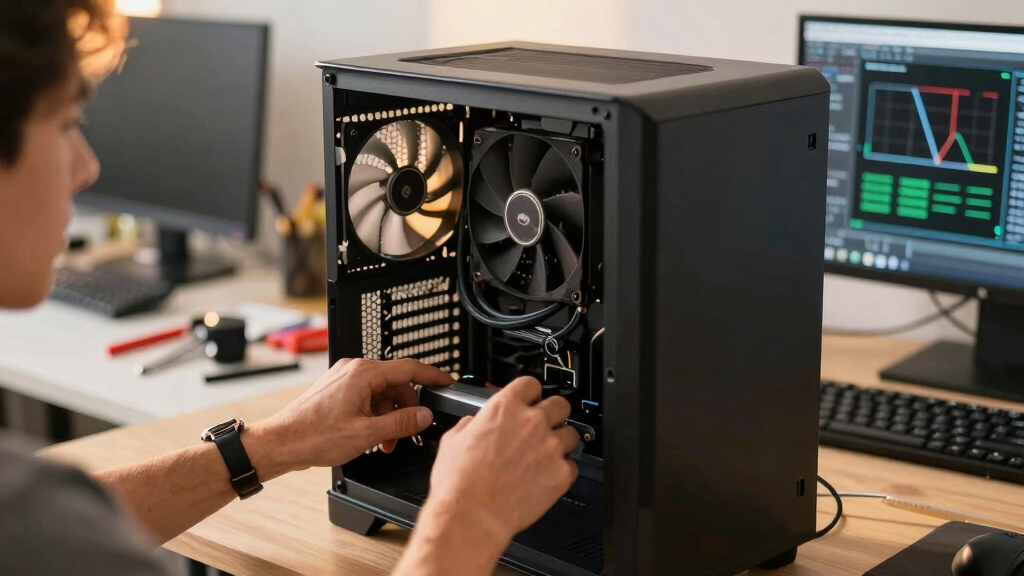
The best fan won’t help if it’s pointed the wrong way. The whole recipe: big fans, running slowly, in a clean front-to-back path, with slightly more intake than exhaust. Build a config in Part 2 and watch the pressure balance respond.
Why Proper Fan Selection and Airflow Matter in 2026
Choosing the right fans and airflow setup is critical for maintaining high performance while minimizing noise, especially in AI and high-power workstations. Proper airflow reduces thermal stress on components, extends hardware lifespan, and creates a quieter workspace. The emphasis on larger, slower fans reflects a broader industry shift toward efficiency and silence in high-performance computing environments.
As an affiliate, we earn on qualifying purchases.
Advances in Fan Technology and Best Practices in 2026
Over recent years, fan design has improved significantly, with brands like Noctua, Arctic, and be quiet! leading the way in engineering quieter, more efficient fans. The principle that larger fans moving air slowly are quieter than smaller, fast-spinning fans remains central. This approach has become standard for building high-performance, low-noise systems, especially as workloads like AI training demand better thermal management without noise disruption.
Previous years saw a focus on high-RPM fans, but current best practices favor larger fans operating at lower speeds, combined with optimized airflow pathways within the case. This paradigm shift has been supported by extensive testing and user feedback, confirming that well-planned airflow and appropriate fan choice are key to achieving both cooling and silence.
"Larger, slower fans like the Noctua NF-A12x25 are the gold standard for quiet, reliable airflow in high-performance workstations."
— Thorsten Meyer, AI hardware expert
As an affiliate, we earn on qualifying purchases.
Remaining Questions About Long-Term Fan Reliability
While current fans like the Noctua NF-A12x25 are praised for their durability, long-term performance in continuous high-load scenarios over several years remains to be fully documented. Additionally, the optimal airflow configuration can vary depending on case design and specific workload demands, which are still being refined through ongoing testing.
As an affiliate, we earn on qualifying purchases.
Next Steps for Building Quiet, High-Performance Workstations in 2026
Manufacturers are expected to release new fan models with further noise reduction and efficiency improvements. Meanwhile, system builders should focus on applying proven airflow principles—using larger fans and strategic placement—to achieve the best balance of cooling and silence. Continued testing and community feedback will refine these configurations further throughout 2026.
airflow setup for high-performance PC
As an affiliate, we earn on qualifying purchases.
As an affiliate, we earn on qualifying purchases.
Key Questions
Why are larger fans quieter than smaller ones?
Larger fans move the same amount of air at lower RPMs, which reduces mechanical noise and airflow turbulence, resulting in quieter operation.
Can I use these fans in any case?
Most modern cases support 120mm and 140mm fans, but always verify compatibility with your specific case model before purchasing.
Premium fans like Noctua are quieter at similar airflow levels, but budget fans like Arctic P12 Pro offer nearly comparable performance at lower cost, with a slight increase in noise at higher speeds.
How should I set up my airflow for maximum quietness?
Use large, slow-moving intake fans at the front, static-pressure fans on radiators or dense heatsinks, and exhaust fans at the rear or top, ensuring a gentle, continuous airflow through the case.
Source: ThorstenMeyerAI.com
Fall Picks
fall essentials
As an affiliate, we earn on qualifying purchases.