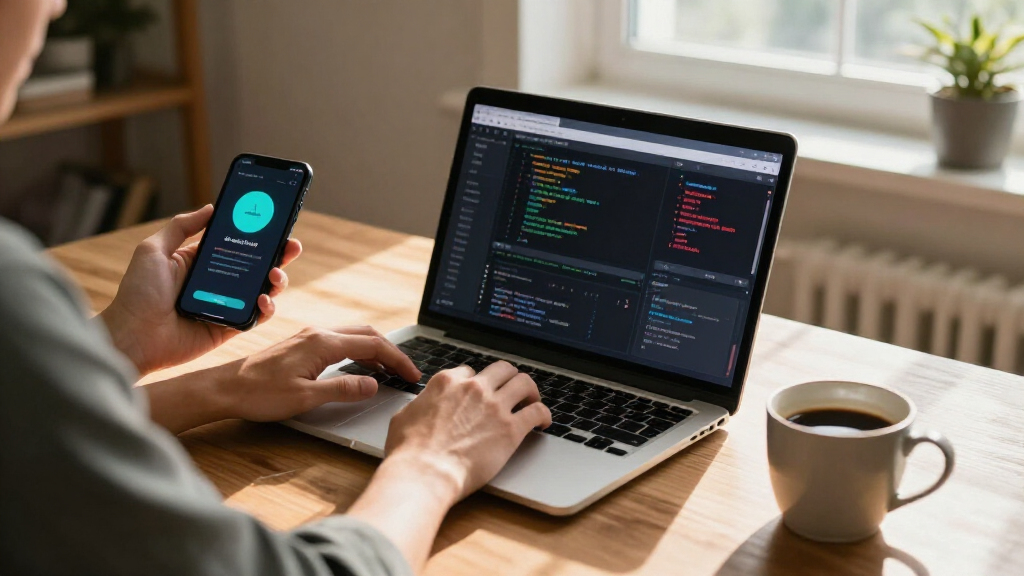
🔍 Read the full analysis: The Software I No Longer Buy, And The AI-Built Tools I Use on ThorstenMeyerAI.com

Get business pricing on monitors, keyboards and dev gear
- Business-only prices and quantity discounts
- Tax-exempt purchasing
- Multiple users, one account, clear invoices
TL;DR
Thorsten Meyer says he now uses tools built with Claude and Codex coding agents for analytics, project tracking, PDFs and video recording instead of paying separate software vendors. His account describes one person’s workflow, not an independently verified cost comparison; he says the trade-off is taking responsibility for upkeep and security while relying on Anthropic and OpenAI.
Writer Thorsten Meyer says he has stopped paying separate vendors for several work tools, including web analytics, project tracking, PDF handling and video recording, and now uses software he built with Claude and Codex coding agents. His November 25 account describes a personal setup rather than a general cost study, and says the trade-off is that he now handles maintenance and security while depending on Anthropic and OpenAI.
Meyer says he pays for Claude and Codex subscriptions, while AI models used for voices, images and video clips are billed separately by use. He describes the coding agents as tools that can inspect a software project, write code, run tests and report results after he gives them a task. He says he sets the goals and reviews what they produce; the article does not provide subscription prices or a before-and-after comparison of his total expenses.
To let software agents use his tools, Meyer says he gives each one written instructions and a standard interface. He identifies the Model Context Protocol, or MCP, as one way for applications to connect with AI-powered tools. His account describes a network of services spread across machines, with agents moving work between them. He says seven tools covered in the article had 5,648 commits and 2,128 test files in his repositories as of November 24, 2026. Those figures are his project measurements, not an independent assessment of quality or reliability.
Meyer says the arrangement suits people who enjoy building and can define their needs clearly. He argues that workers do not need to write code themselves if they can specify a workflow and judge whether the result is correct. He also acknowledges that each project needs documentation because an agent does not automatically retain business knowledge between sessions, and that the tools still require human review.
The Trade-Off Behind Custom Software
Meyer’s account describes how coding agents can be used to build tools for specific workflows in place of some commercial software services. It does not establish how widely people are adopting this approach or whether it reduces costs after development time and ongoing support are included.
Running self-built software also means taking responsibility for maintenance, security, access permissions and failures that a vendor might otherwise manage. Meyer says he relies heavily on two AI providers, Anthropic and OpenAI. Changes to their subscription terms, model capabilities or access could affect his development process. Users who prefer vendor support may choose to continue using established software services.
Products Worth Considering

Apple MacBook Air 15-inch Laptop with M5 Chip, 16GB Memory, 512GB SSD, Liquid Retina Display, and 12MP Center Stage Camera (Midnight)

Apple MacBook Air 13-inch with M5 chip, 16GB Memory, 1TB SSD, Starlight

Amazon Kindle Paperwhite (2024) – 16GB, 7 Glare-Free Display, Waterproof
As an affiliate, we earn on qualifying purchases.
From SaaS to an Agent-Ready Fleet
Meyer frames the change against the subscription model commonly called software as a service, or SaaS. The U.S. National Institute of Standards and Technology defines SaaS as using a provider’s applications on cloud infrastructure, with the provider managing underlying resources and the customer having limited control over the application. Meyer compares separate services to desks rented in different buildings, each with its own login and rules.
He distinguishes ordinary applications, which people operate through screens and buttons, from tools that also expose instructions and interfaces for software agents. MCP is an open-source protocol Anthropic announced on November 25, 2024; its documentation compares it to USB-C for AI applications. The analogy describes a connection standard, not a guarantee that connected tools are secure or that an agent has permission to perform every action. Meyer says permissions and credentials still require deliberate management.
““I no longer pay other vendors for the software I run my work on.””
— Thorsten Meyer, describing his own practice
Costs, Security and Reliability
The article does not give subscription amounts, development hours or a full operating-cost comparison, so readers cannot tell from the figures provided whether Meyer’s system is cheaper than the services it replaced. The commit and test-file counts describe activity in his repositories; they do not show how the tools perform under failure, how often they need repair or whether they have undergone external security review.
It is also unclear how the setup handles backups, data protection, access control and service outages, or what support is available if an AI provider changes its products. Meyer explicitly says maintenance and security are now his responsibility, but the source material does not detail his safeguards. His account is a first-person description, not independent verification of the software or its results.
Whether Others Can Replicate It
Meyer’s article is presented as a written companion to a video explaining the approach and showing the tools. The source does not announce a product launch, independent evaluation or planned follow-up. The practical next test is whether the tools remain reliable as his business changes, and whether their ongoing costs and upkeep compare favorably with the services they replaced.
For readers considering a similar setup, the account points to questions that need answers before replacing a vendor: who will review code, apply updates, protect credentials, recover lost data and respond when a tool stops working? Meyer’s experience suggests AI agents can help produce software, but the article leaves those operating responsibilities with the user.
Key Questions
What software does Thorsten Meyer say he replaced?
He says he now uses tools he built for web analytics, project tracking, PDF work and video recording, rather than paying separate vendors for those functions.
Which AI coding agents does Meyer use?
Meyer says he uses Claude and Codex. He describes them as agents that can read and write project code, run tests and report back, with him setting tasks and reviewing results.
Does the account prove that AI-built software is cheaper?
No. Meyer describes his own subscriptions and workflow but gives no full comparison of vendor fees, development time and ongoing operating costs. The article supports a personal account, not a general cost conclusion.
What does Meyer say users take on when they build their own tools?
He says maintenance and security become the user’s responsibility. His account also identifies dependence on Anthropic and OpenAI as a risk of his own arrangement.
Source: ThorstenMeyerAI.com