
TL;DR

Get business pricing on monitors, keyboards and dev gear
- Business-only prices and quantity discounts
- Tax-exempt purchasing
- Multiple users, one account, clear invoices
Bigwords.page is a browser tool that turns a link into a full-screen sign, timer or message on devices with a web browser. Its site says content is stored in the URL fragment rather than sent to a server, but details about privacy protections and browser compatibility have not been independently verified.
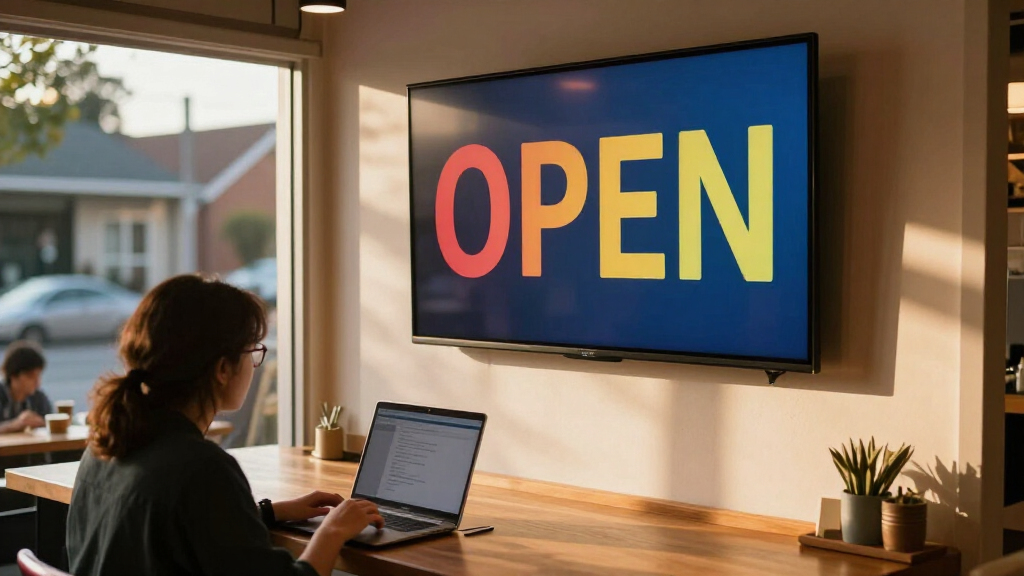
Bigwords.page is a browser-based tool that lets users turn a link into a full-screen sign, message or countdown, without installing an app or creating an account, according to the project’s website. The service is designed for situations such as greeting someone at an airport, showing a timer on a television or displaying Wi-Fi details at a front desk.
The site describes an editor for making a display and says each card can also be opened as a working link, shared or bookmarked. Users can format text with Markdown-style bold, italics and headings, while the display automatically adjusts text size to fill the available screen. The site says the tool works in browsers on phones, tablets, laptops and smart TVs.
Other listed features include slides separated by two vertical bars, which rotate on a timer, and countdowns configured with a date or duration in the link. The project also says it can generate QR codes and links for Wi-Fi, calls, texts and email in the browser, and can display images. These feature descriptions come from the project; the supplied material does not include independent testing or user reports.
Bigwords.page says the message is kept in the URL fragment, the portion of a web address after a # sign, which the site says browsers do not send to its server. It describes the product as requiring no account and no app and says nothing is stored on a server. The source does not provide a technical audit or further detail about how every feature handles data.
A Sign Without a Dedicated App
The project offers a low-friction option for displaying short, legible information on screens that already have a browser. A link can be more practical than installing signage software when the task is temporary: a traveler can hold up a phone at arrivals, a host can put a countdown on a television, or a business can show a Wi-Fi password at a reception desk. The automatic text sizing and fullscreen presentation are aimed at making the message readable across different screen sizes.
Keeping the display in a link may also make it easy to share and reopen. At the same time, a URL containing a message can itself be sensitive: anyone who receives or can access the link may be able to see its contents. The project’s privacy description addresses whether the message is sent to a server, but does not establish that a shared link is suitable for confidential information. Users should treat the link as part of the message’s exposure.
As an affiliate, we earn on qualifying purchases.
How the Link Builds the Display
Bigwords.page’s central design is that the URL acts as the display configuration, rather than merely pointing to a separate document or requiring a saved account. The site says users can create a card in its editor or generate a link themselves. Text styling, slide divisions and countdown settings can be represented through the link, while the page renders the result in a browser.
The project’s examples focus on short, practical messages rather than permanent digital-signage systems. The source material does not describe scheduling, remote device management, access controls or a dashboard for managing multiple screens. Its claims are limited to a browser-based display, sharing and bookmarking links, and the listed formatting and media features.
““The message lives in the URL fragment, which browsers never send to a server.””
— Bigwords.page
As an affiliate, we earn on qualifying purchases.
Privacy and Compatibility Questions
The supplied material does not identify who built the project, when it launched, or how widely it has been used. It also provides no independent evaluation of the claim that messages are not stored on a server. The site’s explanation about URL fragments describes one part of how a browser sends web addresses, but the source does not document the implementation or data handling for every feature, including generated QR codes, images and link actions.
Browser support is described broadly, but no list of tested browsers, smart-TV models or accessibility features is provided. It is also unclear how the timer behaves when a page is closed, whether slides can be customized beyond their rotation, or what limits apply to message length and images. Those details may affect whether the tool is suitable for a particular display or use.
As an affiliate, we earn on qualifying purchases.
Testing the Tool in Practice
Readers can visit the project’s website to try the editor and open a display on a device with a browser. The supplied source does not announce a release schedule, planned features, pricing or a roadmap, so no further development milestone is confirmed. Future updates from the project or user testing could clarify device compatibility, data handling and the practical limits of its sign and countdown features.
As an affiliate, we earn on qualifying purchases.
Key Questions
What is Bigwords.page?
It is a browser-based sign and message tool that creates a full-screen display from a link, according to its website.
Do users need to install an app or create an account?
The project says no app or account is required. Its display is opened in a browser through a link.
What can the display show?
The site lists formatted text, rotating slides, countdowns, QR codes and images, as well as links for Wi-Fi, calls, texts and email. These are features described by the project; the source does not include independent testing.
Does Bigwords.page store messages on a server?
The site says the message is stored in the URL fragment and that nothing is stored on a server. The supplied material does not include an independent technical audit, so that privacy claim has not been verified here.
Is it safe to put private information in a sign link?
The source does not establish that links have access controls. Because a link may be shared or exposed, users should avoid putting confidential information in a display unless they have verified how access and data handling work.
Source: hn
Halloween Picks
halloween
As an affiliate, we earn on qualifying purchases.