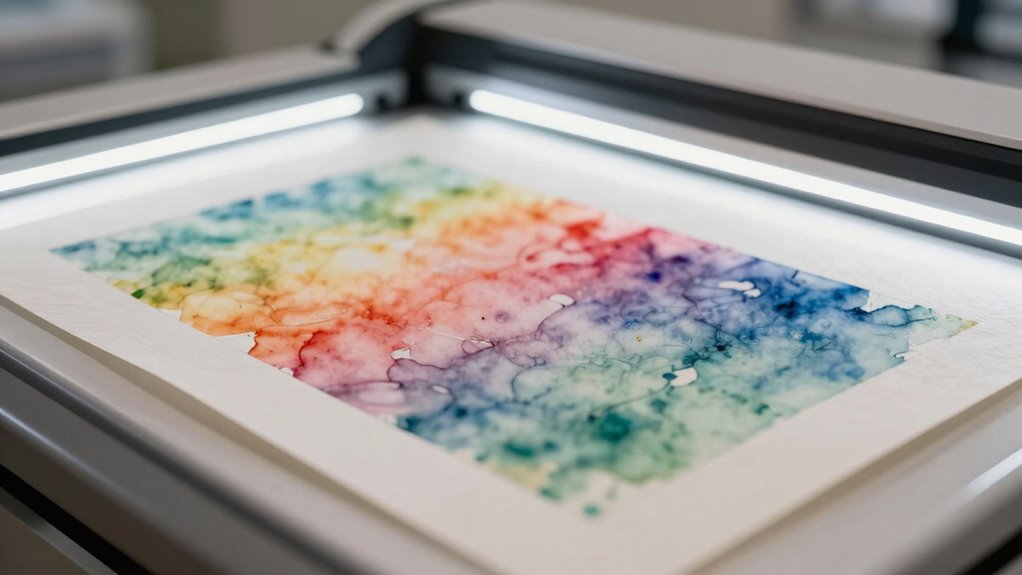
Your scanner’s lighting quality is essential for accurately capturing artwork’s true colors, fine details, and textures. Proper lighting guarantees high clarity, avoids distortions, and produces consistent, vibrant images. Poor lighting can cause dullness, color shifts, or loss of detail, making your digital reproductions less reliable. When lighting is stable and even, every nuance is preserved naturally. Keep exploring to discover how ideal lighting elevates your artwork digitization and ensures impeccable results.

Get business pricing on monitors, keyboards and dev gear
- Business-only prices and quantity discounts
- Tax-exempt purchasing
- Multiple users, one account, clear invoices
Key Takeaways
- Proper lighting ensures high-resolution scans with accurate colors and details.
- Consistent lighting prevents distortions caused by shadows, glare, or hotspots.
- Accurate color reproduction relies on stable, even lighting conditions during scanning.
- Uniform lighting reveals fine textures and subtle nuances in artwork.
- Stable lighting environments maintain image quality despite external environmental factors.
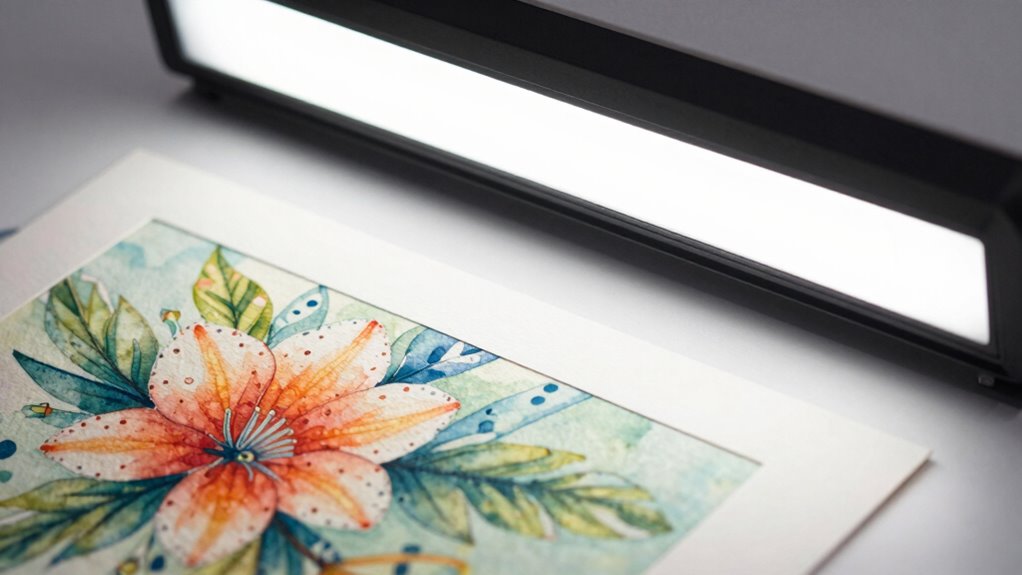
Good lighting is essential for achieving high-quality scans, as it directly impacts the clarity and accuracy of the digital images. When capturing artwork, the way light interacts with the piece determines how true to life the digital version will be. Proper lighting helps ensure that colors are reproduced accurately, which is critical for artists, collectors, and archivists who rely on precise representations. If your scanner’s lighting isn’t consistent or well-designed, the resulting images can appear dull, washed out, or overly saturated, compromising the artwork’s integrity.
Color accuracy is a major factor in artwork scanning, and consistent lighting plays a pivotal role in maintaining that accuracy. When the light source is stable and evenly distributed, each color in the artwork is captured as it appears in real life. Variations in lighting, such as uneven brightness or color temperature shifts, can distort the hues, making the scanned image look different from the original. This can be especially problematic when reproducing artwork for prints, exhibitions, or digital portfolios, where fidelity to the original is paramount. By ensuring lighting consistency, you prevent these discrepancies and preserve the artwork’s true essence.
Furthermore, lighting consistency isn’t just about the light’s brightness; it also involves uniformity across the entire scanning surface. Inconsistent lighting can result in shadows, glare, or hotspots that obscure details and distort colors. These imperfections make post-processing more difficult and can reduce the overall quality of the digital image. When your scanner’s lighting is reliable and evenly distributed, every part of the artwork is captured with the same level of detail, ensuring that no areas are overexposed or underexposed. This lighting uniformity helps you maintain high-resolution, detailed images that serve as faithful digital records. Additionally, maintaining a stable light source minimizes the likelihood of color temperature shifts, which can significantly impact color fidelity.
In addition, high-quality lighting enhances the contrast and fine details of the artwork, making it easier to analyze or reproduce. It allows you to see textures, brushstrokes, and subtle color gradations clearly. When the lighting is inconsistent or poor, these nuances can be lost or misrepresented, diminishing the artwork’s visual impact. Proper lighting stability also contributes to reducing the need for extensive post-processing adjustments, saving time and effort. When the lighting is consistent and well-designed, these details are preserved naturally, supporting accurate reproduction and analysis. Moreover, lighting consistency can improve the overall efficiency of the scanning process by reducing the need for retakes or adjustments.
Achieving consistent lighting also involves understanding the importance of a stable environment, as external factors like ambient light or temperature fluctuations can influence the results. Ultimately, the importance of scanner lighting quality cannot be overstated. It influences not only the aesthetic fidelity of your digital images but also the accuracy of color reproduction and the consistency of the entire scanning process. When you pay attention to these factors, you ensure that your artwork is preserved with precision and clarity, ready for display, analysis, or reproduction.
As an affiliate, we earn on qualifying purchases.
Frequently Asked Questions
How Does Lighting Affect Color Accuracy in Artwork Scans?
Lighting directly impacts color accuracy in artwork scans by influencing how colors appear. When lighting is consistent and well-balanced, it guarantees color consistency and spectral accuracy, capturing true hues without distortion. Poor lighting can cause color shifts or washed-out details, making the artwork look different from its original. By using quality scanner lighting, you get precise, vibrant reproductions that faithfully reflect the original’s colors and details.
Can Poor Lighting Cause Damage to Delicate Artwork During Scanning?
Poor lighting during scanning can indeed cause damage to delicate artwork, especially if light flickering or shadow interference occurs. Flickering lights can lead to uneven exposure, risking heat buildup or physical stress on fragile pieces. Shadows might require repeated scans, increasing handling and potential damage. To protect your artwork, guarantee stable, flicker-free lighting that minimizes shadow interference, creating a safe environment for delicate pieces during the scanning process.
What Are the Best Lighting Conditions for Capturing Detailed Textures?
When capturing detailed textures, you want ambient illumination that’s soft and even, avoiding harsh shadows. Use diffused light to spread illumination uniformly across the artwork, revealing fine details without glare. Maintain consistent lighting conditions to prevent color shifts or detail loss. Proper light diffusion and ambient illumination create ideal conditions, enhancing texture clarity and ensuring your artwork’s true details are faithfully captured with precision and quality.
How Do Different Light Temperatures Influence Scan Quality?
Different light temperatures influence scan quality by altering the color temperature and light spectrum, which affect color accuracy and detail. Cooler temperatures (around 5000K-6500K) provide a neutral, natural light that captures true colors and fine textures. Warmer temperatures (3000K-4000K) can add a yellowish tint, reducing detail clarity. Selecting the right color temperature guarantees your scanner reproduces artwork faithfully, highlighting textures without color distortion.
Is Adjustable Lighting Necessary for Different Types of Artwork?
Absolutely, adjustable lighting is essential for capturing different types of artwork perfectly. Think of gallery lighting or museum illumination—each piece demands unique lighting to reveal its true colors and details. Without adjustable settings, your scans might look dull or overly harsh. You need flexibility to match the artwork’s material, texture, and color. This guarantees every scan is as vivid and accurate as the original, making your digital collection truly breathtaking.
high quality scanner light source
As an affiliate, we earn on qualifying purchases.
As an affiliate, we earn on qualifying purchases.
Conclusion
Think of your scanner as a lighthouse guiding your artwork through a stormy sea of colors and details. When the lighting is just right, it illuminates every nuance, revealing the true essence of your piece like a beacon of clarity. Poor lighting, on the other hand, dims this brilliance, casting shadows of doubt on your work’s integrity. So, guarantee your scanner’s lighting shines bright, turning your artwork into a masterpiece that captures hearts and minds alike.
art reproduction scanner lighting
As an affiliate, we earn on qualifying purchases.
As an affiliate, we earn on qualifying purchases.
As an affiliate, we earn on qualifying purchases.
Halloween Picks
halloween
As an affiliate, we earn on qualifying purchases.


![Pixel 11 Ads Show A Mysterious Screen-equipped Tracker That's Not Pixel Watch 5 Or Fitbit Air [Gallery]](https://bestcadpapers.com/wp-content/uploads/2026/08/pixel-11-ads-show-a-mysterious-screen-equipped-tracker-that-s-not-pixel-watch-5-featured-560x300.jpg)