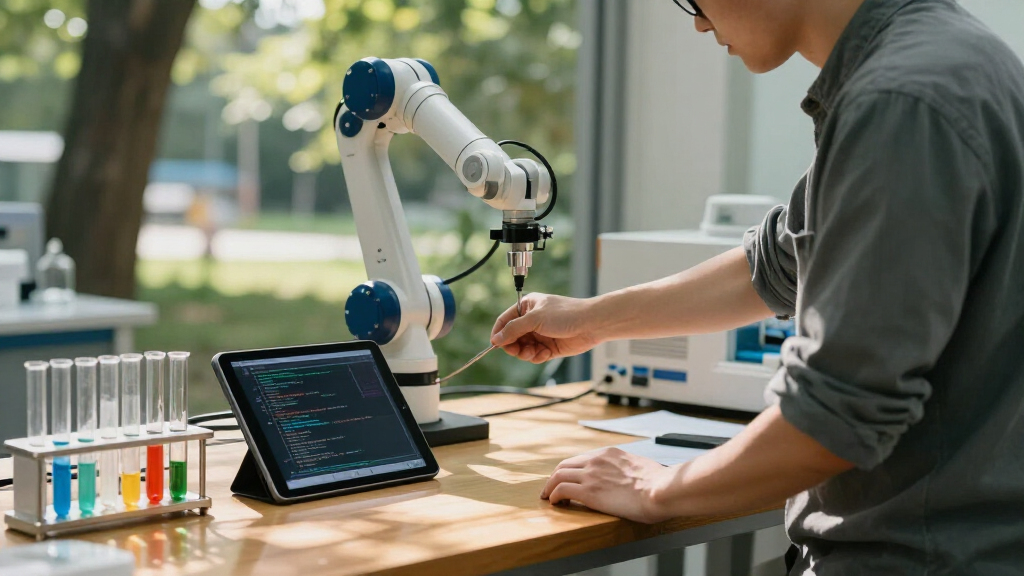

🔍 Read the full analysis: Why Anthropic Is Pushing Claude To Interact With Real Lab Equipment on ThorstenMeyerAI.com

Get business pricing on monitors, keyboards and dev gear
- Business-only prices and quantity discounts
- Tax-exempt purchasing
- Multiple users, one account, clear invoices
TL;DR
Anthropic is reportedly working to enable its Claude AI models to operate physical laboratory equipment. This move marks a significant step toward autonomous scientific experimentation, though details remain limited.
Anthropic is actively working to develop its Claude AI models capable of controlling real laboratory equipment, according to a report from The Neuron. This initiative aims to move AI from primarily software-based assistance to direct manipulation of physical scientific instruments, marking a significant evolution in AI-driven research automation.
The report indicates that Anthropic intends for Claude to actively operate laboratory hardware, such as pipetting robots, centrifuges, and measurement devices, rather than solely providing advice or analysis. While Anthropic has not officially announced specific partnerships, timelines, or technical specifications, the company has expanded Claude’s capabilities over the past year to include software navigation, screen interaction, and automated task execution.
Industry sources suggest that this effort is part of a broader trend toward autonomous laboratories, where AI systems conduct experiments with minimal human intervention. Academic and commercial players have demonstrated robot chemists and self-driving labs, but Anthropic’s focus appears to be on integrating large language models into physical experimentation workflows, potentially offering a new level of flexibility and intelligence.
It remains unclear whether Anthropic has developed working prototypes, is conducting internal trials, or is still in the planning and recruitment phase. The company has not disclosed any partners or specific hardware integrations, and no public timelines have been announced for deployment or testing. For more details, see the original analysis.
Implications for Scientific Research Automation
If successful, Anthropic’s effort to enable Claude to control laboratory hardware could significantly accelerate research cycles, reduce costs, and democratize access to complex experiments. Automating repetitive and time-consuming tasks like reagent handling and calibration could free scientists to focus on higher-level analysis and innovation.
From a competitive standpoint, this move positions Anthropic among a handful of AI firms exploring physical-world automation, potentially reshaping how scientific experiments are conducted. However, safety remains a critical concern, especially when AI systems handle hazardous chemicals or operate sensitive equipment. Anthropic emphasizes its safety-first approach, which could influence industry standards and regulatory discussions in autonomous laboratory systems.
As an affiliate, we earn on qualifying purchases.
Evolution of AI in Laboratory Automation
The transition from AI assisting in software environments to controlling physical laboratory equipment has been gradual over recent years. Academic labs and startups have demonstrated robotic chemists and autonomous research systems capable of designing and executing experiments with limited human oversight. Large language models, such as GPT variants, have increasingly been layered onto these systems to translate natural language instructions into executable protocols.
Anthropic’s focus on agentic capabilities—such as navigating software interfaces and now controlling hardware—represents a natural progression in this trajectory. Unlike earlier efforts that relied on predefined scripts or limited automation, the company aims to leverage Claude’s language understanding and decision-making skills for real-time experimental control, potentially offering greater flexibility and adaptability.
Despite these developments, no major AI company has yet publicly released a fully autonomous laboratory platform at scale, making Anthropic’s reported ambitions noteworthy, even if still early-stage.
“If Anthropic succeeds in enabling Claude to operate physical lab equipment reliably, it could revolutionize how experiments are conducted, making them faster and more accessible.”
— Thorsten Meyer, AI researcher
As an affiliate, we earn on qualifying purchases.
Unconfirmed Details and Development Stage
It is not yet clear whether Anthropic has operational prototypes, ongoing lab partnerships, or is still in the research and hiring phase. The company has not disclosed specific hardware, experimental domains, or timelines for deployment. The report indicates intent but does not confirm progress toward a functional system, leaving the current status ambiguous.
digital laboratory measurement devices
As an affiliate, we earn on qualifying purchases.
As an affiliate, we earn on qualifying purchases.
Expected Indicators of Progress
Future signals include official announcements from Anthropic, such as research papers, product launches, or partnership disclosures. Monitoring hiring trends for robotics and lab automation experts, as well as any partnership with academic or industrial labs, will provide clues about the project’s advancement. Clarifying the scope, safety measures, and deployment timelines remains an area to watch.
As an affiliate, we earn on qualifying purchases.
Key Questions
What would Claude controlling lab equipment enable?
If successful, Claude could perform experiments autonomously, reducing human labor, increasing precision, and enabling continuous operation of scientific workflows.
Has Anthropic announced any partnerships for this project?
No, the company has not publicly disclosed partnerships or specific hardware integrations related to this effort.
What are the safety concerns with AI controlling laboratory hardware?
Risks include accidental chemical spills, equipment damage, or hazardous reactions if the AI misinterprets instructions. Safety protocols and rigorous testing are essential before deployment.
How does this effort compare to other autonomous lab projects?
While other startups and academic groups have demonstrated autonomous labs, Anthropic’s focus on large language models and safety-first approach could differentiate it in terms of flexibility and reliability.
When might we see a real-world application of Claude operating lab equipment?
There are no official timelines yet; progress depends on prototype development, safety validation, and partnership formation. It could still be several years before commercial deployment.
Primary source: Anthropic · via ThorstenMeyerAI.com
Halloween Picks
halloween
As an affiliate, we earn on qualifying purchases.