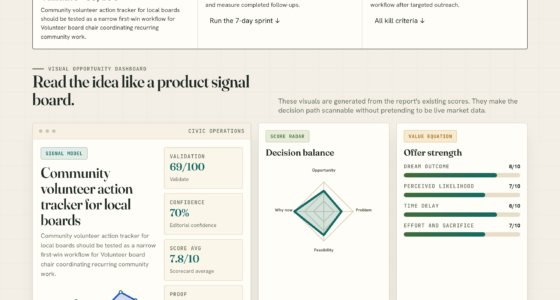

📊 Full opportunity report: The Six Chokepoints: How AI Stopped Being a Utility and Became a Lever on ThorstenMeyerAI.com — validation score, market gap, and execution plan.
TL;DR
In 2026, key control points in AI infrastructure shifted from open utility-like access to concentrated chokepoints. Major firms and governments now hold leverage over power, compute, data, models, distribution, and capital, reshaping AI power dynamics.
In 2026, the longstanding metaphor of AI as a utility — a neutral, always-on infrastructure — has been fundamentally challenged. Major actions by governments and private firms have demonstrated that control over critical AI components now resides with a small number of entities wielding significant leverage, rather than a broadly accessible resource.
Over recent weeks, several pivotal events have confirmed a shift in AI power dynamics. A government abruptly shut down a frontier AI model worldwide within approximately ninety minutes. A defense agency converted combat footage into a proprietary dataset, retaining exclusive control. Meanwhile, the most capital-rich AI company leased its supercomputers to rivals under contractual clauses that allow seizure if certain conditions are not met. These actions are not glitches but deliberate demonstrations of control, emphasizing that AI infrastructure is now governed by a handful of entities who can throttle, gate, or revoke access at will.
Experts point out that control over physical power, compute resources, data, models, distribution channels, and capital now define AI dominance. Companies like SpaceX, Nvidia, and sovereign governments are competing to dominate these chokepoints, effectively turning AI from a shared utility into a set of strategic levers. This concentration of control marks a significant departure from the earlier narrative of AI as a neutral infrastructure accessible to all.
The Six Chokepoints
For a decade AI was sold as a utility — abundant, neutral, always on. In 2026 it became a lever: scarce, controlled, revocable. Here are the six places power actually sits — and who started to squeeze.
Every layer is concentrating into fewer hands, and 2026 is the year the holders stopped treating their leverage as theoretical. A kill switch wasn’t discussed — it was pulled. The utility you’re allowed to forget about; the lever, you have to watch who’s holding. Optionality just became architecture.
Implications of AI Control Concentration in 2026
This shift alters the foundational economics and politics of AI. Control over physical power, compute, and data means fewer players can scale or innovate freely, increasing barriers for new entrants. Governments and corporations now possess the ability to restrict, modify, or shut down AI services at will, raising concerns about dependency, security, and the potential for abuse. For users and developers, this means AI is no longer a universally accessible utility but a set of strategic assets that can be wielded for geopolitical, economic, or security advantage.

The AI Control Plane: Distributed Systems Engineering for Governance-First AI
As an affiliate, we earn on qualifying purchases.
As an affiliate, we earn on qualifying purchases.
2026’s Turning Point for AI Infrastructure Control
Historically, AI was presented as a utility akin to electricity: a neutral, always-on service available to anyone. This narrative justified investments and fostered a broad user base. However, recent events have shattered this model. The week of major shutdowns and contractual reassertions in 2026 revealed that control is now concentrated among a few key players. Large tech firms, sovereign states, and a handful of investors are now shaping the AI landscape through physical power generation, compute clusters, proprietary data, and platform ownership.
Earlier efforts to democratize AI access are being replaced by strategic gatekeeping. The shift is driven by the high capital costs, technical complexity, and geopolitical interests that favor a handful of entities controlling critical chokepoints. This emerging landscape signals a new era where AI is less a utility and more a lever of power.
“By building our own power generation and infrastructure, we set the ceiling for AI compute capacity, bypassing the limitations of the grid.”
— SpaceX spokesperson

Essential Math for AI: Next-Level Mathematics for Efficient and Successful AI Systems
As an affiliate, we earn on qualifying purchases.
As an affiliate, we earn on qualifying purchases.
Unresolved Questions About the Future of AI Control
It remains unclear how widespread the adoption of chokepoint control will become across the entire AI ecosystem. While major players have demonstrated their power, the extent to which this model will consolidate or face resistance from regulators and smaller firms is still uncertain. Additionally, the long-term implications for innovation, competition, and user access are yet to be fully understood.

Immutable Backups Explained: How to Protect Data from Ransomware | industrial data privacy | ISO 27001 disaster readiness | secure storage compliance | cyber-proofing backup expert | Backup Security
As an affiliate, we earn on qualifying purchases.
As an affiliate, we earn on qualifying purchases.
Next Steps in the Evolving AI Power Landscape
Expect ongoing consolidation of control among a few dominant firms and governments. Regulatory responses may attempt to curb or regulate chokepoint leverage, but the effectiveness remains to be seen. Meanwhile, new entrants may seek alternative architectures or decentralization strategies to bypass these control points. Monitoring how these dynamics unfold will be critical for understanding AI’s future role in society and geopolitics.

Platform Engineering for Artificial Intelligence: Designing scalable infrastructure, data pipelines, and model lifecycle management for generative AI and agentic protocols (English Edition)
As an affiliate, we earn on qualifying purchases.
As an affiliate, we earn on qualifying purchases.
Key Questions
What are the six chokepoints in AI control?
The six chokepoints are power, compute, data, model access, distribution, and capital. Each represents a critical control point where ownership or regulation can influence AI deployment and access.
Why is control shifting from utility to leverage?
Because the high costs, technical barriers, and strategic interests mean that only a few entities can dominate physical power, compute resources, or data, giving them the ability to gate or revoke access at will.
What implications does this have for AI development?
It could limit competition and innovation, increase dependency on major players, and raise geopolitical risks, as AI becomes a strategic asset rather than a neutral utility.
Could regulation change this trend?
Potentially, but regulators face challenges in addressing physical infrastructure, data sovereignty, and contractual leverage, making the trend toward control concentration likely to persist in the near term.
Source: ThorstenMeyerAI.com