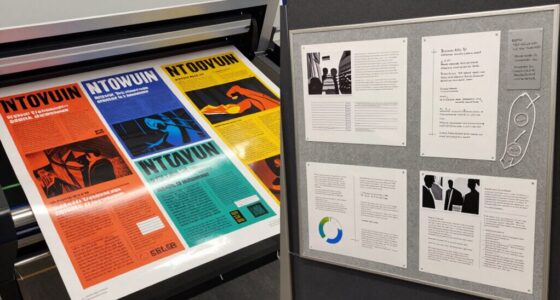
When choosing between spot colors and CMYK, consider your need for precise color accuracy and brand consistency. Spot colors use pre-mixed inks for exact shades, ideal for logos and branding, while CMYK combines cyan, magenta, yellow, and black inks for a broad color range. CMYK is more cost-effective and faster but less precise. If you want to guarantee perfect color match, spot colors are better. To learn how to make the best choice, explore these key differences.

Get business pricing on monitors, keyboards and dev gear
- Business-only prices and quantity discounts
- Tax-exempt purchasing
- Multiple users, one account, clear invoices
Key Takeaways
- Spot colors offer precise, consistent matching ideal for branding, while CMYK provides a broad color range suitable for most images.
- Using spot colors involves higher costs and longer setup times compared to the faster, more economical CMYK process.
- CMYK relies on ink layering and can result in slight color variations, whereas spot colors maintain exact hue fidelity.
- Spot colors excel in reproducing specific shades like metallics or Pantone hues, which CMYK cannot accurately match.
- Combining both techniques strategically enhances print quality, with spot colors for key branding elements and CMYK for backgrounds.
As an affiliate, we earn on qualifying purchases.
What Are Spot Colors and How Do They Work?
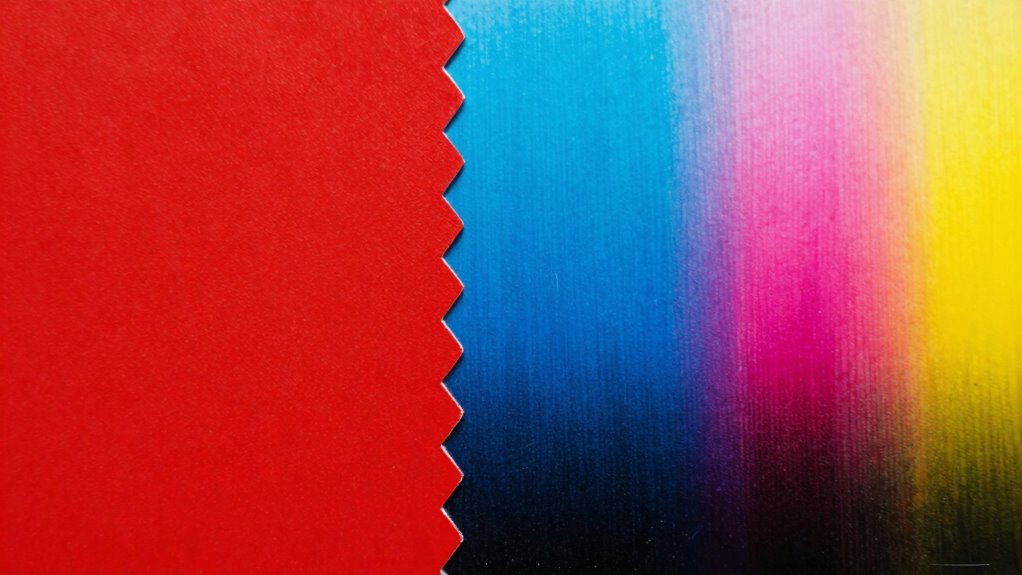
Spot colors are pre-mixed inks used in printing to produce specific, consistent shades that cannot be achieved with standard CMYK process inks. This is essential for precise color matching, especially for branding or logos that require exact hues. When working with spot colors, you focus on ink formulation to ensure the color stays consistent across all prints. Unlike CMYK, which mixes four colors to approximate a broad spectrum, spot colors rely on a single ink for accuracy. You select the spot color from a standardized palette or custom mix it to match your desired shade. This process guarantees consistency and accuracy, making spot colors ideal for maintaining brand integrity and achieving vibrant, specific colors in your printed materials. Additionally, color matching plays a crucial role in ensuring the final printed result aligns perfectly with your original design. Incorporating color management techniques can further enhance the precision and consistency of spot color printing, leading to a more professional outcome.
CMYK color printer ink cartridges
As an affiliate, we earn on qualifying purchases.
As an affiliate, we earn on qualifying purchases.
How Does CMYK Printing Work and What Are Its Capabilities?

CMYK printing works by combining four ink colors—cyan, magenta, yellow, and black—to produce a wide range of hues. This process relies on precise color mixing to achieve accurate results, but it has limits in the colors it can reproduce. Understanding its color gamut helps you see what shades are possible and where spot colors may be necessary. Additionally, Free Floating techniques can enhance the final output by providing more flexibility in color matching. Being aware of digital printing advancements can also help optimize print quality and color accuracy in your projects.
Color Mixing Process
Have you ever wondered how printers produce a full spectrum of colors from just four inks? It all comes down to color blending and pigment mixing. CMYK printing uses cyan, magenta, yellow, and black inks, which are layered and combined to create a wide range of hues. When the inks are printed onto paper, they blend through a process called subtractive color mixing—each ink absorbs certain wavelengths of light and reflects others. By varying the amount of each ink, printers can produce millions of different colors. This precise pigment mixing allows for smooth gradients and consistent color reproduction. While it doesn’t match the full range of human vision, the CMYK process effectively reproduces most colors needed for high-quality print work.
Color Gamut Range
Understanding the color gamut of CMYK printing is essential to grasp its capabilities and limitations. The color gamut refers to the range of colors that can be reproduced using CMYK inks. Unlike spot colors, which can produce more vibrant hues, CMYK’s color gamut is limited, especially in bright reds, greens, and blues. To help you visualize, here are key points:
- CMYK can’t match the vividness of some spot colors
- Certain shades fall outside its reproducible spectrum
- Overlapping inks can cause color shifts
- Bright, neon, or metallic colors require special inks
- The color gamut varies depending on printer and paper quality
Knowing these limits ensures you choose the right printing method for your design’s color needs.
As an affiliate, we earn on qualifying purchases.
How Do Spot Colors and CMYK Compare in Color Accuracy and Consistency?
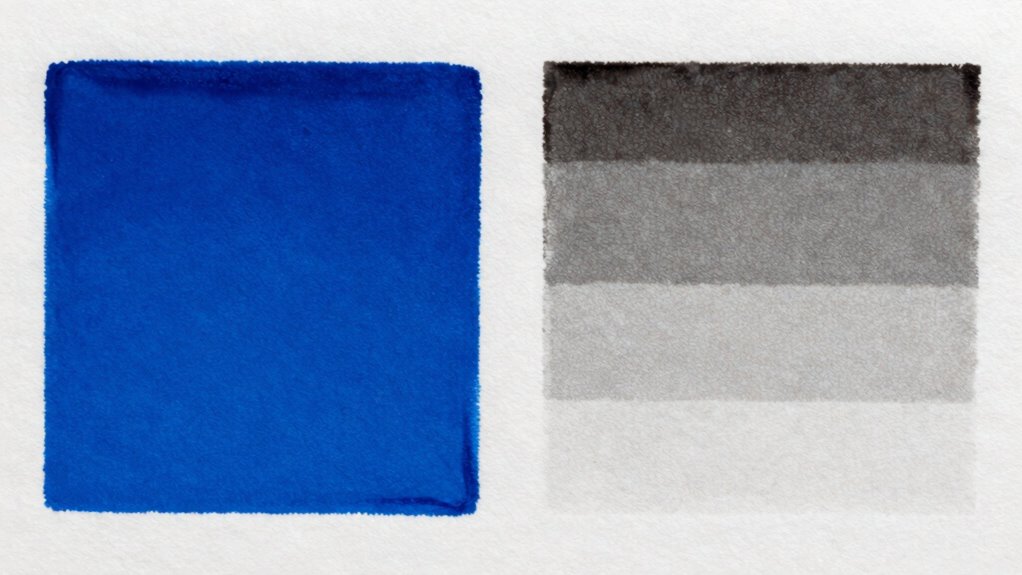
Spot colors often deliver superior color accuracy and consistency compared to CMYK, especially when exact brand colors are essential. They provide precise color matching because they are pre-mixed with specific ink formulations, reducing variability. This consistency ensures your colors stay true across different prints and batches. CMYK, on the other hand, relies on ink blending during printing, which can sometimes lead to slight color shifts due to variations in ink density and substrate. Spot colors maintain their integrity because they don’t depend on mixing inks during printing, offering more reliable results. If your project demands exact color matching and consistency, spot colors give you the edge. However, they may come at a higher cost, so weigh your priorities carefully.
professional color management tools
As an affiliate, we earn on qualifying purchases.
As an affiliate, we earn on qualifying purchases.
Should You Use Spot Colors or CMYK for Your Project?

Deciding between spot colors and CMYK depends on your project’s needs for color consistency and accuracy. You’ll also want to think about costs and production factors that could impact your choice. Understanding these points helps you choose the best option for your specific project goals. Additionally, being aware of color management practices can help ensure your printed materials meet your expectations. Considering the cost implications of each method can also influence your decision, especially for large-scale printing runs. Proper color calibration is essential to maintain color fidelity across different printing processes. Knowing how print technology affects color output can further guide your choice to achieve optimal results. Furthermore, understanding how color matching techniques are applied in various printing methods can improve the final quality of your prints.
Color Consistency and Accuracy
When it comes to achieving consistent and accurate color reproduction, choosing between spot colors and CMYK is essential. Your decision impacts color matching and brand consistency across different prints and materials. Spot colors provide precise color matching, ensuring your brand’s colors stay uniform every time. CMYK, however, can vary slightly due to printing conditions, making it less reliable for exact matches. Consider these factors:
- Spot colors offer exact color matching for logo and brand colors.
- CMYK may produce slight variations, affecting brand consistency.
- Spot colors maintain accuracy across different print runs.
- CMYK is more flexible but less consistent for specific colors.
- Your project’s need for color precision influences your choice.
- Additionally, print color management is crucial for maintaining consistency in complex printing projects.
Choosing the right method guarantees your colors look consistent and true to your brand identity.
Cost and Production Factors
Choosing between spot colors and CMYK often depends on your project’s budget and production timeline. Spot colors typically involve custom ink formulation, which can be costly and time-consuming but guarantees precise color matching. CMYK uses standard inks, making it more affordable and faster to produce, especially for large quantities. However, maintaining perfect color registration can be challenging with CMYK, risking inconsistencies. Consider the table below to weigh your options:
| Factor | Spot Colors | CMYK |
|---|---|---|
| Cost | Higher due to custom ink formulation | Lower, uses standard inks |
| Production Time | Longer, requires precise setup | Faster, suitable for quick turnaround |
| Color Accuracy | Superior, consistent color match | Less precise, potential registration issues |
| Overall Flexibility | Limited, fewer colors available | Highly flexible with broad color range |
Additionally, color consistency is often more reliable with spot colors, which is crucial for branding. When planning your print project, consider how color matching impacts your overall design goals and brand identity.
What Are the Pros and Cons of CMYK Printing?
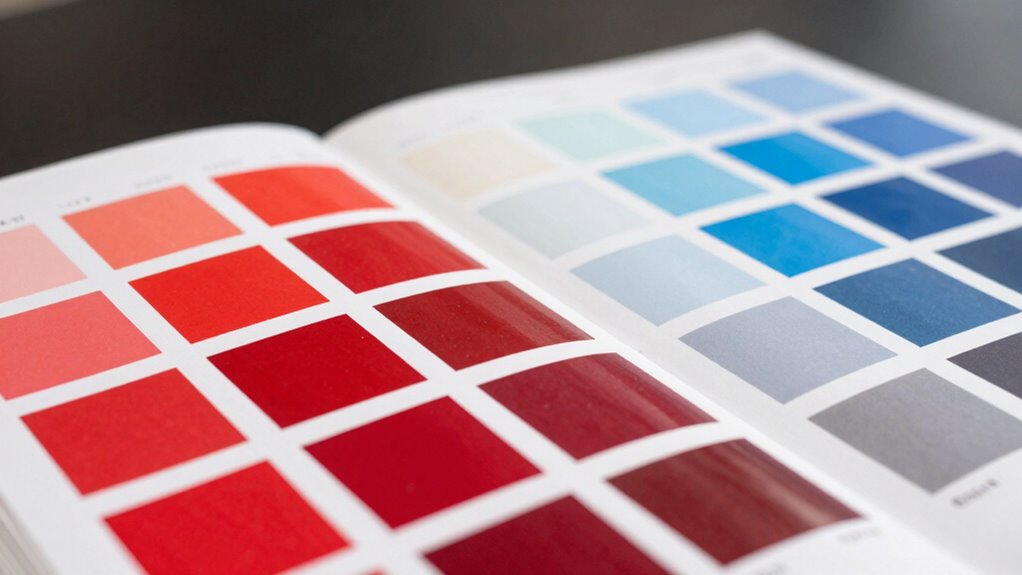
CMYK printing offers a reliable and cost-effective way to produce vibrant, full-color images on a variety of materials. Its main advantage is consistent color matching across different prints, thanks to standardized ink formulation. You benefit from widespread availability and ease of use, making it ideal for large-scale projects. However, there are some drawbacks to contemplate:
- Limited color range compared to spot colors
- Difficulties achieving exact Pantone matches
- Potential color shifts due to ink formulation variations
- Less effective for metallic or specialty finishes
- Requires precise calibration and color management
While CMYK is versatile and efficient, it may not always deliver the precise hues your project demands. Understanding these pros and cons helps you decide when CMYK is the best choice for your printing needs.
How Do Cost, Complexity, and Time Influence Your Choice?
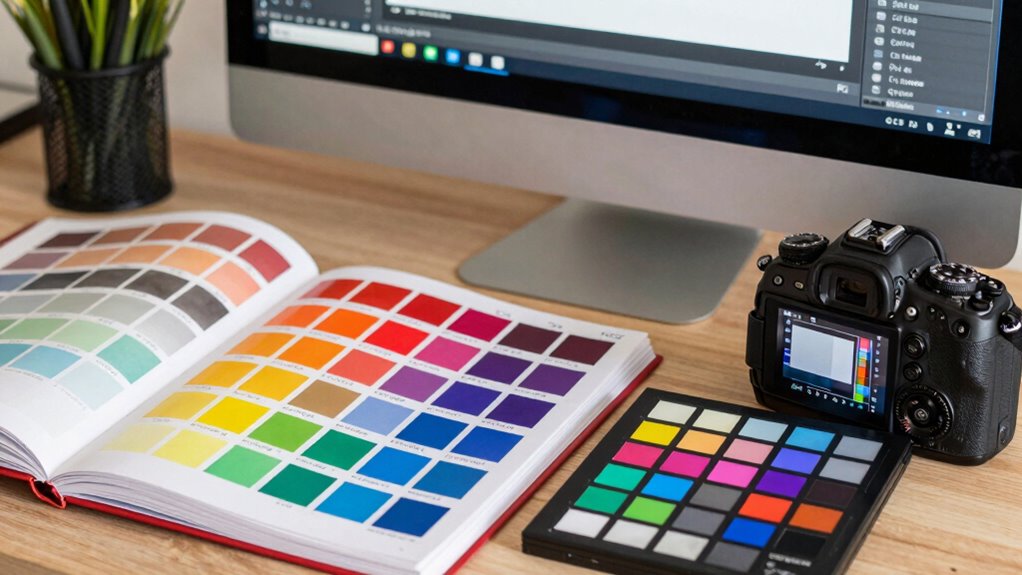
Cost, complexity, and time are key factors that can influence whether you pick spot color or CMYK printing for your project. Spot colors often cost more due to the need for custom inks, which can increase production time and impact ink sustainability. They may also have a higher environmental impact because of the specialized inks used. Additionally, the cost of inks varies depending on whether spot or process printing is used, affecting your overall budget. CMYK printing is typically faster and more cost-effective for large runs, as it uses standard inks and streamlined processes. However, achieving precise color matching with CMYK can be complex and sometimes requires multiple adjustments, adding to the overall time. If sustainability matters to you, consider how ink choices and production methods affect environmental impact, balancing your budget and timeline with eco-conscious decisions. Additionally, understanding chemical properties of inks can help you make more informed choices for your project.
How Can You Combine Spot Colors and CMYK Effectively?

To combine spot colors and CMYK effectively, start by identifying which elements require precise color matching and which can be handled with standard process inks. This approach guarantees consistent branding and accurate color reproduction. When integrating these inks, consider the following tips:
- Use spot colors for critical branding elements to maintain consistency.
- Rely on CMYK for backgrounds and less vital graphics to save costs.
- Communicate clearly with your printer about color expectations.
- Test print samples to verify color matching before final production.
- Incorporate both ink types strategically to optimize quality and efficiency.
- Understanding color management techniques can help ensure color accuracy across different printing processes. Additionally, familiarizing yourself with spectrophotometers can improve your ability to match colors precisely during the pre-press stage.
- Being aware of color consistency methods can further enhance the reliability of your printed materials.
Balancing spot colors with CMYK allows you to achieve vibrant, consistent results while managing production complexity and costs. This method ensures your branding stays true across all printed materials, making your designs stand out with precision.
What Common Mistakes Should You Avoid When Choosing Print Colors?

Choosing print colors may seem straightforward, but making common mistakes can compromise your final design. One key mistake is poor color matching, which can lead to unexpected results on the printed piece. Always double-check color samples to verify consistency across different materials and lighting conditions. You should also consider how color accuracy varies with different printing techniques to maintain fidelity. Another pitfall is neglecting ink formulation; using incompatible inks or improper mixing can cause color shifts or dull finishes. Be aware that spot colors require precise formulation to achieve the desired hue, and overlapping with CMYK can result in muddy or inaccurate colors. Avoid relying solely on digital previews without testing prints, as colors often appear differently in print. Additionally, understanding color consistency across various printing methods can help prevent discrepancies in your final product. Recognizing how traditional Indonesian decor influences color choices can also guide you toward authentic and harmonious color palettes in your design process. Furthermore, being aware of lighting conditions during printing and display can significantly impact how colors are perceived in the final product. Considering material properties such as paper texture and coating can also influence color appearance and should be factored into your planning.
How to Decide Between Spot Colors and CMYK for Your Printing Needs

Deciding between spot colors and CMYK depends on your specific design goals and printing requirements. Consider how precise color matching and printing efficiency impact your project. Spot colors are ideal when you need consistent, vibrant hues that match specific brand colors, especially for logos. CMYK offers a cost-effective solution for full-color images and designs with photo realism. Additionally, understanding outdoor cooling fans can help you optimize your setup for comfort during printing or design work. When choosing between these options, it’s also important to understand the printing process involved, as this can influence your decision. Evaluate these factors:
- Color matching: Do you need exact color consistency or can slight variations be acceptable?
- Printing efficiency: Is quick turnaround more important, favoring CMYK?
- Design complexity: Are your designs simple or detailed requiring multiple colors?
- Budget constraints: Is keeping costs low a priority?
- Material considerations: Will the substrate influence your color choice?
Balancing these factors helps you choose the best option for your printing needs.
Frequently Asked Questions
Can Spot Colors Be Used in Digital Printing?
Yes, spot colors can be used in digital printing, but they’re less common due to digital color calibration differences. Unlike screen vs print, digital printers typically use CMYK, which may not perfectly match spot colors. If you need precise color matching, verify your digital files are properly calibrated and consult with your printer about how spot colors will translate to digital output, as some shades may vary from print to screen.
How Does Color Matching Differ Between Spot Colors and CMYK?
You’ll find that color matching with spot colors offers superior color consistency and precision, ensuring your printed colors stay true to your design. Unlike CMYK, which relies on mixing four inks and can vary, spot colors use specific inks for exact hues, reducing color shifts. This makes spot colors ideal for brand-critical elements. With CMYK, slight variations can occur, so careful proofing is essential to maintain color accuracy.
Are Spot Colors More Environmentally Friendly Than CMYK?
You might think spot colors are more eco-friendly, but it depends. Spot inks often use eco-friendly formulations, reducing environmental impact, yet their production can generate more waste. CMYK inks are generally more sustainable due to their use of standard, recyclable inks, but may require more ink layers for certain colors. Ultimately, choosing eco-friendly inks and mindful printing practices makes both options environmentally responsible, with spot colors offering some advantages when sustainability is a priority.
What Are the Best File Formats for Spot Color Printing?
You should use vector file formats like Adobe Illustrator (.AI) or EPS for spot color printing. These formats guarantee color consistency and sharp details, which are essential for maintaining brand recognition. Avoid raster files like JPEG or PNG, as they can compromise color accuracy and print quality. Choosing the right file format helps ensure your spot colors match precisely, preserving your brand’s integrity in the final print.
How Do Spot Colors Affect Overall Print Durability and Longevity?
Spot colors enhance print durability and color stability, helping your designs maintain their vibrancy over time. By using specific inks, you reduce the risk of fading or color shifts, which improves overall print longevity. This is especially beneficial for logos or branding materials that need to stay consistent. Incorporating spot colors guarantees your prints remain sharp and true to original colors, even after extended exposure to light and environmental factors.
Conclusion
Choosing between spot colors and CMYK isn’t just a decision; it’s the difference between making your print project look like a masterpiece or a blurry mess. Get it wrong, and your colors could fade faster than a sunset or look completely off. Make the right choice, and your prints will dazzle, captivate, and leave a lasting impression that’s almost too vibrant to believe. So, choose wisely—your design’s future depends on it!
Fall Picks
fall essentials
As an affiliate, we earn on qualifying purchases.