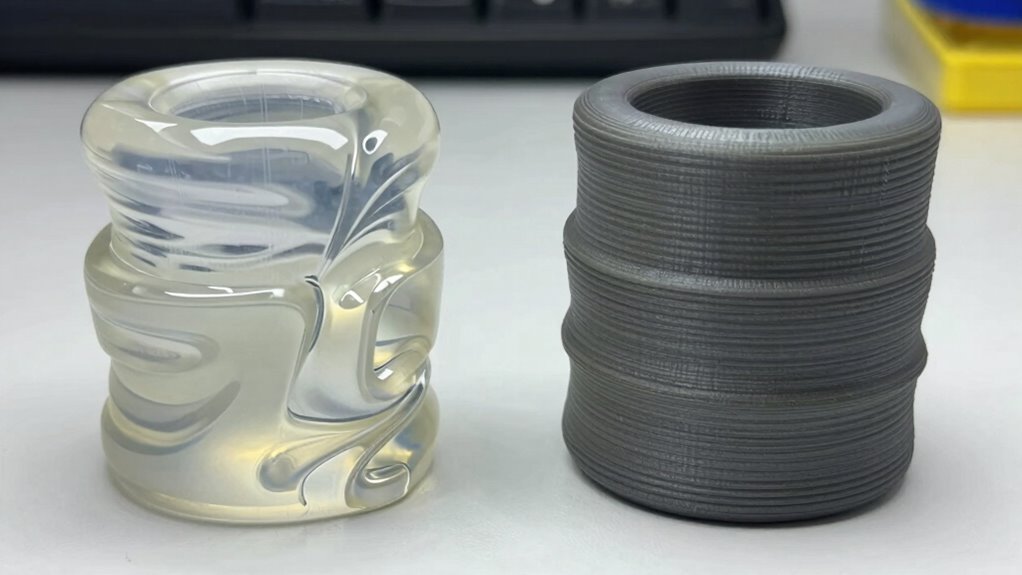

If your projects demand high detail, smooth surfaces, and intricate features like miniatures or jewelry, resin printing is the best fit. But if you’re building larger, durable prototypes or functional parts on a budget, FDM offers faster speeds and easier operation. Consider your priorities—cost, complexity, surface finish—and you’ll find the right method for you. To discover more about matching your specific needs, explore the full comparison.
Key Takeaways
- Choose resin for high-detail miniatures, jewelry, and intricate models requiring smooth, professional finishes.
- Opt for FDM when building larger, durable, functional prototypes that need strength and quick turnaround.
- Consider resin if surface quality and fine detail are priorities; FDM is better for larger, less detailed, and cost-effective projects.
- Use resin with careful handling and post-processing routines; FDM offers easier setup, maintenance, and safety for beginners.
- Budget and project size influence your choice: resin is costlier but ideal for detailed parts; FDM supports larger, budget-friendly builds.

ANYCUBIC Photon Mono 4, Resin 3D Printer with 7'' 10K Mono LCD Screen, Stable LighTurbo Light Source and 70mm/h Fast Printing, Print Volume 6.04'' x 3.42'' x 6.49''
【7'' 10K High Resolution】Photon Mono 4 boasts an impressive 105% increase in print precision compared to Mono 2….
As an affiliate, we earn on qualifying purchases.
As an affiliate, we earn on qualifying purchases.
What Are the Main Differences Between Resin and FDM 3D Printing?

While both resin and FDM 3D printing create three-dimensional objects, they operate through fundamentally different processes. Resin printing involves resin curing, where a liquid resin hardens layer by layer using a UV light source. This results in high-resolution, detailed models with smooth surfaces. In contrast, FDM printing uses an FDM filament, which is heated and extruded through a nozzle to build objects layer by layer. This process is generally faster and more cost-effective for larger parts, but it produces visible layer lines and less intricate details. Resin printers excel at fine details and smooth finishes, making them ideal for miniatures and jewelry. Additionally, layer resolution plays a crucial role in determining the overall quality of the printed object. FDM printers are versatile and suitable for functional prototypes and larger objects, where speed and material variety matter most. Moreover, advancements in printing technology continue to expand the capabilities and applications of both methods.

FLASHFORGE Adventurer 5M 3D Printer,600mm/s Max High-Speed FDM 3D Printers with Fully Auto Leveling, 280°C Direct Extruder with Quick Detachable Nozzle, Effective Cooling, Core XY Structure
Unparalleled Speed: With Core XY All Metal Structure, Flashforge Adventurer 5M Can realize Max 600mm/s travel speed and…
As an affiliate, we earn on qualifying purchases.
As an affiliate, we earn on qualifying purchases.
What Types of Projects Are Best for Resin 3D Printing?
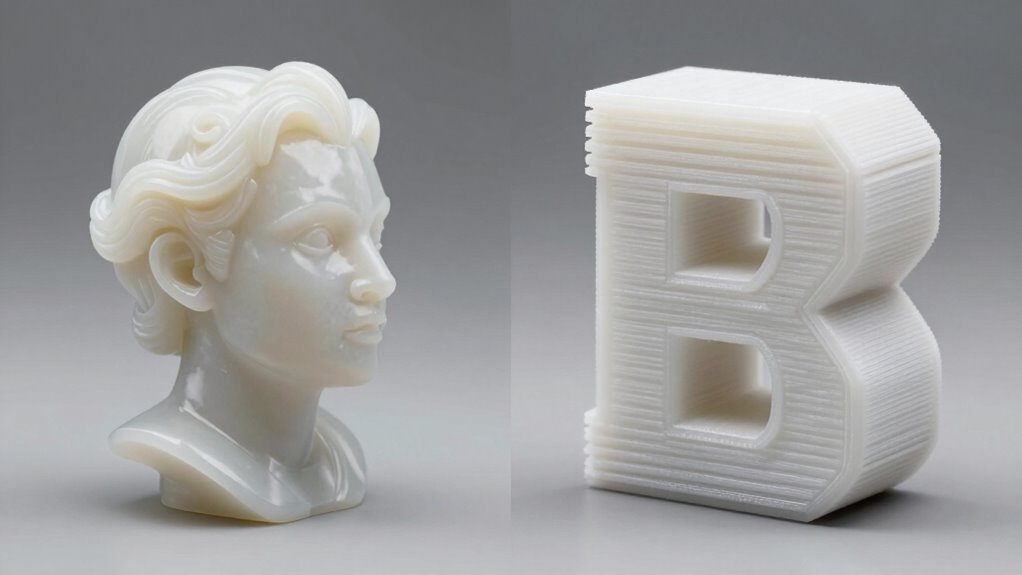
Resin 3D printing excels at creating detailed miniatures and intricate models, thanks to its high resolution. If you need precise prototypes with fine features, resin is your best choice. These projects benefit from the smooth surface finish and accuracy resin offers.
Detail-Oriented Miniatures
If you want to create highly detailed and intricate miniatures, resin 3D printing is the ideal choice. Its ability to produce fine features relies on precise resin curing, which captures intricate details better than filament extrusion. Resin printers use liquid resin that hardens layer by layer under UV light, enabling sharp, smooth surfaces perfect for miniature models. Unlike filament extrusion, which builds objects from melted filament, resin offers superior resolution and surface finish. This makes it perfect for miniatures with complex textures, tiny features, and delicate parts. The quick curing process ensures you can achieve high levels of detail without sacrificing accuracy. If precision and detail are your top priorities, resin 3D printing provides the clean, crisp results necessary for stunning, miniature-scale projects.
High-Precision Prototypes
High-precision prototypes are ideal for projects that demand exceptional detail and accuracy, such as engineering components, medical models, and jewelry designs. Resin curing is critical here, as it guarantees your prints achieve their fine features and smooth surfaces. Proper filament storage isn’t a concern with resin printing, but it’s essential to store your resin in a cool, dark place to prevent premature curing or contamination. Resin printers excel at capturing intricate details and complex geometries, making them perfect for prototypes that require high precision. Their ability to produce smooth surfaces reduces post-processing time and enhances the final product’s quality. If your project depends on tight tolerances and detailed features, resin printing is your best option for delivering high-precision prototypes.

52 Pcs Resin 3D Printing Tool Kit with 304 Stainless Steel Resin Filter Funnel,Silicone Pad, Scraper,Tweezers & Cleaning Tools | Accessories for Model Removal, Resin Recycling & Post-Processing
【Premium Stainless Steel Funnel & Filters 】 Our durable 304 stainless steel funnel ensures smooth resin pouring with…
As an affiliate, we earn on qualifying purchases.
As an affiliate, we earn on qualifying purchases.
When Should You Use FDM 3D Printing Instead?
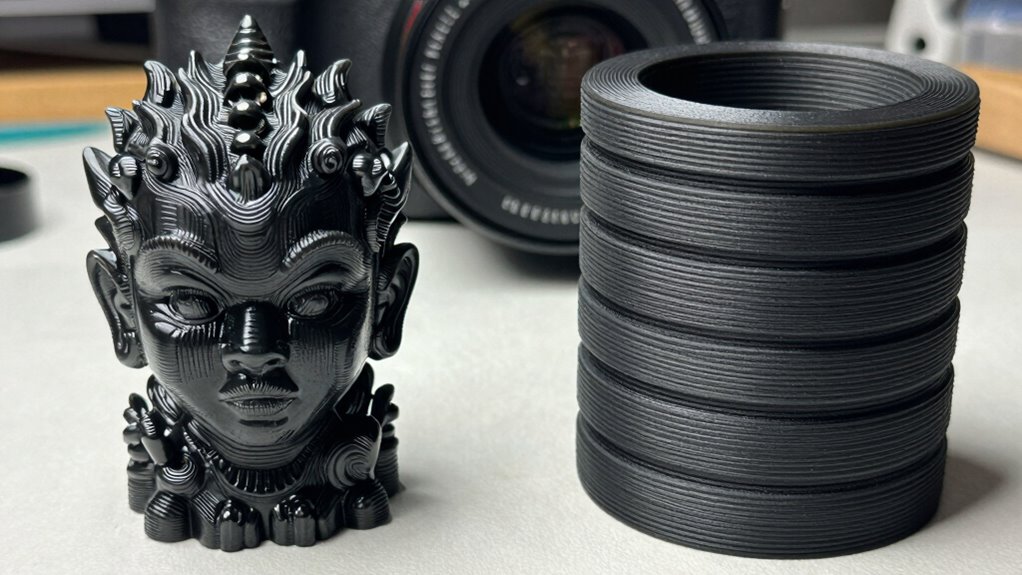
Wondering when FDM 3D printing is the better choice? If your project requires durability with some flexibility, FDM is ideal. While resin offers high durability, it tends to be more brittle and less forgiving under stress. FDM’s flexibility allows parts to bend slightly without cracking, making it perfect for functional prototypes and mechanical components. Additionally, FDM printers excel when making larger, more robust objects, especially when speed and cost-efficiency matter. If you’re working on models that need to withstand daily use or environmental stress, FDM’s versatility outshines resin. It’s also better suited for projects where quick iteration and easy post-processing are priorities. In these cases, FDM provides the durability and flexibility you need to match your project’s demands. Vetted – How Get Divorce
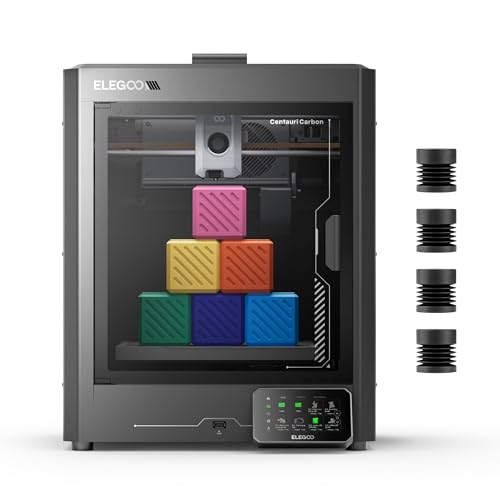
ELEGOO Centauri Carbon 3D Printer, CoreXY 500mm/s High Speed Printing with Auto Calibration, 320°C Nozzle and Built-in Camera, Ready to Print Out of the Box, 256x256x256mm Printing Size
Print Right Out of the Box: ELEGOO Centauri Carbon arrives fully assembled and pre-calibrated, ready to go right…
As an affiliate, we earn on qualifying purchases.
As an affiliate, we earn on qualifying purchases.
How Do Material Costs and Printing Speeds Compare?
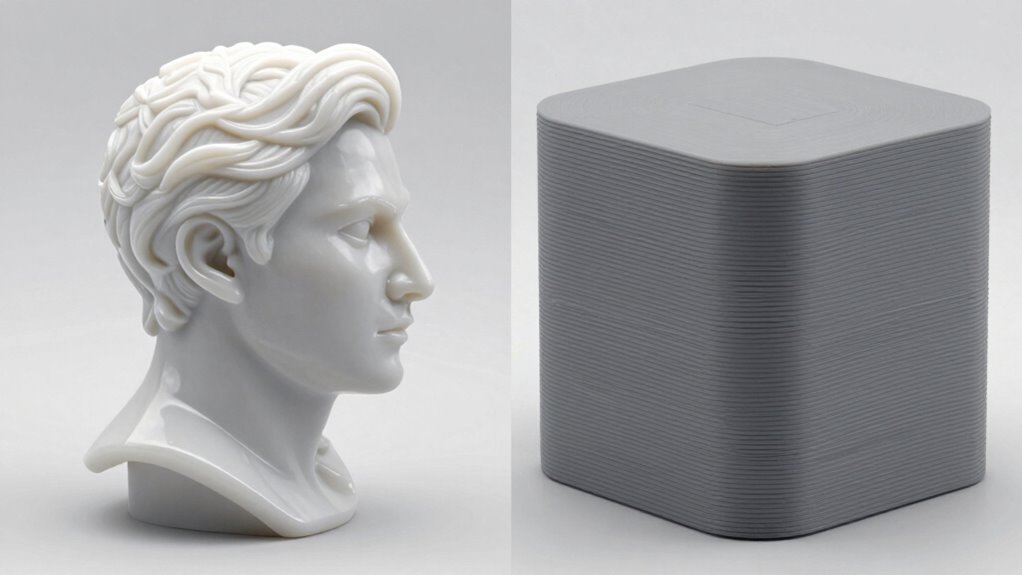
When comparing FDM and resin 3D printing, cost and speed often influence your decision as much as material properties. FDM typically offers lower material costs, making it more budget-friendly for larger projects, while resin tends to be more expensive per volume. Printing speeds vary; FDM printers usually produce parts faster due to larger layer sizes, but resin printers can achieve high detail quickly with fine layers. Material durability also plays a role—FDM parts generally have better impact resistance, whereas resin parts excel in detail but may be more fragile. Environmental impact differs too: FDM filaments are often easier to recycle, while resin printing involves chemicals that require careful disposal. Print quality is another important factor, as resin printers can achieve smoother surfaces and finer features compared to FDM. Additionally, material versatility can influence your choice, as resin and filament materials offer different properties suited to specific applications. Balancing material costs, speed, durability, impact, and print quality helps determine the best choice for your project.
What Surface Finishes and Detail Levels Can You Expect?
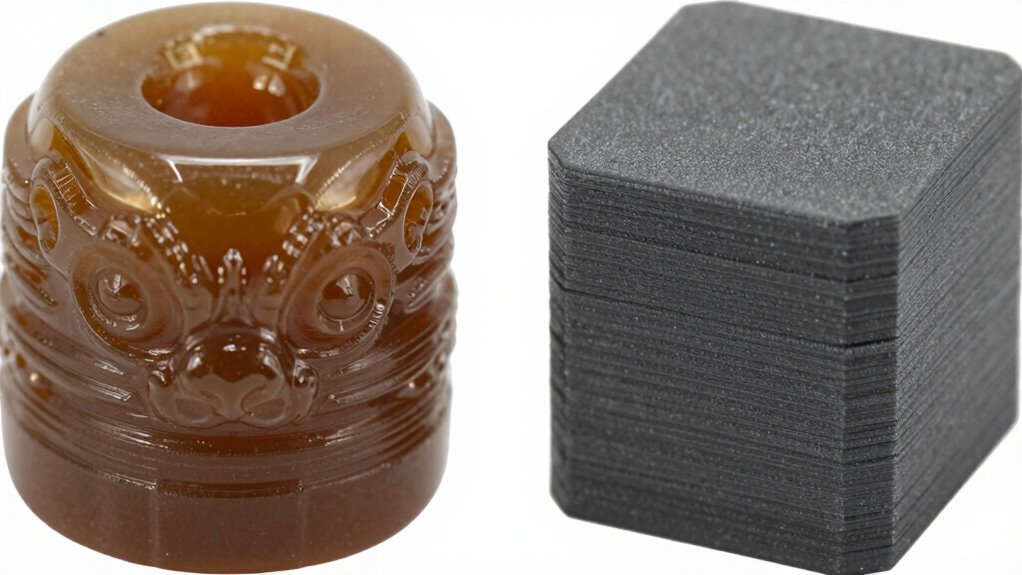
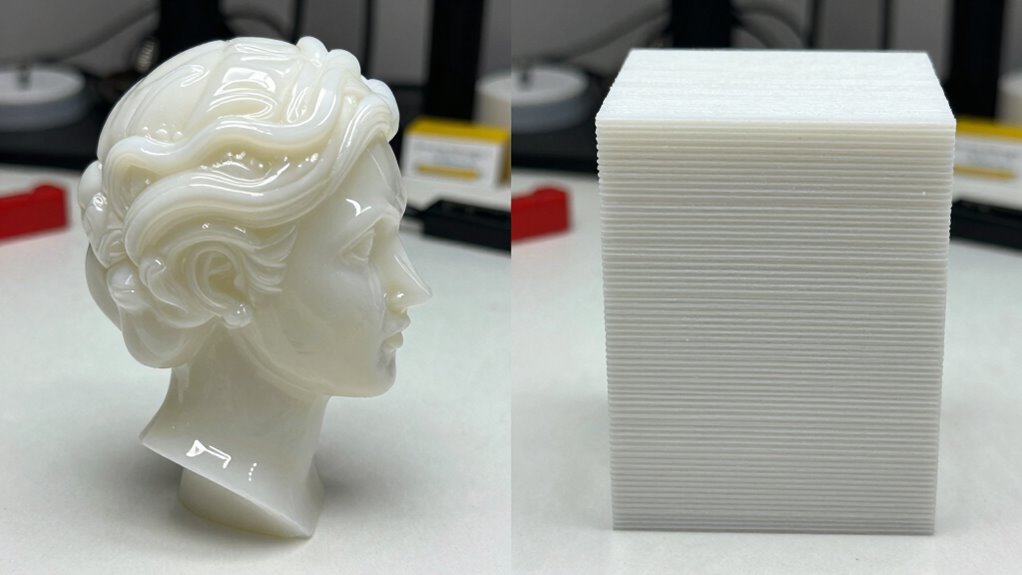
When comparing resin and FDM printing, you’ll notice differences in surface smoothness and fine detail resolution. Resin prints typically offer smoother finishes and sharper details, while FDM models may show visible layer lines. Understanding these distinctions helps you choose the right method for your desired finish and level of detail. Additionally, goal-setting strategies can help you plan and improve your 3D printing projects effectively.
Surface Smoothness Levels
Surface smoothness varies considerably between resin and FDM 3D printing, directly impacting the level of detail and finish you can achieve. Resin prints typically provide a much smoother surface, often requiring minimal post-processing, while FDM prints tend to have visible layer lines that need additional smoothing. With resin, you can expect a high-quality finish and fine detail, making it ideal for intricate models. Resin color options are plentiful, but the surface finish remains consistently smooth. FDM filament types vary widely, from PLA to ABS, but the inherent layer lines affect surface smoothness unless you invest in post-processing techniques. Your choice depends on whether you prioritize a sleek, smooth surface straight off the printer or are willing to refine the finish afterward.
Fine Detail Resolution
Resin 3D printers excel at capturing fine details and producing high-resolution surface finishes right out of the machine. Their precision stems from the resin curing process, which allows for intricate feature reproduction with minimal layer lines. You’ll notice smoother surfaces and sharper edges compared to FDM prints. Resin’s ability to achieve fine detail is ideal for jewelry, dental models, and miniatures. In contrast, FDM printers rely on filament feeding, which can limit the resolution and lead to visible layer lines. While FDM is great for larger, functional parts, resin’s superior surface finish and microscopic detail make it the better choice when high-fidelity surface quality matters most. Expect exceptionally detailed, smooth surfaces that require little post-processing when working with resin.
Layer Visibility Differences
Have you ever noticed the difference in visible layer lines between FDM and resin 3D prints? FDM parts often show noticeable layer visibility, resulting in a rougher surface finish. Resin prints, on the other hand, tend to have a smoother surface with minimal layer lines, creating a higher-quality finish. This difference impacts the final look and feel of your project, especially for detailed models. Here’s a quick comparison:
| Aspect | FDM | Resin | Best For |
|---|---|---|---|
| Layer visibility | More prominent, visible lines | Nearly invisible, smooth | Fine details, high quality |
| Surface finish | Rougher, layered look | Smooth, professional finish | Aesthetics, prototypes |
| Detail resolution | Moderate | Very high | Intricate details |
| Post-processing | Sanding needed | Minimal required | Rapid, polished results |
Understanding these differences helps you choose the right method for your project’s surface quality. Additionally, layer visibility can significantly influence the perception of a printed part’s quality and detail.
Which 3D Printing Method Is Easier for Beginners?
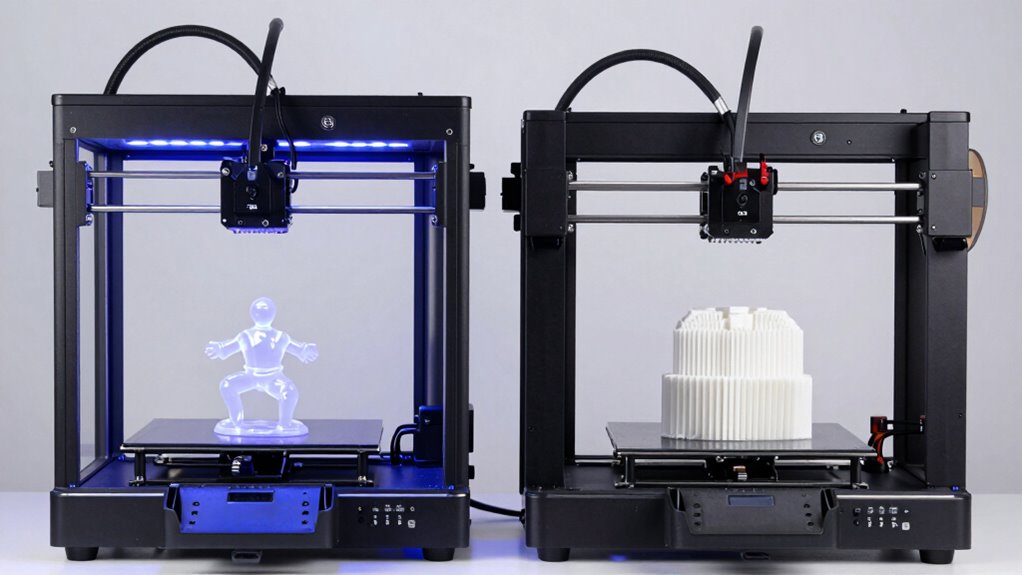
Choosing the easiest 3D printing method for beginners depends on how much setup and calibration you’re willing to handle. Resin printing offers high detail but requires understanding resin safety, handling liquids carefully, and proper ventilation. On the other hand, FDM printing with various filament types is generally more straightforward, with simpler cleanup. Consider these points:
- Resin printing demands safety precautions, making it slightly more complex initially.
- FDM printers often have fewer calibration steps, easing the learning curve.
- Your familiarity with filament types influences ease; PLA is beginner-friendly, while ABS needs more attention.
If you prefer a simpler start, FDM is usually better. But if you’re ready to learn resin safety and enjoy detailed prints, resin printing might suit you better.
What Are the Maintenance and Post-Processing Requirements?
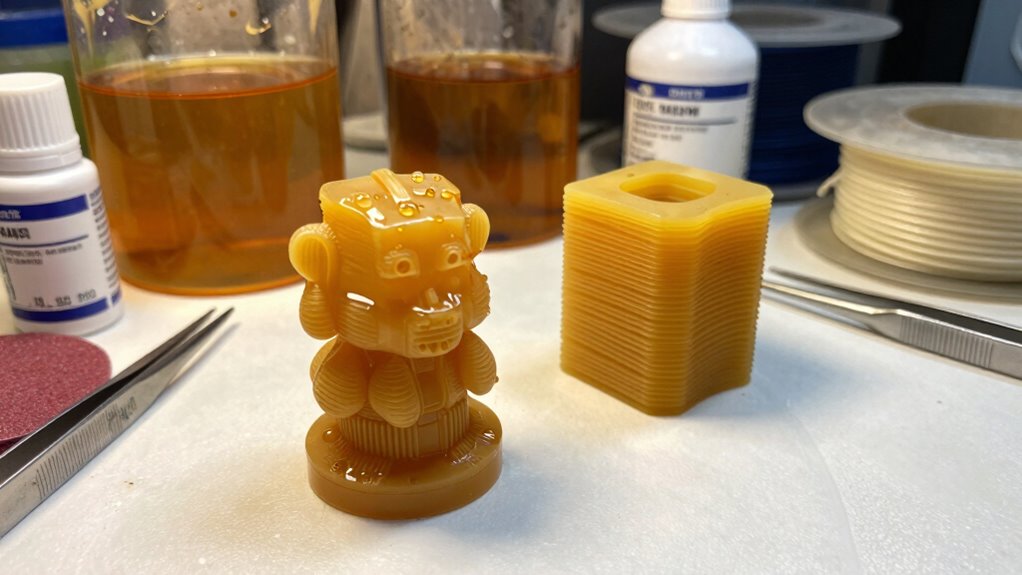
Maintaining your 3D printer and performing post-processing are key steps to guarantee quality results and extend the machine’s lifespan. Regular cleaning procedures help prevent resin residues or filament buildup, which can affect print quality. For resin printers, you’ll need to carefully clean the vat and build platform after each use, while FDM printers require cleaning of the nozzle and bed surface. Equipment maintenance also involves checking belts, lubricating moving parts, and updating firmware to keep everything running smoothly. Post-processing varies: resin prints often need washing and curing, whereas FDM parts might require support removal and sanding. Staying consistent with cleaning procedures and maintenance routines ensures your printer remains reliable and produces high-quality projects over time. Understanding the importance of timing can help you better synchronize maintenance activities with your printing schedule, reducing downtime and enhancing longevity.
How to Decide the Right 3D Printing Method for Your Budget and Goals?
Selecting the right 3D printing method depends on balancing your budget with your specific project goals. To make the best choice, consider these factors:
- If durability is your priority, resin offers high resin durability, producing detailed, long-lasting parts, but at a higher cost.
- For projects requiring flexibility, FDM provides greater fdm flexibility, allowing you to print larger, more functional prototypes affordably.
- Think about your post-processing capacity; resin prints need careful handling and cleaning, while FDM parts generally require less post-processing.
Frequently Asked Questions
Which 3D Printing Method Offers Better Environmental Sustainability?
You’ll find FDM 3D printing generally more environmentally sustainable because it has fewer recyclability challenges and lower energy consumption differences compared to resin printing. Resin printing produces hazardous waste and uses more energy during curing, making it less eco-friendly. With FDM, you can recycle filament scraps more easily and use less power, helping you reduce your environmental footprint. So, FDM is a better choice if sustainability matters to you.
How Do Safety Concerns Differ Between Resin and FDM Printing?
You should be aware that resin printing poses more chemical hazard risks because of the liquid resins, which can cause skin irritation and require careful handling. FDM printing is generally safer, but it still has fire risks from heated extruders and filament ignition. Always wear protective gear, work in well-ventilated areas, and follow safety guidelines to minimize chemical hazards and fire dangers in either method.
Can Resin or FDM Printers Be Used for Large-Scale Production?
You can use FDM printers for large-scale production more easily than resin printers, thanks to their faster speeds and lower costs per part. Resin printers face scaling challenges because they print slower and require more post-processing, making them less suitable for mass production. If you’re aiming for high volume, FDM is your best choice, but for detailed, smaller batches, resin printers excel despite their limitations.
What Are the Typical Failure Modes for Each Printing Type?
You often face failure modes like poor supports or layer adhesion in FDM printing, leading to warping or layer separation. Resin printing can encounter resin curing issues, resulting in incomplete prints or surface defects. In both types, improper calibration or material handling exacerbates these problems. To minimize failures, guarantee supports are correctly placed, layer settings are optimized, and resin or filament quality is maintained.
How Do Software and Slicing Requirements Vary Between Methods?
Imagine a tightrope walker balancing perfectly—your software and slicing requirements mirror that precision. For resin printing, expect complex software with high slicing precision, demanding detailed layer control. FDM printing offers more straightforward software, focusing on basic slicing functions. You’ll need to adapt your workflow accordingly: resin demands meticulous settings, while FDM allows quicker, less intricate slicing, making your choice dependent on project complexity and desired outcome.
Conclusion
So, whether you’re craving tiny, flawless figurines or hefty, functional prototypes, the choice is yours. Resin offers stunning detail but demands patience and a steady hand, while FDM is perfect for quick, rugged builds—think of it as the bread and butter of 3D printing. Ultimately, pick what fits your budget, patience level, and project goals—because nothing says “I’m a maker” like juggling resin fumes or wrestling with filament. Happy printing!