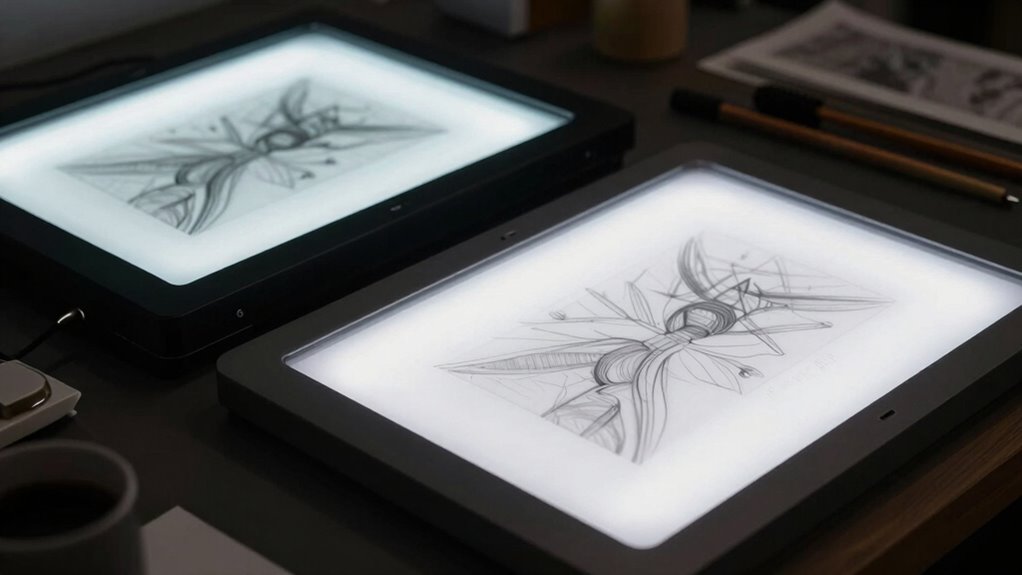

If you’re serious about your creative work, choosing between a light pad and a light table depends on your workspace needs and budget. Light pads are portable, affordable, and ideal for detailed sketching, tracing, and digital preparations. Light tables offer larger, stationary surfaces perfect for layered projects and professional presentations, but they tend to cost more. Understanding their differences helps you pick the right tool for your projects—keep exploring to find out which one fits your artistic style best.
Key Takeaways
- Light pads are portable, ideal for detailed, close-up work, and suitable for artists who need mobility and flexibility.
- Light tables provide larger surfaces for complex, layered projects, making them better for professional studio use.
- Adjustable brightness on light pads enhances precision for detailed tasks, while light tables excel in viewing multiple sheets simultaneously.
- Cost-effective light pads are accessible for serious artists working on individual projects, whereas light tables are a larger investment for comprehensive workflows.
- Choosing between them depends on workspace size, project complexity, and whether portability or a larger surface is more critical for your work.
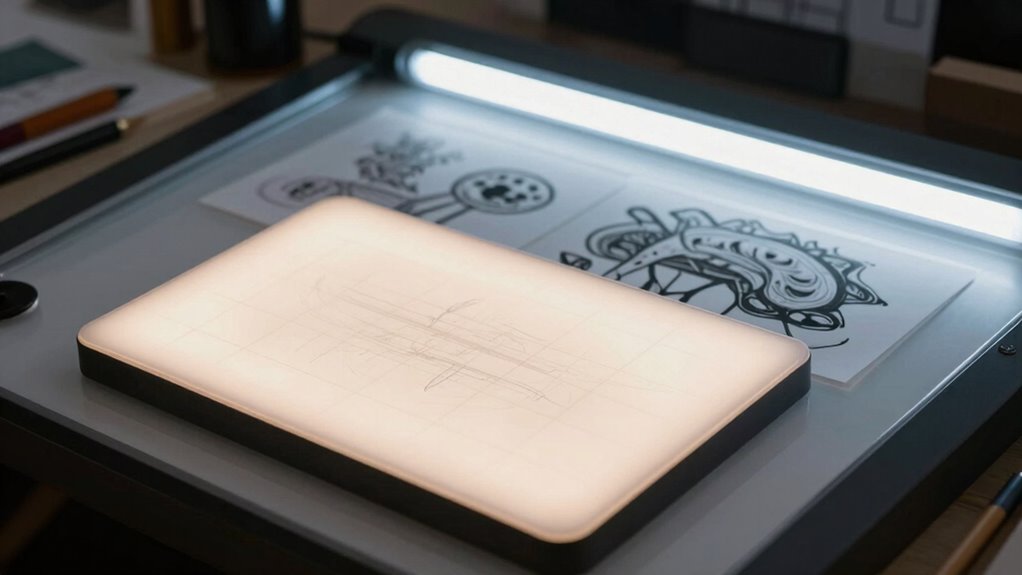
When choosing between a light pad and a light table, understanding their differences can help you pick the right tool for your needs. Both devices offer artistic illumination that makes creative work easier, but they serve different purposes depending on your projects. If you’re into digital sketching or traditional art, knowing how each tool functions can considerably impact your workflow and results. Light pads are typically thin, portable, and designed for close-up illumination. They shine a gentle, even light through a single surface, making them ideal for tracing, sketching, or refining artwork. When you’re working on detailed illustrations or digital sketches, a light pad provides the perfect amount of brightness without overwhelming your workspace. Its portability means you can easily carry it around, whether you’re sketching at a café or setting up for a quick practice session at home. The surface of a light pad is usually smooth, which is excellent for pencil work, and many models come with adjustable brightness levels so you can customize the lighting to suit your project. This makes it especially useful for artists who prefer working with traditional media but want a clear view of their sketches. Additionally, light pads often feature a sleek, minimal design that complements various creative setups. Understanding the differences in illumination between these devices can help artists optimize their workspace and enhance their creative process.
Furthermore, the cost of each device can vary significantly, influencing which option is more accessible for different budgets. Both tools enhance artistic illumination, but your choice depends on your workflow. For quick sketches, detailed tracing, or digital sketching prep, a light pad is usually more practical. If you need a larger working surface for layered projects or professional presentations, a light table is likely the better investment. Knowing the applications of each tool can help you determine which device aligns best with your specific art style and project needs. Understanding these differences ensures you select a device that complements your art style, improves your efficiency, and boosts your creative output.
As an affiliate, we earn on qualifying purchases.
Frequently Asked Questions
Can Light Pads Replace Traditional Sketchbooks Entirely?
Light pads can’t fully replace traditional sketchbooks because they lack the tactile feel and spontaneous creativity that paper offers. However, with digital compatibility, you can easily transfer your sketches to digital platforms, enhancing your workflow. Plus, their portability advantages mean you can sketch anywhere, anytime. While light pads are excellent tools for digital artists and on-the-go work, traditional sketchbooks still hold value for freehand, tactile inspiration and raw creativity.
How Do Light Pads Impact Long-Term Eye Health?
Using a light pad won’t turn your eyes into steel, but it can considerably reduce eye strain and visual fatigue during long sessions. By providing a gentle, consistent light source, it minimizes glare and harsh contrasts that tire your eyes. Over time, this can help protect your eye health, preventing discomfort and long-term issues. So, you can create confidently without risking your vision’s future.
Are Light Tables Better for Professional Framing Work?
Light tables are better for professional framing work because they offer superior color accuracy, ensuring your artwork is perfectly lit and true to its colors. However, they often face portability issues, making it challenging to move them around easily. If precision is your priority and you work mainly in a fixed space, a light table is ideal. But if you need portability, consider a lightweight, portable option that balances these factors.
Do Light Pads Require Special Batteries or Power Sources?
Light pads typically don’t require special batteries; they often use standard rechargeable batteries or USB power sources. When choosing a light pad, check its battery compatibility and power source requirements. Most models are powered via USB or an AC adapter, making them convenient for portable use. You just need to verify your power source matches the device’s specifications, so it works reliably without interruptions during your creative projects.
Can Light Tables Be Used for 3D Object Tracing?
Yes, you can use light tables for 3D object tracing, especially for 3D visualization. The transparency of materials helps you see through objects clearly, making it easier to trace complex shapes from different angles. Light tables provide a steady, bright surface, which is ideal for working with layered or transparent materials. This setup enhances your ability to accurately trace and refine 3D designs or objects.
As an affiliate, we earn on qualifying purchases.
Conclusion
So, which one’s right for your creative needs—light pads or light tables? Think about your work style and the projects you tackle. Do you prefer the portability and sleek design of a light pad, or does the larger surface and versatility of a light table better suit your craft? Ultimately, your choice depends on what helps you work more efficiently and inspires your best ideas. Isn’t it time you chose the tool that’ll elevate your artistry?
As an affiliate, we earn on qualifying purchases.
professional light table for layered projects
As an affiliate, we earn on qualifying purchases.
As an affiliate, we earn on qualifying purchases.