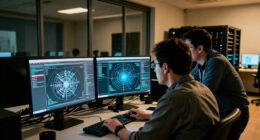

📊 Full opportunity report: The Vortex Field Unit’s Zero-Image Technique For Storm Data In AI on ThorstenMeyerAI.com — validation score, market gap, and execution plan.

Get business pricing on monitors, keyboards and dev gear
- Business-only prices and quantity discounts
- Tax-exempt purchasing
- Multiple users, one account, clear invoices
TL;DR
The Vortex Field Unit has developed a new zero-image visualization method for storm data using procedural graphics, enhancing AI-based weather analysis. This approach avoids external media, focusing on synchronized, data-driven visual layers.
The Vortex Field Unit has introduced a zero-image technique for visualizing storm data in artificial intelligence applications, marking a significant departure from traditional imagery-based methods. This innovation employs synchronized, procedural graphics generated entirely through code, emphasizing data integrity and disciplined visualization. The development aims to improve the accuracy and clarity of storm modeling in AI systems, making complex weather phenomena more interpretable without relying on external media assets. For more details, see the original analysis on how the Vortex Field Unit renders signature storm data.
The new approach was showcased via an AI-crafted digital exhibition called the Plains Intercept Archive, which visualizes a supercell’s lifecycle through a scroll-driven interface. All visual elements—including cloud formations, rain curtains, and radar reflectivity—are generated dynamically using HTML, CSS, and JavaScript, with no external images or media requests involved. The visualization synchronizes multiple layers to depict the storm’s evolution, from initial formation to dissipation, in real time. This approach exemplifies advanced procedural graphics techniques for weather data visualization. According to the creators, this method enhances the fidelity of storm data representation by focusing on data agreement and procedural graphics, rather than static imagery.
Developed through a three-stage pipeline—building, critique, and art-direction—the technique emphasizes technical rigor and visual clarity. The interface employs a restrained color palette and legible typography to evoke a stormy atmosphere while maintaining clarity. The entire system is self-hosted, with all visual assets generated via code, ensuring a seamless, scalable experience. The project demonstrates how advanced procedural graphics can serve as a reliable tool for AI-driven weather analysis, especially in scenarios where external media may introduce inaccuracies or inconsistencies. Insights into such innovative visualization methods are detailed in the original analysis.
The Vortex Field Unit’s Zero-Image Technique for Storm Data in AI
A procedural visualization method replaces static storm imagery with synchronized, code-generated layers—giving AI weather analysis a more disciplined, scalable, and data-centric visual language.
Storm visualization without the image file
The technique renders atmospheric structure entirely through code. Cloud formations, rain curtains, radar reflectivity, and lifecycle transitions are generated as synchronized visual layers instead of imported media.
Data before decoration
Every visible element is tied to an intended storm state, reducing the risk that a dramatic but unrelated image distorts interpretation.
Code-generated layers
HTML, CSS, and JavaScript construct the exhibition’s visual system without external image or media requests.
Synchronized evolution
Scroll-driven interactions align multiple layers to depict formation, intensification, maturity, and dissipation.
One storm, four coordinated signals
The Plains Intercept Archive treats the supercell lifecycle as a layered system. Each visual component is generated independently, then synchronized into a coherent event.
From raw signal to interpretable storm
The method’s value comes from agreement across the full chain. Data, procedural rules, synchronized layers, and AI interpretation must all describe the same evolving phenomenon.
Storm data
Measurements and modeled states define the source conditions.
Visual rules
Code translates values into controlled shapes, density, and motion.
Layer agreement
Cloud, rain, radar, and time remain synchronized.
AI insight
A coherent display supports interpretation and communication.
Static imagery versus zero-image rendering
The zero-image approach prioritizes flexibility, reproducibility, and visual consistency. Its operational value, however, still depends on testing beyond the exhibition setting.
| Criterion | Static imagery | Zero-image technique | Current evidence |
|---|---|---|---|
| External media dependency | ✗ Required | ✓ Eliminated | Demonstrated in the exhibition |
| Dynamic storm evolution | ~ Limited | ✓ Synchronized | Demonstrated through scrolling |
| Visual reproducibility | ~ Asset-dependent | ✓ Rule-driven | Strong conceptual advantage |
| Operational forecasting use | ✓ Established | ~ Experimental | Field validation still required |
| Adaptation to new phenomena | ~ New assets needed | ~ Potentially scalable | Not yet proven broadly |
High promise, incomplete proof
Procedural storm displays could improve interpretability and reduce inconsistent visual inputs. The largest gap is evidence from live, diverse, and operational weather conditions.
What happens next
Adoption will depend on measurable gains in clarity and accuracy, followed by disciplined validation in environments far less controlled than a digital exhibition.
The Vortex Field Unit demonstrates a credible shift toward code-native, data-centric storm visualization. It is an experimental technique with meaningful AI potential—not yet a validated replacement for operational forecasting tools.
Implications for AI Weather Modeling
This new zero-image visualization technique offers a more precise and flexible way for AI systems to interpret storm data. By relying on procedural graphics that are synchronized and data-driven, it reduces dependency on static images, which can be limiting or prone to misinterpretation. This approach could lead to improved accuracy in storm prediction models, better understanding of storm dynamics, and enhanced communication of complex weather phenomena to scientists and decision-makers. The method also aligns with broader trends toward data-centric visualization in AI, emphasizing disciplined, scalable, and reproducible representations of natural phenomena.
As an affiliate, we earn on qualifying purchases.
Background on Storm Visualization Techniques
Traditional storm visualization methods often depend on static images, radar snapshots, or external media assets, which can limit flexibility and data fidelity. Recent advances in AI and procedural graphics have opened new possibilities for dynamic, real-time visualization of weather phenomena. The Vortex Field Unit’s project builds on these developments, emphasizing the importance of synchronized, layered visualizations that accurately reflect storm evolution. Prior efforts in digital storm chases and weather simulations have demonstrated the potential of procedural graphics, but this project pushes the boundaries by eliminating external media entirely and focusing on disciplined, code-generated visuals.
“This zero-image approach signifies a shift towards data-centric visualization, where procedural graphics serve as a more reliable and scalable medium for storm analysis in AI systems.”
— Thorsten Meyer
As an affiliate, we earn on qualifying purchases.
Unanswered Questions About Practical Implementation
It is not yet clear how this zero-image technique will perform in real-world AI applications beyond the exhibition context. The scalability, integration with existing weather models, and robustness under diverse storm conditions remain to be tested. Additionally, the extent to which this method can replace or complement traditional visualization tools in operational settings is still uncertain. Further research and field validation are needed to confirm its practical utility and limitations.
procedural graphics programming books
As an affiliate, we earn on qualifying purchases.
As an affiliate, we earn on qualifying purchases.
Next Steps for Development and Adoption
Developers plan to conduct pilot tests integrating this visualization approach into existing AI weather models to evaluate its effectiveness. Further refinement of the procedural graphics, including real-time data integration and interactive features, is expected. Industry adoption will likely depend on the outcomes of these tests and the demonstration of improved accuracy and clarity in storm analysis. The Vortex Field Unit may also explore expanding this technique to other meteorological phenomena and broader visualization contexts.
As an affiliate, we earn on qualifying purchases.
Key Questions
How does the zero-image technique differ from traditional storm visualization?
It uses procedural graphics generated entirely through code, avoiding static images or external media, and relies on synchronized, layered visuals driven by scroll interactions to depict storm evolution.
What are the potential benefits of this approach for AI weather models?
It offers more precise, scalable, and data-centric visualizations that can improve the accuracy and interpretability of storm data in AI systems.
Is this method ready for operational use in weather forecasting?
Not yet; it is still in experimental stages. Further testing and validation are needed to assess its performance in real-world scenarios.
Can this approach be applied to other weather phenomena?
Potentially, yes. Its procedural, data-driven nature makes it adaptable for visualizing other complex natural phenomena, but specific applications are still under development.
Source: ThorstenMeyerAI.com
Halloween Picks
halloween
As an affiliate, we earn on qualifying purchases.