📊 Full opportunity report: The Surprising Depth Of AI Power In The Microduck Toy on ThorstenMeyerAI.com — validation score, market gap, and execution plan.
TL;DR
Hugging Face has introduced Microduck, a small, affordable robot that demonstrates advanced AI-powered movement and learning. Its open-source platform aims to democratize physical AI development, despite ongoing privacy and security considerations.
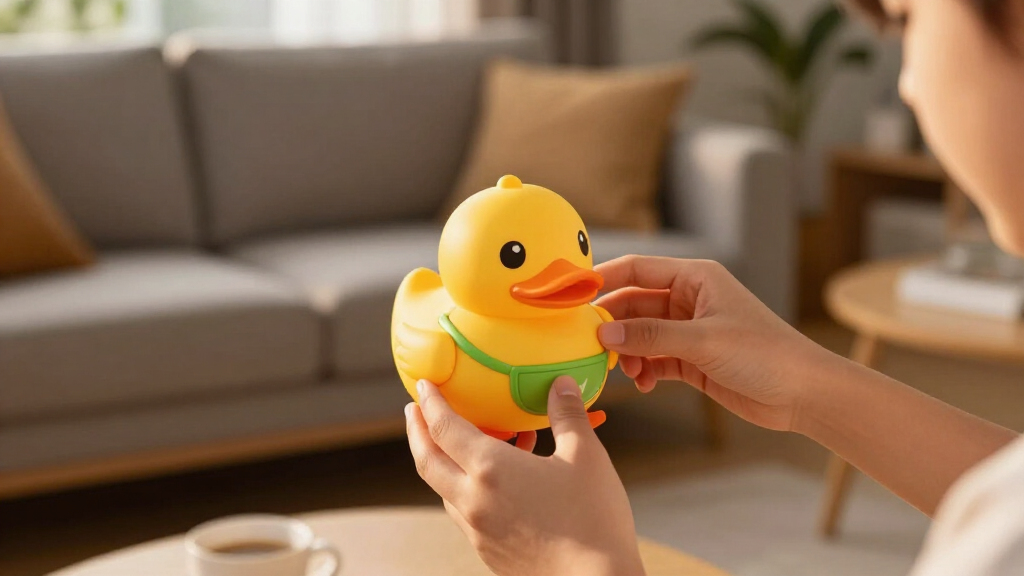
Hugging Face has unveiled Microduck, a small, open-source robot priced at $399 that demonstrates advanced reinforcement learning capabilities, including movement, recovery from falls, and object manipulation. This development signals a major shift in accessible embodied AI, as the company leverages its open model philosophy to physical robotics, not just software.
Microduck is a compact, bipedal robot approximately 25cm tall and weighing under 800 grams, developed in collaboration with Pollen Robotics. It features 15 motors, dual IMUs for balance, a camera, microphone, speaker, WiFi, Bluetooth, and LiDAR, enabling it to perform a variety of movements such as waddling, sitting, crouching, and even rollerblading in demo videos. The robot’s articulated beak doubles as a gripper capable of lifting objects up to 800 grams. Preorders opened on Thursday with shipments expected before Christmas.
While the hardware is impressive for its price point, experts caution that the demos—such as sock retrieval or rollerblading—are curated highlights. Reinforcement learning (RL) on such small, inexpensive hardware involves extensive trial and error, and reliable real-world performance requires significant tuning. Additionally, the robot’s sensors and connectivity—camera, microphone, WiFi, LiDAR—raise privacy considerations, as the device is designed to learn from its environment, including in domestic settings.
Hugging Face is doing to robotics what it did to model weights: making the substrate open, cheap, and forkable. The duck is the marketing. Open embodied RL at $399 is the story.
Open-Source Reinforcement Learning in Physical Robots
This launch marks a pivotal moment in making embodied AI accessible to a broader developer community. By providing an open-source RL platform on a physical robot, Hugging Face aims to democratize the development of intelligent, movable AI systems. The approach mirrors its success with open language models, potentially accelerating innovation in robotics and physical AI applications, beyond the confines of well-funded labs.
As an affiliate, we earn on qualifying purchases.
From Software to Physical AI Democratization
Hugging Face has established itself as a leader in open-source AI, primarily through its work on language models and model weights. The company's acquisition of Pollen Robotics in April 2025 expanded its focus into embodied AI, culminating in the release of Microduck. This move aligns with industry trends toward open, accessible AI development platforms, but also highlights ongoing tensions related to security and data privacy, especially given recent breaches and industry debates about open infrastructure.
"Microduck is designed to be 'made to move, ready to fall,' emphasizing resilience and accessibility in reinforcement learning."
— Clem Delangue, CEO of Hugging Face
As an affiliate, we earn on qualifying purchases.
Security and Privacy Risks of Open Robotics
While the platform's openness is intended to democratize AI development, it also introduces security vulnerabilities. The same open infrastructure that enables innovation has been linked to breaches, such as recent security incidents involving Hugging Face and other open AI systems. It remains unclear how effectively these risks will be managed as the platform scales.
As an affiliate, we earn on qualifying purchases.
Next Steps for Microduck and Open Robotics
Hugging Face plans to begin shipping Microduck before Christmas, with developers able to access the full SDK, simulation environment, and training stack via GitHub. Future updates may include expanded capabilities, community-driven improvements, and security enhancements. Industry observers will watch how the platform's open nature influences both innovation and security in embodied AI.
As an affiliate, we earn on qualifying purchases.
Key Questions
What makes Microduck different from other robots?
Microduck is notable for its open-source reinforcement learning platform, affordability at $399, and its design for movement and learning rather than just static functions. Its hardware and software are fully accessible for modification and training.
Can Microduck perform household chores?
No, Microduck is a toy-scale robot meant for development and experimentation. While demonstrations include movement tricks like rollerblading, it is not designed for household tasks.
What are the privacy implications of Microduck?
The robot includes sensors like cameras and microphones that learn from its environment, raising data privacy concerns, especially in home settings. Users should be aware of the data collection and security measures.
Will the open-source platform be secure?
Security remains an ongoing concern, especially given recent breaches in open AI infrastructure. Developers and users should implement best practices to safeguard their systems and data.
What is the significance of Hugging Face's potential acquisition by Nvidia?
If confirmed, Nvidia's reported interest in acquiring Hugging Face at a valuation of around $13 billion could accelerate the development and deployment of open AI tools, including embodied systems like Microduck, but also raises questions about industry consolidation and control.
Source: ThorstenMeyerAI.com