If you’re choosing between inkjet and laser for your business, consider your printing volume and speed needs. Laser printers excel at high-volume tasks, offering faster speeds and lower long-term costs thanks to higher-capacity toner and energy efficiency. Inkjet printers are better for low-volume or occasional use with a lower upfront cost. Understanding these differences helps you pick the right option—keep exploring to find out which suits your business best.

Get business pricing on monitors, keyboards and dev gear
- Business-only prices and quantity discounts
- Tax-exempt purchasing
- Multiple users, one account, clear invoices
Key Takeaways
- Laser printers excel in high-volume, fast printing, ideal for busy business environments.
- Inkjet printers are suitable for low-volume, occasional printing with slower speeds.
- Laser printers are more energy-efficient and cost-effective for large-scale and frequent use.
- Inkjet printers have lower initial costs but higher per-page expenses, impacting long-term costs.
- Business needs dictate choosing laser for efficiency and volume, or inkjet for budget-friendly, infrequent printing.
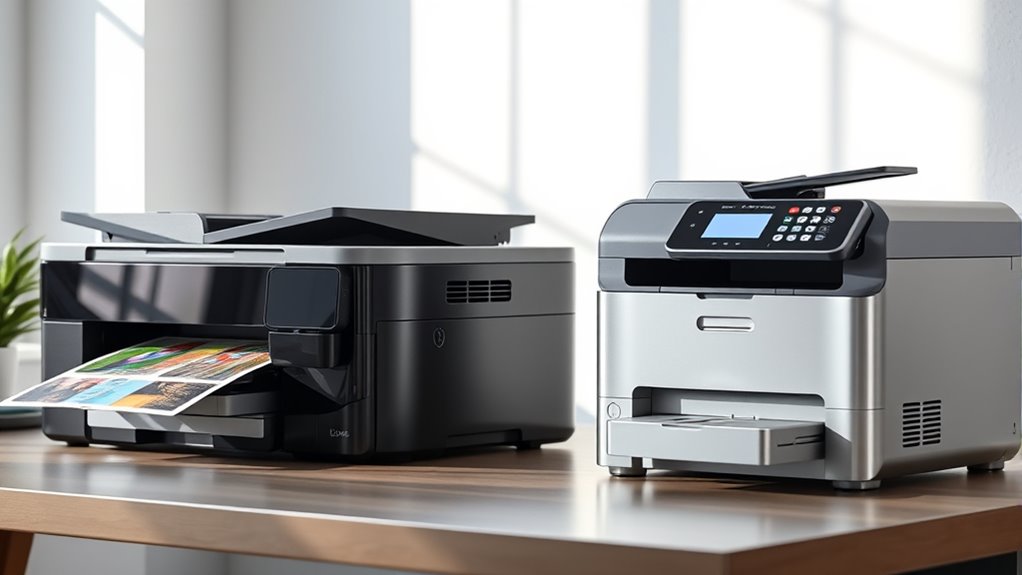
When choosing a printing solution for your business, understanding the differences between inkjet and laser printers is essential. One of the most critical factors to contemplate is printing speed. Laser printers are known for their rapid output, often producing dozens of pages per minute, making them ideal for high-volume tasks. If you frequently handle large batches of documents, a laser printer can save you significant time, ensuring your workflow remains uninterrupted. Inkjet printers, on the other hand, tend to have slower printing speeds, which might be acceptable for occasional or low-volume use but can become a bottleneck if your business demands quick turnaround times. Additionally, laser printers are generally more energy-efficient, which can help reduce operational costs over time.
Cost efficiency is another crucial aspect. Laser printers typically have a higher upfront cost, but they tend to be more economical over time, especially when printing large volumes. They use toner cartridges that last longer and generally cost less per page compared to inkjet cartridges. This means your ongoing expenses for toner are lower, and you won’t need to replace cartridges as frequently. Inkjet printers usually have a lower initial purchase price, but the cost of ink cartridges and their shorter lifespan can add up quickly. If your business prints infrequently or in small quantities, an inkjet might be more budget-friendly initially, but be prepared for higher per-page costs if your printing volume increases.
As an affiliate, we earn on qualifying purchases.
Frequently Asked Questions
Which Printer Type Has Lower Long-Term Maintenance Costs?
You’ll find that laser printers typically have lower long-term maintenance costs because of their superior efficiency and durability. Laser printers handle high-volume printing better, reducing frequent repairs and consumables replacement. Inkjet printers, while cheaper upfront, tend to require more maintenance due to ink drying issues and nozzle clogs. Overall, laser’s efficiency and durability make it a more cost-effective choice for ongoing business needs, saving you money in the long run.
How Do Inkjet and Laser Printers Compare in Print Quality?
You’ll find that inkjet printers excel in color accuracy and print resolution, making them ideal for detailed images and vibrant photos. Laser printers, on the other hand, produce sharp, crisp text with high clarity but may lack the same color depth. If your focus is on high-quality photo printing, inkjets are the better choice. For professional documents, laser printers deliver consistent, clean results with excellent resolution.
Are There Environmental Benefits to Choosing One Over the Other?
You might be surprised, but choosing an eco-friendly option can make a difference. Laser printers often consume less energy, especially in standby mode, making them more eco-friendly overall. However, inkjet printers that use eco-friendly inks reduce chemical waste and pollution. If you prioritize sustainability, consider how energy consumption and environmentally safe inks impact your choice. By weighing these factors, you can select a printer that aligns with your green goals.
Which Printer Type Is Better for High-Volume Printing?
For high-volume printing, laser printers are your best choice. They offer faster print speeds, allowing you to produce large quantities quickly, and handle various paper types with ease. Inkjet printers tend to be slower and may struggle with heavy workloads, leading to delays. By choosing a laser printer, you’ll benefit from increased efficiency and versatility, making it ideal for busy business environments that demand rapid, high-volume output.
What Are the Initial Purchase Price Differences?
You’ll find that laser printers generally have a higher upfront investment compared to inkjet printers. The cost comparison shows laser models often start at a higher price point due to their advanced technology and faster printing speeds. However, this initial cost might be offset by lower printing costs over time. If you need high-volume printing, a laser printer’s durability and efficiency could make it a smarter investment despite the higher upfront price.
As an affiliate, we earn on qualifying purchases.
Conclusion
Choosing between inkjet and laser printers is like picking the right brush for your masterpiece—you want precision, speed, and reliability. Inkjet printers splash vibrant colors and excel in detail, perfect for creative projects, while laser printers fire off pages at lightning speed, ideal for heavy-duty business tasks. Consider your needs carefully; whichever you choose, it’ll be the steady heartbeat of your office. Make your decision, and let your printing process flow smoothly like a well-oiled machine.
As an affiliate, we earn on qualifying purchases.
compact inkjet printer for small office
As an affiliate, we earn on qualifying purchases.
As an affiliate, we earn on qualifying purchases.
Fall Picks
fall essentials
As an affiliate, we earn on qualifying purchases.