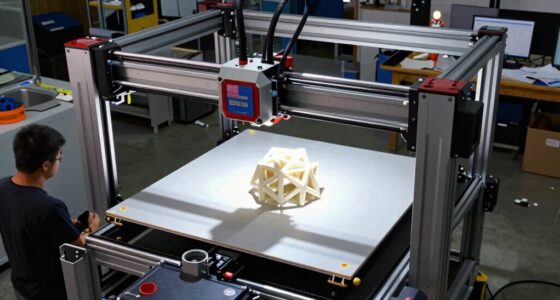
If you’re working with materials like ABS, nylon, or polycarbonate, an enclosed 3D printer with a heated chamber is essential. The heated chamber prevents warping, cracking, and layer separation by maintaining a stable temperature environment. It’s especially important for large or intricate prints where temperature fluctuations can cause failures. If you want consistent, high-quality results with challenging filaments, you’ll find the details about when and why to choose such a system helpful.
Key Takeaways
- When printing high-performance materials like ABS, nylon, or polycarbonate, a heated chamber prevents warping and cracking.
- Enclosed printers are ideal for sensitive environments, minimizing drafts and dust that affect print quality.
- They provide consistent temperature control for large or complex prints, ensuring strong layer adhesion.
- When safety is a priority, the enclosure reduces heat exposure and contains fumes during high-temperature filament printing.
- For achieving high-quality, reliable results with challenging filaments, a heated chamber is essential.
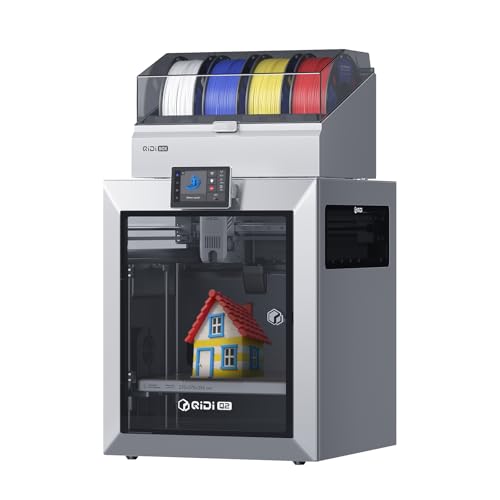
QIDI Q2 Combo 3D Printer, Enclosed FDM with 65℃ Heated Chamber, Ultra Air Filtration, 600mm/s High Speed, AI Camera, Full Auto Leveling, 270x270x256mm Build Volume, from Beginner to Expert
【Unlock Multi-Color & Multi-Material】: QIDI Q2 combo enables up to 16-color multi-material 3D printing with dry-while-print technology, keeping…
As an affiliate, we earn on qualifying purchases.
As an affiliate, we earn on qualifying purchases.
What Are Enclosed 3D Printers and How Do They Work?
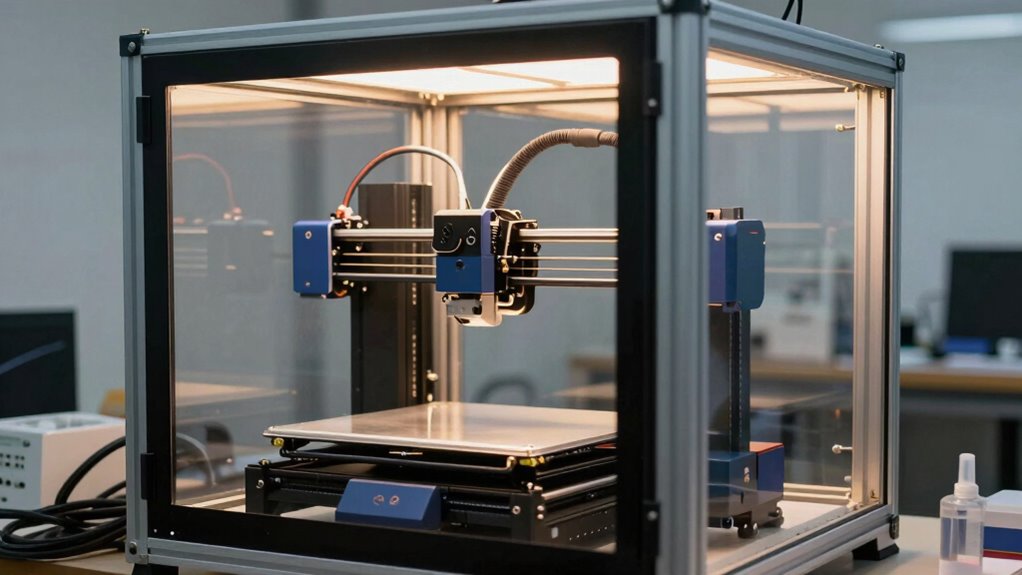
Enclosed 3D printers are machines designed with a protective casing that surrounds the printing area. This enclosure helps maintain a stable environment, which improves material compatibility by reducing warping and adhesion issues. It also enhances energy efficiency by retaining heat, meaning less power is needed to keep the temperature steady. Unlike open models, enclosed printers can better control airflow and temperature, making them suitable for working with sensitive materials like ABS or nylon. The casing also minimizes external influences such as drafts or dust, ensuring consistent print quality. You simply load your filament, set your parameters, and let the enclosure maintain ideal conditions. This design not only improves your print results but also makes the process safer by containing fumes and moving parts. Enclosed print chambers are especially beneficial for achieving high-quality results with challenging materials.

Polymaker HT-PLA Filament 1.75mm Black, High Temp PLA for 3D Printing, Heat Stable Up to 150°C, Easy to Print, Works with Most FDM Printers, 1kg Spool
High Heat Stability – Withstands temperatures up to 150°C, making HT-PLA ideal for prints placed in hot environments…
As an affiliate, we earn on qualifying purchases.
As an affiliate, we earn on qualifying purchases.
Why Do High-Performance Materials Need a Heated Chamber?
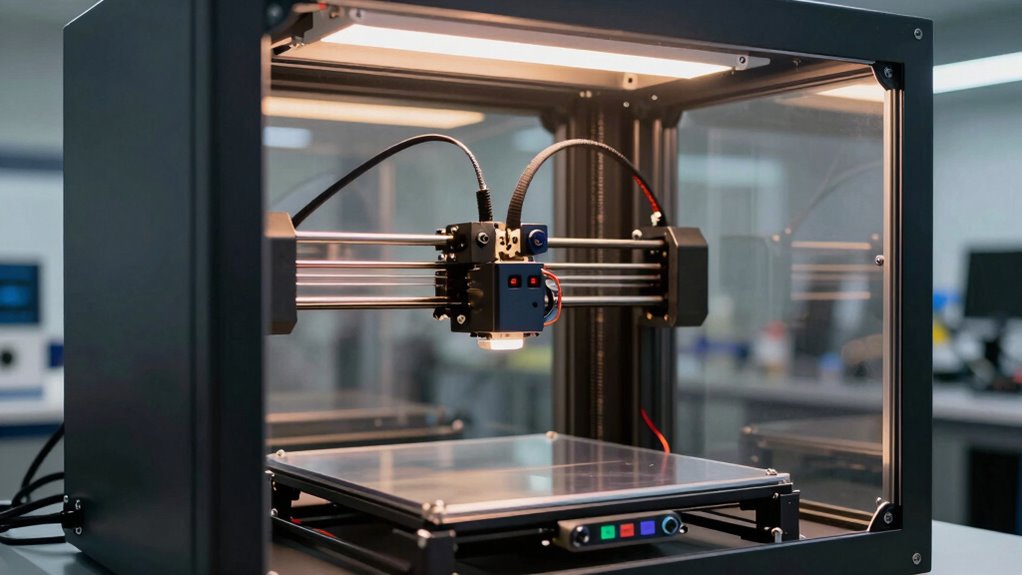
High-performance materials like ABS, nylon, and polycarbonate often require more controlled conditions to produce quality prints. A heated chamber provides essential temperature control, helping these materials adhere better and reduce warping or cracking. Without a consistent environment, fluctuations in temperature can cause incompatible materials to shrink or distort, compromising your print’s integrity. A heated chamber maintains ideal conditions, ensuring material compatibility and reliable layer bonding. It also minimizes residual stresses that lead to defects. By controlling the ambient temperature, you create a stable environment that supports high-performance materials’ unique needs. This control ultimately results in stronger, more precise parts, making a heated chamber indispensable when working with advanced filaments. Temperature stability is crucial for achieving high-quality, professional-grade 3D prints with these advanced materials. Additionally, implementing proper temperature regulation can prevent sudden fluctuations that might compromise print quality, and understanding the importance of thermal management can further optimize your printing results.

YOOPAI 3D Printer Enclosure, Dustproof Tent Constant Temperature Protective Cover for Creality Ender 3 V3 SE/KE/Ender 3/Ender 3 Pro/Ender 3V2/Ender 3 S1/ For Anycubic Elegoo Printers, 29.5×25.6×21.6"
【Improve Print Quality with Constant Temperature】Provides a stable and controlled environment for your prints, maintaining a consistent temperature…
As an affiliate, we earn on qualifying purchases.
As an affiliate, we earn on qualifying purchases.
When Is an Enclosed 3D Printer With a Heated Chamber Necessary?
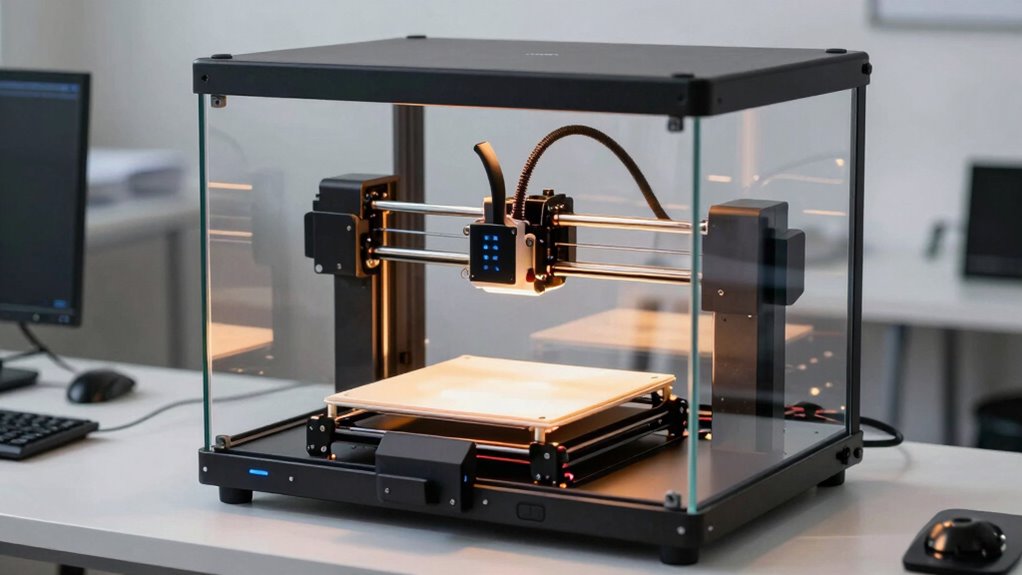
You’ll want an enclosed 3D printer with a heated chamber when working with high-temperature filaments, as they need stable conditions to print successfully. It helps reduce warping and cracking by maintaining a consistent environment throughout the build. If you require reliable results with challenging materials, a heated chamber becomes essential.
High-Temperature Filament Use
When working with high-temperature filaments like ABS, Polycarbonate, or Peek, an enclosed 3D printer with a heated chamber becomes crucial to guarantee successful prints. These materials require higher extrusion and chamber temperatures to ensure proper filament compatibility and adhesion. Without effective chamber insulation, heat loss can cause warping, cracking, or layer separation, ruining your print. An enclosed environment maintains consistent temperatures, reducing thermal gradients. Consider these key points:
- Guarantees filament compatibility by maintaining ideal extrusion temperatures.
- Prevents warping and cracking through stable chamber conditions.
- Enhances layer adhesion for high-performance materials.
- Preserves temperature consistency thanks to chamber insulation, reducing thermal fluctuations.
Using an enclosed 3D printer with a heated chamber is essential when printing with these demanding filaments to achieve reliable, high-quality results.
Reducing Warping and Cracking
Warping and cracking become significant issues when printing with high-temperature or dimensional-sensitive filaments, especially if your printer lacks an enclosed chamber. These problems often stem from uneven cooling and rapid temperature drops, which cause internal stresses. Choosing filament compatibility is essential; materials like ABS, PETG, and Nylon are more prone to warping without proper heat retention. A well-designed chamber helps maintain a consistent environment, reducing temperature fluctuations that lead to warping and cracking. Chamber design plays an important role—insulated walls, controlled airflow, and heated beds work together to stabilize the print’s surroundings. If you’re working with challenging filaments or detailed parts, an enclosed 3D printer with an effective heated chamber becomes necessary to improve print quality and prevent defects. Proper temperature regulation within the chamber ensures optimal adhesion and reduces the chances of warping.
Consistent Print Environment
A consistent print environment is crucial whenever you work with high-performance or temperature-sensitive filaments, as fluctuations can compromise print quality. An enclosed print chamber helps maintain stable conditions, guaranteeing material stability during printing. Without it, temperature swings can cause warping, layer separation, or poor adhesion. Consider these key points:
- Achieving uniform temperature inside the print chamber prevents warping.
- Maintaining stable heat improves material stability for complex prints.
- Reducing external airflow minimizes temperature fluctuations.
- Consistent conditions lead to better adhesion and enhanced print quality.
- Smart lock technology can be integrated into enclosed 3D printers to enhance security and control access.
- An enclosed chamber also helps protect sensitive components from drafts and dust, further improving print reliability.
- Implementing temperature regulation systems can further optimize the environment for critical materials.
- Incorporating environmental controls such as humidity management can also be beneficial for certain filament types.
If your projects demand precision, an enclosed 3D printer with a heated chamber is indispensable. It ensures a controlled environment, minimizes print failures, and delivers reliable, high-quality results every time.

Creality 3D Printer Heater, PTC Chamber Heater 400W – 45-70°C, Filament Drying, Reduces Warping, Dual Safety Protection, Mini Heater Temp Control for LCD/DLP/FDM 3D Printers
Efficient Chamber Heating:70°C high-temperature hot air circulation. Equipped with a 400W PTC heater and dual axis fans, it…
As an affiliate, we earn on qualifying purchases.
As an affiliate, we earn on qualifying purchases.
What Features Should You Look for in an Enclosed 3D Printer With a Heated Chamber?
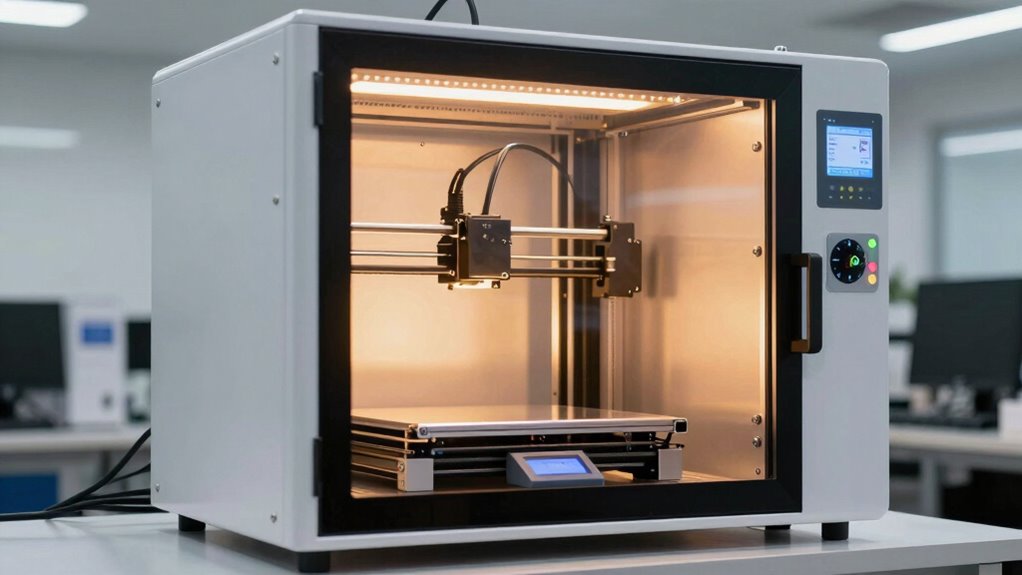
Choosing the right enclosed 3D printer with a heated chamber means prioritizing features that enhance print quality and reliability. Look for a machine with broad material compatibility, so you can print with different filaments like ABS, PETG, or nylon without issues. A heated chamber that maintains consistent temperature helps prevent warping and improves adhesion. Energy efficiency is also key—select a model with good insulation and smart temperature controls to reduce power consumption. Additionally, check for reliable temperature sensors and a user-friendly interface for easy adjustments. Robust build quality and safety features are essential too, ensuring your prints are safe and consistent. Incorporating luxury-grade components can also significantly improve durability and performance. Proper thermal management within the printer can help maintain consistent print conditions and extend equipment lifespan. Paying attention to temperature stability features can further ensure high-quality, reliable results. By focusing on these features, you’ll maximize your printer’s performance and produce high-quality, durable parts.
How Does a Heated Chamber Help Prevent Warping and Cracking?
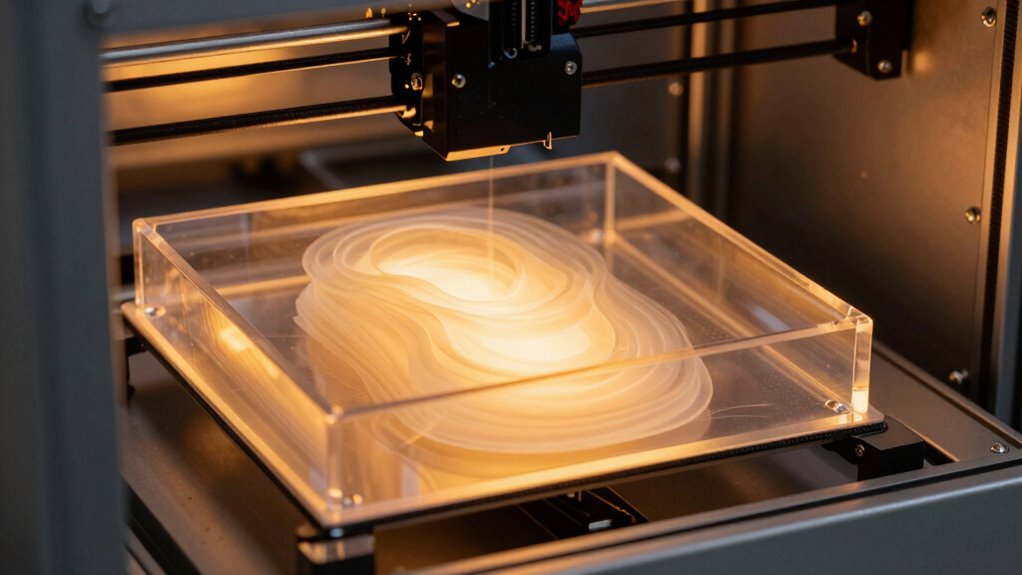
A heated chamber keeps the entire print at a consistent temperature, reducing temperature gradients that cause warping and cracking. By minimizing material stress, it helps your prints stay intact and strong throughout the process. Plus, it guarantees better adhesion between layers, resulting in higher-quality results. Additionally, maintaining a stable environment can improve the appearance of your final product by reducing surface imperfections caused by temperature fluctuations, which is essential for achieving professional-looking finishes. Incorporating a heated chamber can also enhance print reliability, especially when working with complex or large models. Maintaining a stable thermal environment is crucial for preventing issues like layer separation and ensuring consistent print quality. Proper temperature control is an important consideration for achieving optimal 3D print results. Furthermore, a heated chamber can assist in managing print warping by maintaining uniform heat distribution throughout the printing process.
Reduces Temperature Gradients
When you use a heated chamber in your 3D printer, it actively maintains a consistent temperature around your print, which considerably reduces temperature gradients. This temperature stability minimizes uneven cooling that can cause warping or cracking. Proper airflow management within the chamber guarantees heat is evenly distributed, preventing hotspots or cold spots that could lead to defects. To maximize benefits, consider these key points:
- Keeps the entire print at a uniform temperature, reducing internal stresses.
- Prevents sudden temperature shifts that cause warping.
- Ensures consistent heat distribution through controlled airflow.
- Maintains a stable environment, especially for temperature-sensitive materials. Additionally, a well-designed heated chamber can extend the lifespan of your printer components by reducing thermal stress. Keep in mind that thermal management is crucial for achieving high-quality, durable prints and reliable operation over time.
Minimizes Material Stress
A heated chamber actively maintains a consistent temperature around your print, which considerably reduces the material stresses that lead to warping and cracking. By controlling the environment, it helps prevent uneven cooling that can cause these issues. This benefit is especially important for filament compatibility, as some materials like ABS or nylon are prone to warping without stable heat. Additionally, an enclosed chamber can minimize chamber noise, creating a quieter workspace while maintaining steady conditions. When the temperature stays uniform, your filament experiences less internal stress, resulting in stronger, more precise parts. This stability reduces the risk of cracks or deformation during printing. Overall, a heated chamber ensures better print quality by managing the thermal environment to match your filament’s requirements. Environmental control is essential for optimizing print outcomes and reducing material waste. Proper temperature regulation is crucial for achieving consistent results, especially when working with sensitive filaments. Furthermore, thermal stability within the chamber can enhance adhesion between layers, leading to smoother surfaces and improved structural integrity. In addition, maintaining a stable thermal environment can also help in reducing print failures caused by sudden temperature fluctuations. Implementing thermal management techniques can further enhance overall print success and material efficiency.
Ensures Consistent Adhesion
Because a heated chamber keeps the printing environment stable, it helps your filament adhere more reliably to the build surface. Proper temperature regulation prevents sudden shifts that cause warping or cracking. Good airflow management ensures even heat distribution, avoiding cold spots that weaken adhesion. To maximize this benefit, consider these factors:
- Consistent chamber temperature to prevent warping.
- Controlled airflow to promote uniform heat.
- Reduced temperature fluctuations during printing.
- Better adhesion for complex geometries and large prints.
Which Materials Benefit Most From Enclosed, Heated Environments?
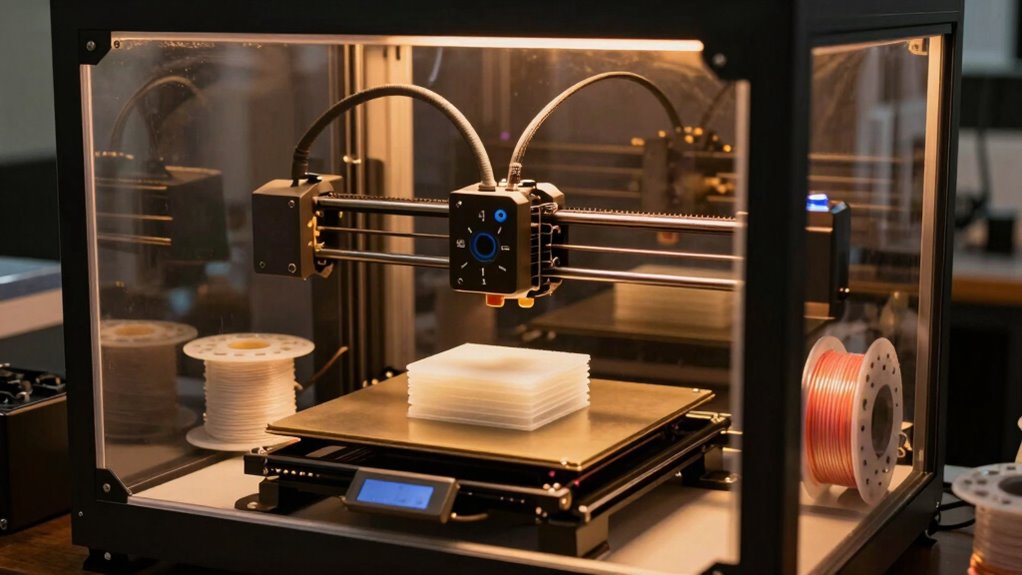
Have you ever wondered which 3D printing materials gain the most from enclosed, heated environments? If so, you’ll find that filament compatibility plays a key role. Materials like ABS, nylon, and polycarbonate benefit markedly because they tend to warp or crack without proper temperature control. The heated chamber maintains consistent temperatures, reducing stress on these filaments during printing. Chamber size also matters—larger chambers better accommodate bigger or multiple parts, ensuring uniform heat distribution. Enclosed environments help prevent drafts and temperature fluctuations, making these materials easier to print with high quality. If you frequently work with temperature-sensitive filaments, investing in an enclosed, heated chamber can expand your material options and improve your overall printing success.
Enclosed vs. Open-Frame 3D Printers: Pros and Cons
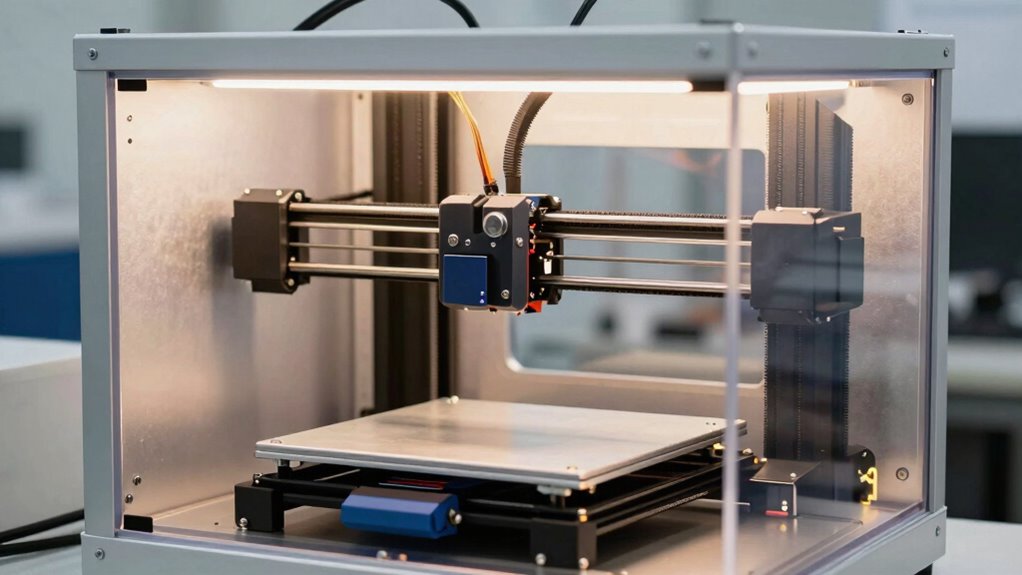
Enclosed 3D printers offer significant advantages in controlling temperature, which can lead to higher-quality prints, but they also come with some drawbacks compared to open-frame models.
Consider these key points:
- Filament storage is more secure in enclosed setups, reducing moisture exposure.
- Print speed may be slower due to the need to maintain a stable chamber environment.
- Enclosed printers often require less post-processing for warping and layer adhesion.
- Open-frame models provide easier access for maintenance and quicker filament changes, but can be more prone to temperature fluctuations.
While enclosed models excel at temperature stability, they might limit airflow and cooling, impacting print speed and convenience. Your choice depends on balancing print quality with accessibility and workflow demands.
How to Set Up and Maintain Your Heated Chamber for Best Results

To get the best results from your heated chamber, you need to set proper temperature levels that match your filament and print type. Ensuring effective insulation keeps the heat steady and reduces energy waste, while regular maintenance prevents issues down the line. By staying attentive to these points, you’ll maintain a reliable environment for high-quality prints.
Proper Temperature Settings
Setting the right temperature for your heated chamber is crucial for successful 3D printing with enclosed printers. Proper temperature ensures filament compatibility and adherence to safety regulations, preventing warping and layer issues. To maximize settings:
- Check filament manufacturer recommendations for ideal chamber temperatures.
- Start with a moderate temperature, around 50-60°C, then adjust based on print quality.
- Monitor the chamber regularly to avoid overheating, which could breach safety regulations.
- Use a thermometer to verify consistent temperature and prevent filament degradation or safety hazards.
Effective Chamber Insulation
Ever wonder how to keep your heated chamber consistently warm and efficient? The key is effective chamber insulation. Proper insulation prevents heat loss, ensuring your printer maintains a stable temperature ideal for filament compatibility. Start by sealing gaps around doors and panels with high-quality insulation materials like foam or silicone gaskets. Use reflective insulation on the chamber walls to reflect heat inward. Insulating the base and top also helps. Avoid thin or uneven insulation, which can cause temperature fluctuations. Regularly check for gaps or wear that could compromise insulation performance. Maintaining a well-insulated chamber reduces energy use and improves print quality, especially with temperature-sensitive filaments. Consistent chamber temperature directly impacts filament adhesion, layer bonding, and overall print success.
Regular Maintenance Practices
Maintaining your heated chamber regularly is essential for consistent 3D printing results. Proper upkeep guarantees ideal filament compatibility and reliable print bed leveling. Here are four key practices:
- Inspect and clean the print bed to prevent adhesion issues and ensure accurate leveling.
- Check filament compatibility regularly, replacing materials that cause clogs or print failures.
- Calibrate print bed leveling after any chamber adjustments or repairs to maintain a uniform print surface.
- Monitor chamber insulation and heating elements for wear or damage, replacing parts as needed to keep temperatures stable.
Common Problems With Heated Chambers and How to Fix Them
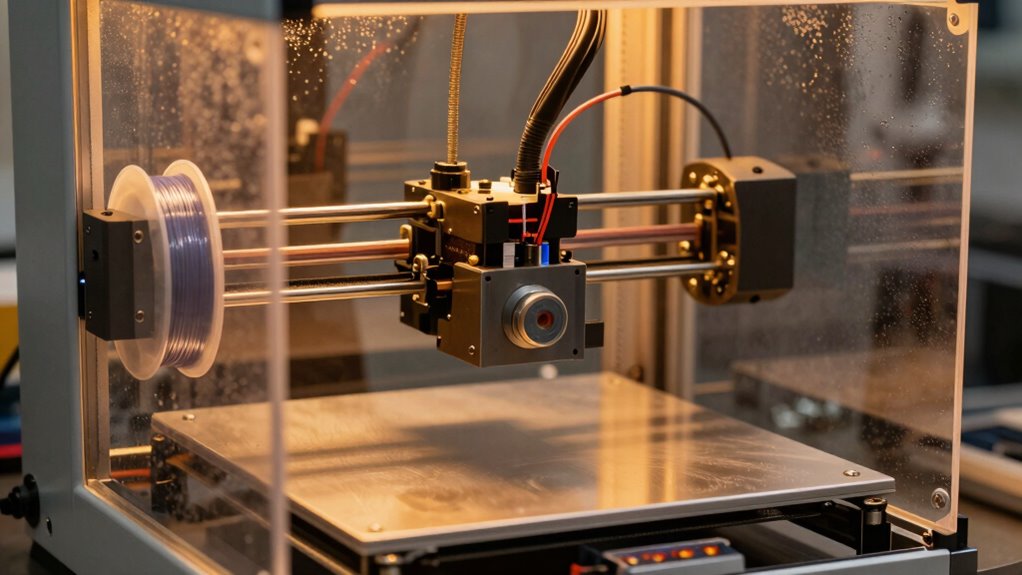
Heated chambers are essential for high-quality 3D printing, but they often come with common issues that can disrupt your workflow. One problem is filament compatibility; some filaments don’t perform well at elevated temperatures, causing warping or poor adhesion. Additionally, chamber noise can become a distraction, especially if the heater or fan units are loud. To address these issues, check filament specifications to confirm compatibility with your chamber’s temperature range. For noise, consider upgrading fans or isolating the chamber to reduce sound levels. Here’s a quick troubleshooting guide:
| Problem | Cause | Fix |
|---|---|---|
| Filament warping | Incompatible filament or temp | Use filament suited for chamber temp |
| Excess chamber noise | Fan or heater issues | Upgrade to quieter components |
| Poor adhesion | Inadequate temperature control | Calibrate chamber temperature |
| Temperature fluctuation | Faulty sensors | Replace or recalibrate sensors |
| Uneven heating | Insulation deficiencies | Improve chamber insulation |
Is Investing in an Enclosed 3D Printer With a Heated Chamber Worth It for Your Projects?

Are you wondering whether investing in an enclosed 3D printer with a heated chamber is worth it for your projects? The answer depends on your needs. Here are four reasons it could be a smart move:
- Improved filament compatibility, especially with materials like ABS and ASA that require stable temperatures.
- Better printer calibration, leading to more accurate and consistent prints.
- Reduced warping and cracking, saving you time and filament costs.
- Enhanced safety, especially when working with high-temperature filaments.
If your projects demand precise, high-quality results and you frequently print challenging materials, an enclosed printer with a heated chamber is a worthwhile investment. It streamlines your process and improves overall print quality.
Frequently Asked Questions
How Energy-Efficient Are Enclosed 3D Printers With Heated Chambers?
Enclosed 3D printers with heated chambers are quite energy-efficient because their insulation efficiency minimizes heat loss, reducing energy consumption. You’ll notice that maintaining a stable temperature requires less power, saving you money over time. Proper insulation keeps heat contained, so the printer uses less energy to reach and sustain ideal conditions. Overall, these printers are designed to maximize energy use while ensuring high-quality prints.
Can I Retrofit My Existing 3D Printer With a Heated Chamber?
Think of your printer as a ship ready for a new voyage—adding a heated chamber is possible if your model’s retrofit compatibility permits it. You’ll need to focus on chamber insulation to keep heat steady and prevent energy leaks. Before starting, check your printer’s specifications and confirm you can customize the enclosure. With the right upgrades, you’ll transform your machine into a controlled environment that elevates your printing precision.
What Safety Precautions Are Necessary When Operating Heated Chambers?
When operating a heated chamber, you should prioritize fire safety and avoid electrical hazards. Always make certain proper ventilation and keep a fire extinguisher nearby. Check electrical connections regularly for damage or loose wiring, and avoid overloading circuits. Use the chamber within manufacturer guidelines, and never leave it unattended during operation. Wearing protective gear and keeping flammable materials away further reduces risks, ensuring safe and effective printing.
How Does Ambient Room Temperature Affect Enclosed 3D Printing?
Imagine your print’s fate hanging in the balance—ambient room temperature effects matter. When your room is too cold or hot, it impacts chamber insulation considerations, making it harder to maintain consistent temperatures. This fluctuation can lead to warping or print failures. Keep your environment stable, and you’ll help your enclosed 3D printer perform at its best, ensuring smoother, higher-quality results every time.
Are There Maintenance Tips to Extend the Lifespan of Heated Chambers?
To extend your heated chamber’s lifespan, regularly perform calibration procedures to guarantee ideal temperature control. Keep the chamber clean and free of debris, and inspect components like heating elements and sensors for wear or damage. When necessary, replace worn-out components promptly to prevent further issues. Proper maintenance, including calibration and timely component replacement, helps maintain consistent performance and prolongs the life of your heated chamber.
Conclusion
So, unless you enjoy watching your fancy high-performance prints turn into warped disasters or crack like dry earth, investing in an enclosed 3D printer with a heated chamber is pretty much a no-brainer. Save yourself the frustration, the wasted filament, and the heartbreak. After all, who wouldn’t want a tiny, heated fortress protecting their precious creations from the cruel, warping world? Your prints deserve a cozy, warping-free home—trust us, they’ll thank you.