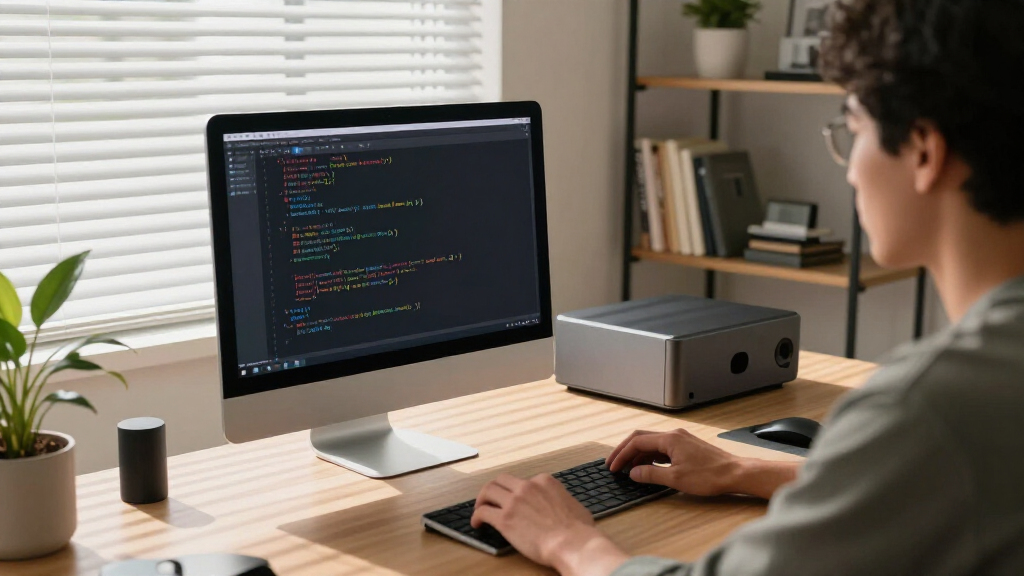

TL;DR

Get business pricing on monitors, keyboards and dev gear
- Business-only prices and quantity discounts
- Tax-exempt purchasing
- Multiple users, one account, clear invoices
Apple’s new Mac Studio with 512GB of unified memory can load frontier-scale AI models locally. However, actual running speed and scalability depend on bandwidth and compute, not just memory capacity.
Apple’s recently announced Mac Studio with 512GB of unified memory can load frontier-scale AI models locally, marking a significant development for AI practitioners seeking local hardware solutions. This capability is confirmed, but its practical performance and limitations are still being evaluated by experts and early adopters. The announcement positions the machine as a potential game-changer for small-scale AI experimentation and privacy-sensitive inference, but it does not mean it can replace high-end data center GPUs for all workloads.
On August 25, 2026, Apple unveiled the Mac Studio M5 Ultra, a desktop workstation equipped with up to 512GB of unified memory and a powerful 80-core GPU, designed to handle large AI models locally. The machine’s key feature is its ability to load models that previously required multiple datacenter GPUs, thanks to the large shared memory pool. The 512GB configuration, which will be available in late October at a price exceeding $10,000, is built by connecting two M5 Max chips via Apple’s UltraFusion interconnect, effectively creating a quad-die processor with integrated neural accelerators.
Apple claims the M5 Ultra delivers up to 4.3x faster AI performance than the M3 Ultra and nearly 10x faster than the M1 Ultra in some benchmarks. However, these figures are based on Apple’s internal tests, and independent benchmarking on real workloads is still pending. The machine’s primary advantage lies in its capacity to load large models—up to hundreds of billions of parameters—directly into shared memory, enabling local experimentation and development without cloud dependency.
Implications for Local AI Model Deployment
The ability to load frontier-scale models locally on a desktop machine significantly lowers barriers for research, development, and privacy-focused AI work. Small teams and individual researchers can now experiment with large models without relying on cloud services or expensive datacenter hardware. This shift could democratize access to cutting-edge AI, enabling more innovation at the individual or small-team level. However, the machine’s true value depends on its performance in real-world scenarios, which remains to be fully tested outside Apple’s benchmarks.
As an affiliate, we earn on qualifying purchases.
Background on Apple Silicon and AI Capabilities
Apple’s transition to custom silicon with the M-series chips has steadily increased AI processing capabilities on the desktop. Previous models like the M1 Ultra already supported large memory pools and neural accelerators, but the new M5 Ultra doubles down with a 512GB unified memory and a multi-chip design that combines two M5 Max units. This architecture enables the machine to address large models directly, a feature previously limited to specialized hardware. While Apple’s marketing emphasizes the capacity to load large models, actual inference speed and scalability remain critical factors for practical use.
Prior to this, running large AI models locally was largely confined to high-end server hardware or specialized workstations. The new Mac Studio blurs this line, offering a desktop solution that can handle models previously thought to require datacenter resources. Still, the performance of such models in real-world workloads depends heavily on memory bandwidth and compute throughput, which are not unlimited.
“The Mac Studio M5 Ultra is designed to empower developers and researchers with desktop-class AI capabilities, enabling local experimentation with frontier-scale models.”
— Apple spokesperson
As an affiliate, we earn on qualifying purchases.
Performance and Practicality in Real-World Use
It remains unclear how the Mac Studio will perform with actual large models outside controlled benchmarks. Independent benchmarks are not yet available, and real-world inference speeds, especially for multi-user or production workloads, are still unknown. Additionally, software maturity for AI workflows on Apple silicon is evolving, which may impact usability and compatibility for certain models or frameworks.
As an affiliate, we earn on qualifying purchases.
Upcoming Benchmarks and User Experiences
Expect independent testing of the Mac Studio’s AI performance in the coming weeks. Early adopters and AI researchers will likely publish benchmarks and case studies, clarifying its practical capabilities. Software updates from Apple and third-party developers will also influence how well the machine handles large models and complex workflows. The market will determine if this hardware can truly replace or supplement traditional GPU clusters for small-scale AI deployment.
high memory desktop computer for AI
As an affiliate, we earn on qualifying purchases.
As an affiliate, we earn on qualifying purchases.
Key Questions
Can the Mac Studio run any frontier-scale AI model?
It can load models up to the capacity of its 512GB unified memory, but actual inference speed and usability depend on bandwidth and compute power. Running large models efficiently is still subject to hardware limitations.
Is this a replacement for datacenter GPU clusters?
Not entirely. While it can load large models locally, its throughput and scalability are limited compared to dedicated GPU clusters. It is best suited for experimentation and small-scale deployment.
Will software support be sufficient for all AI workflows?
AI software on Apple silicon has improved but is not yet as mature as on traditional GPU platforms. Some workflows may require porting or may run better on other hardware.
How much does the 512GB configuration cost?
The 512GB model is expected to cost around $10,800 before storage upgrades, with preorders open and general availability in late October 2026.
When will independent performance benchmarks be available?
Early benchmarks are expected within weeks of release, providing clearer insights into real-world inference speeds and practical usability.
Source: ThorstenMeyerAI.com
Halloween Picks
halloween
As an affiliate, we earn on qualifying purchases.