
📊 Full opportunity report: Could This Workflow Be Automated? How To Assess It on IdeaNavigator AI — validation score, market gap, and execution plan.

Get business pricing on monitors, keyboards and dev gear
- Business-only prices and quantity discounts
- Tax-exempt purchasing
- Multiple users, one account, clear invoices
TL;DR
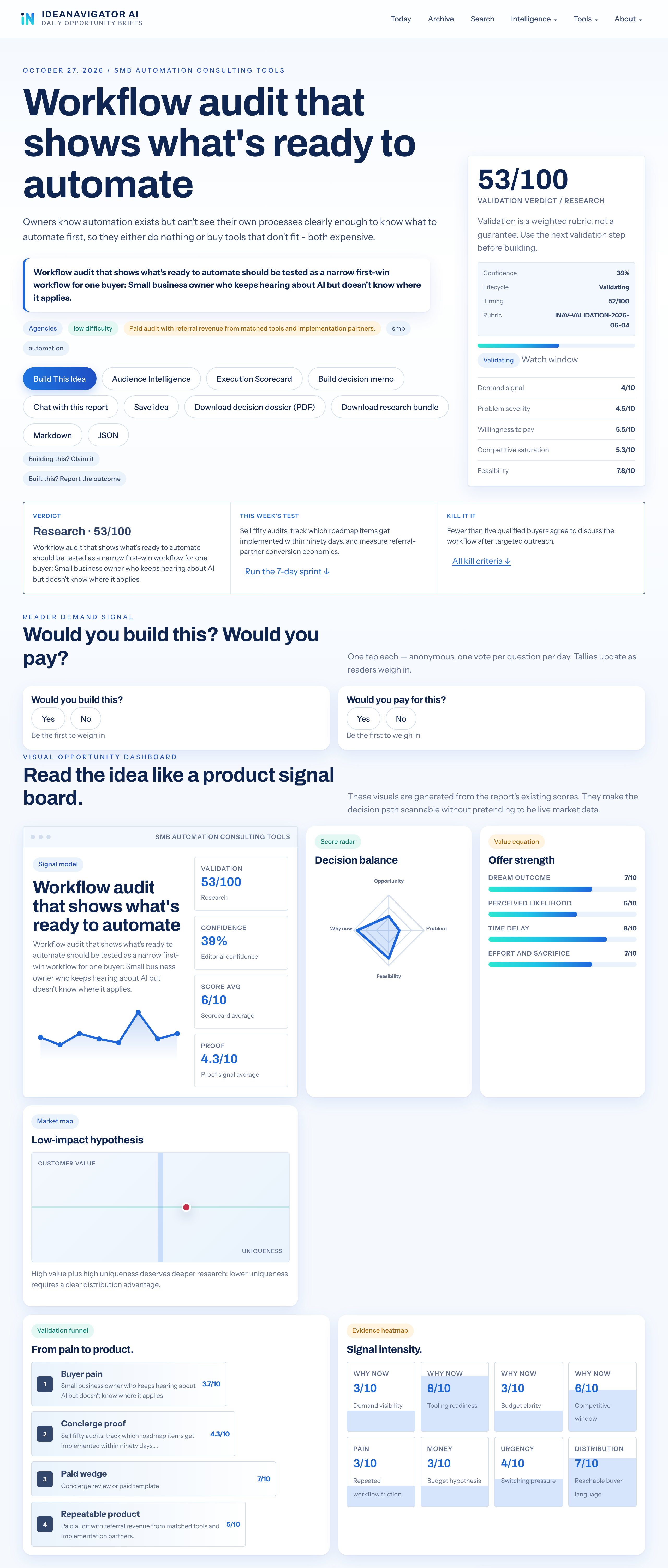
IdeaNavigator AI describes a proposed workflow-audit product for small-business owners who are unsure where automation fits. The concept would use a guided interview to map processes, score automation readiness, return a 90-day roadmap and suggest tools; its demand and results have not yet been established.
IdeaNavigator AI has proposed a guided workflow audit to help small-business owners identify which tasks may be suitable for automation, but the product remains a concept rather than a reported, tested service. According to the company’s proposal, the audit would map a business’s operations, rank processes by automation readiness, potential return and difficulty, then offer a sequenced 90-day roadmap with suggested tools.
IdeaNavigator AI frames the idea around owners who hear about AI and automation but are unsure where those technologies could fit into their operations. The proposal says that without a clear view of existing processes, owners may delay action or purchase tools that do not suit their needs. These are the company’s stated reasons for developing the product, not findings from a published customer study.
Under the proposed minimum viable product, an owner would be interviewed about how the business operates, and the answers would be used to create a process map. IdeaNavigator AI says each process would be scored for automation readiness, estimated return on investment and implementation difficulty. The resulting roadmap would prioritize possible steps across 90 days and match recommendations with tools or implementation partners.
IdeaNavigator AI proposes combining a paid audit with referral revenue when customers select matched products or partners. The company says it would test the concept by selling 50 audits and tracking which recommendations are implemented within 90 days, alongside conversion economics for referral partners. The proposal provides no sales, implementation or revenue results.
Workflow Audit · Concept Review
Could This Workflow Be Automated?
IdeaNavigator AI proposes a guided audit to help small-business owners map operations, assess automation readiness, and plan possible changes. The service is still a concept; demand and results have not been established.
01 / The proposed product
From operations to a prioritized roadmap
The concept is aimed at owners who know automation may help but are unsure which workflow to examine, what it could cost, or whether the payoff would justify the effort.
Guided interview
Ask the owner how the business operates and collect details about recurring work and existing processes.
Score each process
Rank workflows by automation readiness, estimated return on investment, and implementation difficulty.
Sequence the work
Deliver a 90-day roadmap with suggested tools or implementation partners matched to possible changes.
02 / Proposed customer journey
How the audit is meant to work
Map the work
Interview the owner about operations and recurring tasks.
Evaluate fit
Estimate readiness, potential return, and difficulty.
Build a plan
Prioritize possible workflow changes across 90 days.
Track adoption
Observe which roadmap recommendations customers implement.
03 / What the proposal establishes
A useful idea still needs evidence
The company’s rationale is that owners face many automation options without a clear picture of their own workflows. That rationale is not a published customer study or a technical evaluation.
Potential value for owners
A structured assessment could make decisions more concrete by connecting a process to expected effort, possible return, and a practical next step. A roadmap may also help owners avoid buying tools before understanding the work they need to improve.
Its usefulness depends on whether the process map reflects actual operations and whether recommended tools work with existing systems. The scoring method would need clear definitions so customers can compare recommendations meaningfully.
The proposal defines a product idea and test; customer outcomes have not been reported.
Important commercial question
The proposed business model combines a paid audit with referral revenue when customers select matched tools or partners. That can create an incentive to recommend commercial partners.
Clear disclosure of referral arrangements and an explanation of how options are matched would help owners judge whether suggestions reflect business fit, commercial relationships, or both.
04 / Open questions
Demand, accuracy, and payback remain unknown
The proposal does not provide the details needed to estimate whether this paid service would work for businesses with different budgets, staffing, and software systems.
No audit price, completed sales, or customer demand figures are reported.
No method is given for verifying interview answers or handling variation between employees.
Technical feasibility alone does not show that savings exceed setup costs and staff time.
No confirmed partner agreements or referral conversion results are reported.
05 / Validation plan
A 50-audit pilot would test fit
IdeaNavigator AI says it would sell 50 audits, track which recommendations are implemented within 90 days, and measure conversion economics for referral partners.
This is a planned experiment, not a completed pilot. The company has reported no launch date, completed sales, or results.
At a glance / Evidence status
What is known—and what is not
| Topic | Current information | Status |
|---|---|---|
| Product | Guided workflow audit, readiness scoring, and a 90-day roadmap are proposed. | Proposed |
| Validation | Plan to sell 50 audits and track implementation and referral conversion. | Planned |
| Customer results | No reported sales, implementation rates, savings, or measured outcomes. | Unknown |
| Commercial viability | No reported referral conversion figures or confirmed partner agreements. | Unknown |
Testing Automation Advice With Owners
The proposal addresses a practical gap between the availability of automation products and a small business’s ability to choose among them. An owner may recognize that repetitive work could be automated without knowing which process to examine, what a change would cost, or whether the expected savings justify the effort. A structured audit could make that decision more concrete, if its assessment is reliable.
For buyers, the distinction between a ranked recommendation and a demonstrated business result matters. A roadmap can help organize decisions, but its value depends on whether it reflects the owner’s actual processes and whether recommended tools work with existing systems. Tracking implementations over 90 days, as IdeaNavigator AI proposes, would offer an initial signal of whether customers act on the advice; it would not, by itself, establish long-term savings or prove that the audit caused better outcomes.
The proposed referral model also creates a question for customers: recommendations may generate revenue for the service provider. Clear disclosure of referral arrangements and an explanation of how options are matched would help owners judge whether suggestions are based on fit, commercial relationships or both.
Products Worth Considering

Anker SOLIX C200 DC Portable Power Station, 192Wh, 200W

DJI Osmo Mobile 8 3-Axis Smartphone Gimbal Stabilizer

LG 34GX90SA-W 34-inch Ultragear WQHD OLED Curved Gaming Monitor
As an affiliate, we earn on qualifying purchases.
From AI Interest to Process Mapping
IdeaNavigator AI’s proposal links the concept to the expansion of AI tools, which it says has increased decision pressure for small businesses. The company argues that guided process-mapping interviews may now be easier to automate with large language models. This is the proposal’s rationale; it supplies no comparative evidence or technical evaluation showing how accurately an automated interview would capture a business’s operations.
The idea sits within the broader market for small-business automation consulting tools. Unlike a general-purpose AI assistant, the proposed service would focus on diagnosing workflows and sequencing possible changes. Its central product, as described by IdeaNavigator AI, is not simply a list of software options, but an assessment that links processes to readiness, likely returns and difficulty. Those scores would need clear definitions for owners to compare recommendations meaningfully.
IdeaNavigator AI’s proposed validation approach is narrow: sell 50 audits, observe which roadmap items are implemented within 90 days, and measure referral-partner conversion economics. That is a proposed experiment, not evidence that the product has already reached customers or that its recommendations produce savings.
Demand, Accuracy and Payback
Because IdeaNavigator AI has not provided reported test results, several core questions remain unanswered. The proposal does not explain how the interview would verify details, handle processes that vary from one employee to another, or distinguish a task that is technically automatable from one that is worthwhile to automate.
The proposal gives no audit price, definition of the scoring method, or data on how often owners implement recommendations. It also does not quantify expected savings, setup costs or the time required from staff. Those details are necessary to judge whether a paid assessment would be useful to businesses with different sizes, budgets and software systems.
IdeaNavigator AI reports no confirmed partner agreements or referral-conversion figures. Until a pilot is completed, it remains unknown whether owners will pay for this kind of advice, whether recommended tools fit their needs, and whether referral income can support the service without distorting recommendations.
A 50-Audit Pilot Would Test Fit
IdeaNavigator AI says the next stated step is to sell 50 audits and follow the recommended roadmap items for 90 days. The proposed test would record which steps customers put into practice and measure how referrals to tools or implementation partners convert. The company has announced no launch date, completed sales or results in the information available.
For the test to answer more than whether customers click a recommendation, useful reporting would distinguish implementation from adoption and measure outcomes such as time saved, operating costs or errors, where those can be tracked. It would also help to report how the audit’s scores are calculated and whether customers receive alternatives when a referral partner is not suitable.
Until such results are available, the workflow audit should be understood as a product proposal with a defined validation plan, not a proven route to savings. Evidence from paid customers and follow-up would show whether the process map changes decisions and whether the referral model is commercially viable.
Source: IdeaNavigator AI
Key Questions
What is the proposed workflow audit?
According to IdeaNavigator AI, it is a proposed guided interview for small-business owners. The service would map operations, score processes for automation readiness, return and difficulty, and provide a 90-day roadmap with tool suggestions.
Is the audit already available or proven?
IdeaNavigator AI describes a product concept and a proposed validation test. Its information does not report a launch, completed customer sales or measured results.
How would the idea be tested?
IdeaNavigator AI proposes selling 50 audits, tracking which roadmap recommendations customers implement within 90 days, and measuring referral-partner conversion economics.
How would the service make money?
The proposed model combines fees for paid audits with referral revenue from tools and implementation partners matched to recommendations. IdeaNavigator AI reports no prices or partner conversion figures.
What should small-business owners look for before relying on an audit?
Owners would need to understand how readiness and return scores are calculated, what implementation could cost, and whether referral relationships are disclosed. IdeaNavigator AI’s proposal does not yet provide those details.
Source: IdeaNavigator AI