

📊 Full opportunity report: Every New Car In The EU Now Ships With A Driver Monitoring Camera Onboard on IdeaNavigator AI — validation score, market gap, and execution plan.

Get business pricing on monitors, keyboards and dev gear
- Business-only prices and quantity discounts
- Tax-exempt purchasing
- Multiple users, one account, clear invoices
TL;DR
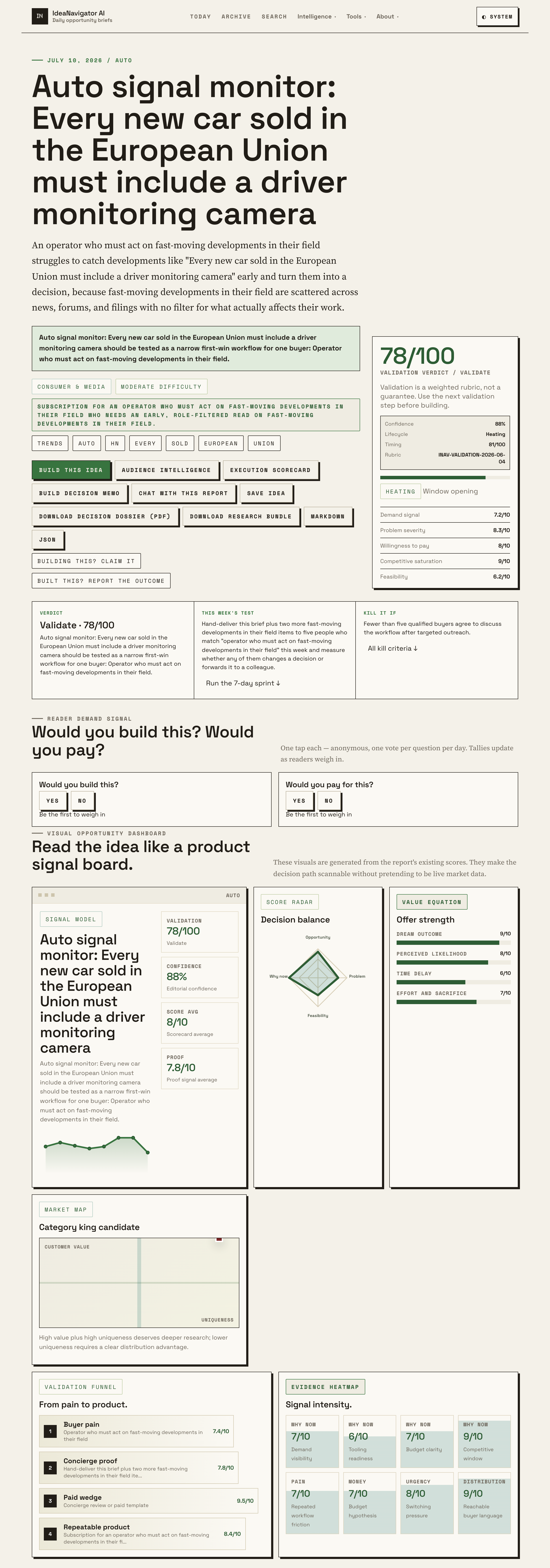
Safety regulations now in force across the European Union require new cars to include driver monitoring capability, a development flagged as a high-signal item by IdeaNavigator AI. Cameras are one way manufacturers meet the rule, but camera-free methods also qualify, so the claim that every new car ships with a camera is not established.
Driver monitoring technology is now a standard feature of new cars sold in the European Union under safety regulations that took effect for all new vehicle registrations in July 2024, a development recently flagged as a high-signal item by the trend-tracking service IdeaNavigator AI. The claim circulating in technology discussion forums — that every new EU car ships with an onboard driver monitoring camera — is only partially accurate: the rules mandate that cars detect driver fatigue and distraction, but manufacturers may comply using camera-free methods, and it is not publicly documented which approach each model uses.
The underlying regulation is the EU’s revised General Safety Regulation (GSR II), which made a package of advanced driver assistance systems mandatory on new vehicles. From July 2022, newly type-approved vehicle models had to include systems such as driver drowsiness and attention warning (DDAW), and from July 2024 the requirement extended to all new cars registered in the EU, not just newly approved types. The regulation also mandates intelligent speed assistance, lane-keeping assistance, event data recorders, and emergency stop signals.
The specific wording of the requirement matters. The GSR requires vehicles to warn the driver when fatigue or distraction is detected, and driver distraction warning became mandatory for new vehicle types from January 2025 under a staged timeline. Regulation permits several technical routes to compliance: camera-based systems that watch the driver’s eyes and head position, as well as steering-pattern analysis that infers drowsiness from how the driver handles the wheel. Many camera-based systems also operate only at certain speeds or in specific conditions.
According to IdeaNavigator AI, which surfaced the topic after it drew strong engagement on Hacker News with a measured signal score of 88 out of 100, the development is significant enough that operators in the automotive sector need same-day awareness rather than weekly summaries. The service attributed the topic’s traction to fast-moving regulatory change in the auto industry, though it did not independently verify the camera claim itself.
Why Fleet Buyers and Privacy Watchers Care
For fleet operators, insurers, and safety regulators, the arrival of mandatory driver monitoring changes the technology baseline of every new vehicle entering EU roads. Systems that detect fatigue and distraction are expected to reduce accidents caused by drowsy or inattentive driving, which European road safety agencies have long identified as a major contributor to serious collisions. For anyone purchasing or specifying vehicles, understanding which monitoring method a model uses — camera or steering-based — now affects procurement decisions, data handling policies, and driver acceptance.
The development also raises data privacy questions. Camera-based systems process biometric-adjacent data such as facial images and eye-tracking patterns. How manufacturers store, process, and share that data falls under the EU’s GDPR framework, and privacy advocates have pressed for clarity on whether footage leaves the vehicle, how long it is retained, and whether it can be requested by law enforcement or insurers. Several manufacturers state that camera data is processed in-vehicle and not transmitted, but these are company claims, and practices vary by brand and market.
For component suppliers, the mandate has created a large, guaranteed market for sensing hardware and monitoring software, shifting competitive dynamics in the automotive supply chain toward firms specializing in interior sensing.
How the EU Requirement Took Shape
The GSR II was adopted by the European Parliament and Council in 2019, with implementation phased over several years. The driver drowsiness and attention warning requirement applied to new type approvals from July 2022 and to all new registrations from July 2024, while driver distraction warning for passenger cars follows a later timeline tied to new vehicle types from 2025 and 2026 depending on category. The regulation aligns with broader UN Economic Commission for Europe rules on advanced driver assistance.
Camera-based driver monitoring had already appeared in premium vehicles before the mandate, marketed under names such as attention assist or driver attention monitoring. The regulation’s effect was to make some form of monitoring universal rather than optional, extending the technology from luxury segments to entry-level models. Similar requirements are advancing in other jurisdictions, including China, while US rules remain largely voluntary, creating a patchwork global landscape for vehicle manufacturers.
The recent discussion cycle on technology forums, as tracked by IdeaNavigator AI, reflects a growing public awareness that cars sold today carry more interior sensing than many buyers realize — and a corresponding demand for clearer disclosure at the point of sale.
The Camera Claim Versus the Rule
The central claim — that every new EU car ships with a driver monitoring camera — is not established. What is confirmed is that every new car registered in the EU since July 2024 must have a driver drowsiness and attention warning system, and newly type-approved cars face distraction warning requirements on a staggered timeline. Because the regulation is technology-neutral, steering-based detection systems can satisfy parts of the requirement without any camera.
No public registry breaks down, model by model, which vehicles use cameras versus other methods, so the share of new EU cars carrying interior cameras is unknown. It is also unclear how many systems are active by default versus enabled only at certain speeds, how drivers can adjust settings, and what data retention practices each manufacturer follows. Claims that camera data is never transmitted are manufacturer statements, not independently verified findings.
Distraction Warnings and Disclosure Ahead
The driver distraction warning requirement continues to phase in for new vehicle types through 2025 and 2026, which will push more manufacturers toward camera-based systems, since eye-tracking is currently the main technology capable of detecting distraction as defined by the rules. Buyers can expect monitoring capability to appear on progressively more models, including budget segments.
Watch for EU-level guidance or case law on interior camera data and GDPR, consumer-group campaigns demanding clearer point-of-sale disclosure, and manufacturer publications listing which models use camera-based monitoring. Outside the EU, regulators in the United Kingdom, China, and elsewhere are moving on similar requirements, which may standardize the technology globally. Operators tracking this space, according to IdeaNavigator AI, benefit from monitoring filings and forum discussion as it happens rather than waiting for periodic roundups.
Key Questions
Does every new car in the EU really have a driver monitoring camera?
Not necessarily. Since July 2024, every new car registered in the EU must have a driver drowsiness and attention warning system, but the rule does not mandate a camera. Some manufacturers meet it with steering-pattern analysis instead, and there is no public breakdown of which models use which method.
When did the EU driver monitoring requirement take effect?
The requirement applied to newly type-approved vehicle models from July 2022 and to all new cars registered in the EU from July 2024. A separate distraction warning requirement phases in for new vehicle types from 2025 onward.
Can a driver turn the monitoring system off?
Practices vary by manufacturer. Some systems can be disabled or adjusted in vehicle settings, while others remain active at all times. Because the systems are tied to a regulatory safety mandate, details on disabling them are set by each automaker rather than by the regulation itself.
What happens to the camera data?
Several manufacturers state that camera data is processed inside the vehicle and not transmitted, but these are company claims and practices vary. Any processing of such data in the EU falls under GDPR, and privacy advocates are pressing for clearer disclosure on retention and sharing.
Do these rules apply outside the EU?
The mandate applies to vehicles registered in the EU. Similar requirements are advancing in other jurisdictions, including China, while the United States has no equivalent federal mandate, though many vehicles sold there include monitoring systems voluntarily.
Source: IdeaNavigator AI
Fall Picks
fall essentials
As an affiliate, we earn on qualifying purchases.