Laser and LED printers both produce high-quality prints efficiently. Laser printers use a laser beam with a rotating drum, making them faster and ideal for high-volume settings. LED printers use multiple LEDs to illuminate the entire page at once, offering simpler, quieter operation and lower maintenance costs. While laser models typically consume more power, LED printers are more energy-efficient. To discover which technology suits your needs best, explore the details behind their differences and advantages.
Key Takeaways
- Laser printers use a laser beam and rotating drum, while LED printers employ an array of LEDs for image exposure.
- Laser printers offer faster print speeds suitable for high-volume environments; LED printers are slightly slower but improving.
- LED printers consume less energy due to fewer moving parts and simpler illumination technology compared to laser printers.
- Laser printers tend to be more durable with longer lifespans, whereas LED printers require less maintenance and have lower repair costs.
- Laser printers are ideal for high-volume, rapid printing needs; LED printers are suitable for small to medium-sized offices and personal use.
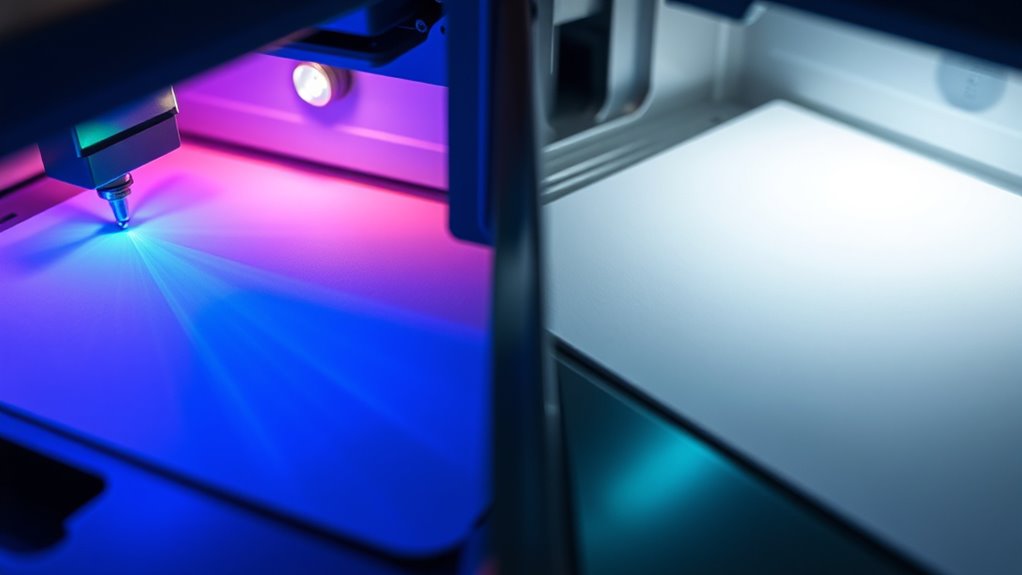
When choosing between laser and LED printing technologies, understanding their fundamental differences can help you make an informed decision. Both methods use similar principles to produce high-quality prints, but they differ markedly in how they operate, especially regarding print speed and energy consumption. If you prioritize faster output, laser printers typically have the edge. They are known for their impressive print speeds, often reaching several pages per minute, making them suitable for high-volume environments. LED printers, on the other hand, tend to be slightly slower, although advances have narrowed this gap. Still, if your workload demands rapid printing, laser technology might be more advantageous.
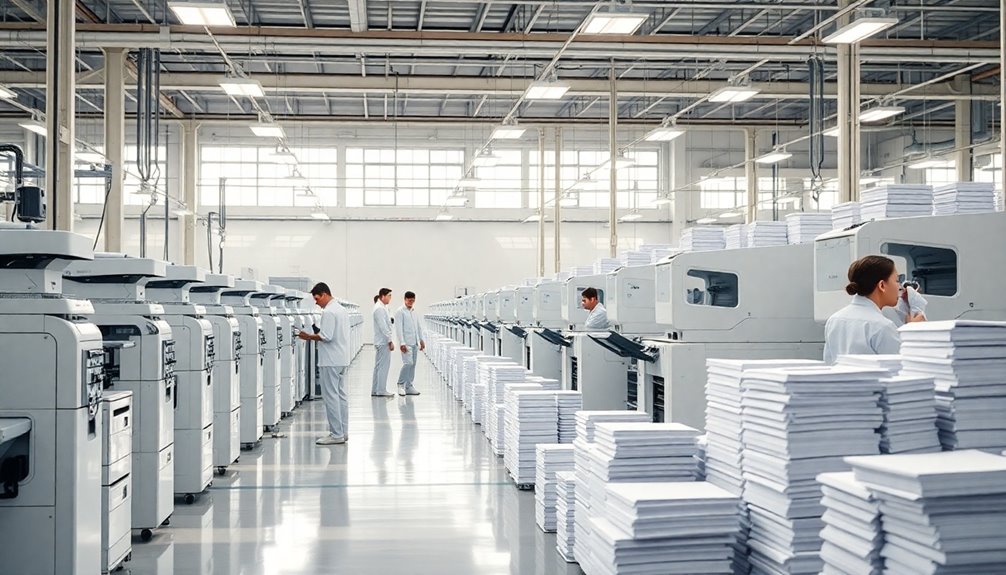
Laser printers offer faster output ideal for high-volume printing needs.
Energy consumption is another critical factor to consider. Traditionally, laser printers consume more energy because of their complex imaging process, which involves a laser beam and a rotating drum. They require high voltage components to operate efficiently, especially during warm-up phases. LED printers, by contrast, generally use less power. Their design features a series of LEDs that directly illuminate the entire page at once, eliminating the need for a rotating mirror or complex optics. This simpler setup reduces energy use, leading to lower operational costs over time. If you’re conscious of energy efficiency or aiming to reduce your carbon footprint, LED printers are worth contemplating.
The print speed differences directly impact productivity. Laser printers excel in environments where large volumes of documents are printed daily. Their ability to produce crisp, high-quality prints quickly can keep your workflow moving smoothly. LED printers, while slightly slower, still deliver excellent print quality, often matching laser printers in resolution. Their speed might be more suited to small to medium-sized offices or personal use, where the volume isn’t as demanding. Additionally, understanding printer components can help in maintaining optimal performance over the long run.
In terms of maintenance and longevity, laser printers tend to have a more robust build, often lasting longer with proper care. The complexity of their components might make repairs more involved, but their durability compensates for that. LED printers, with fewer moving parts, generally require less maintenance and are more resistant to wear and tear. This can translate into lower repair costs over time, making them an economical choice for users with moderate printing needs.
Ultimately, your decision should hinge on your specific requirements: if you need rapid, high-volume printing and don’t mind higher energy use, a laser printer might be best. If energy efficiency, lower operational costs, and simpler maintenance are priorities, an LED printer could serve you better. Both technologies have their strengths, so understanding how they align with your printing habits will help you choose wisely.

Brother Professional Laser Printer with High-Speed 50 ppm Output, Advanced Security Features, and Wireless Networking for Business, Monochrome Printing with Duplex Capability (HL-6210DW)
- High-Speed Printing: 50 ppm output for fast results
- Large Paper Capacity: 520-sheet main tray with expandability
- Wireless and Ethernet: Gigabit Ethernet and dual-band Wi-Fi
As an affiliate, we earn on qualifying purchases.
As an affiliate, we earn on qualifying purchases.
Frequently Asked Questions
Which Technology Is More Environmentally Friendly?
You’ll find LED printers generally more eco-friendly than laser printers because they produce less consumable waste and consume less energy during operation. The eco friendliness comparison shows LED technology tends to have a smaller environmental footprint, thanks to fewer parts that need replacing and lower power use. By choosing an LED printer, you reduce waste impact and support sustainable practices, making it the more environmentally conscious option for your printing needs.
How Do Maintenance Costs Compare Over Time?
Think of maintenance costs like a rollercoaster—sometimes they spike, sometimes they dip. Over time, LED printers tend to have lower, more stable costs because their components last longer, reducing replacement frequency. Laser printers may have fluctuating costs due to more frequent part replacements. You’ll likely find LED printers more budget-friendly long-term, as their steady maintenance needs help you avoid unexpected expenses and keep your printing smooth.
Are There Significant Differences in Print Quality?
You’ll notice some differences in print quality between laser and LED printers. Laser printers often deliver higher print resolution, resulting in sharper images and text. LED printers typically provide consistent color accuracy, but may have slightly lower resolution. Your choice depends on your needs; if detailed images are essential, laser might be better. Overall, both produce professional quality, but subtle differences can impact your specific printing tasks.
Which Printer Type Is More Energy-Efficient?
Think of your printer as a quiet hero in your office. LED printers are like a steady, energy-efficient marathon runner, using less power and consuming less energy. They typically have lower energy consumption and superior power efficiency compared to laser printers, making them a smart choice for saving electricity and reducing costs. If you want a reliable, eco-friendly option, LED printing shines brighter in energy efficiency.
How Do Initial Purchase Costs Differ?
You’ll find that LED printers generally have a lower upfront investment compared to laser printers. The cost comparison shows that LED models tend to be more affordable initially because they have simpler components and manufacturing processes. This makes LED printers a cost-effective choice if you’re looking to minimize your initial expenses. However, consider long-term costs too, as differences in maintenance and toner can influence total ownership costs over time.

FYSETC 3D Printer Parts – Craetive DIY LED Lamp Kit: Only Hardware Accessories NO 3D Printed Parts, Bright Light Energy-efficient Custom Lighting Project for Pure White Nightlight Models
- DIY LED Lamp Kit: Hardware components for custom LED lamp
- Versatile Applications: Decor, gifts, mood lighting, outdoor use
- Creative Personalization: Design and customize your own lamp
As an affiliate, we earn on qualifying purchases.
As an affiliate, we earn on qualifying purchases.
Conclusion
Ultimately, choosing between laser and LED printing depends on your specific needs. Laser printers excel in speed and high-volume tasks, while LED printers offer durability and energy efficiency. Remember, “the proof of the pudding is in the eating”—so test both options if you can. Whichever you pick, guarantee it aligns with your priorities to get the best value. After all, making an informed decision today saves trouble tomorrow.

Brother Color Laser Printer with Wireless Printing Fast 19 PPM Output, Duplex Feature, Mobile Device Compatible, 250-Sheet Paper Tray for Professional Home Office Printing (HL-L3220CDW)
- Fast Printing Speed: Prints up to 19 pages per minute
- Wireless Printing: Supports seamless mobile device printing
- Secure Connectivity: Built-in security protocols included
As an affiliate, we earn on qualifying purchases.
As an affiliate, we earn on qualifying purchases.
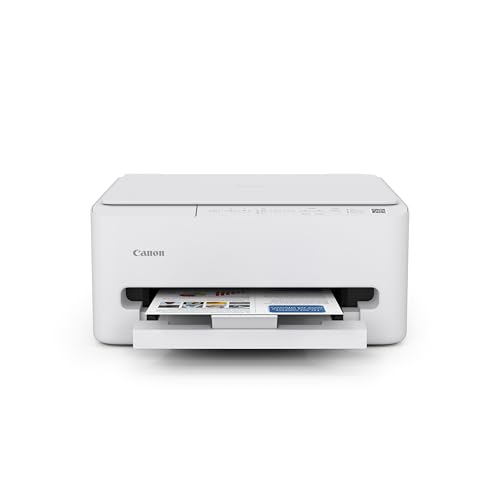
Canon PIXMA TS4320 Wireless Color Inkjet Printer for Duplex Printing, White – Home Printer with Copier/Scanner, Compact Design, Easy Setup, 1 Year Limited Warranty
- Affordable All-in-One Printer: Budget-friendly for home and hybrid use
- Vivid, Sharp Prints: High-quality documents and photos with hybrid ink
- Easy Setup and Operation: Quick setup for smartphone and computer
As an affiliate, we earn on qualifying purchases.
As an affiliate, we earn on qualifying purchases.