
TL;DR

Get business pricing on monitors, keyboards and dev gear
- Business-only prices and quantity discounts
- Tax-exempt purchasing
- Multiple users, one account, clear invoices
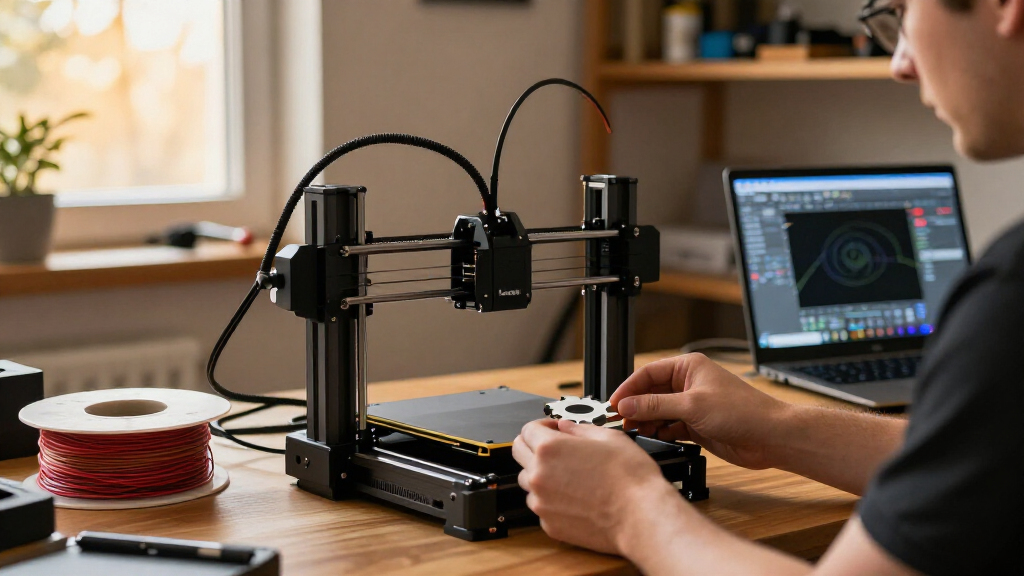
The RepRapMicron project says its PIKA V0.02 prototype can achieve repeatable positioning of about 1 micrometre within an approximately 8 mm cubic work area. The GitHub project also reports depositing UV resin droplets as small as 4 micrometres, but this is a project report, not an independent performance assessment.
The open-source RepRapMicron project says its PIKA V0.02 prototype has achieved repeatable positioning of about 1 micrometre within a work area roughly 8 millimetres on each side, a reported advance toward making small-scale fabrication with commonly available materials. The project also reports depositing UV-resin droplets as small as 4 micrometres; these are developer-reported results, not independently verified measurements.
According to the project’s GitHub wiki, PIKA V0.02 is the recommended build. It reports reliable accuracy of 10 micrometres or better in an approximately 8 mm cubic volume, alongside repeatable positioning around 1 micrometre. Positioning repeatability describes how consistently the mechanism returns to a position; it is not by itself proof that every position is accurate to that same tolerance.
The wiki describes two resin demonstrations. A fine probe etched using the PIKA mechanism was used to deposit droplets as small as 4 micrometres, while a fibre-optic probe was used to cure resin lines about 9 micrometres wide. The project also shows a 0.5 mm “Benchy” test model printed with a reported layer height of 4 micrometres. The source does not provide independent test data or a detailed measurement protocol for these results.
PIKA is presented as a compact, precise CNC-style system intended for micron-scale fabrication and manipulation. Its axes use 400-step NEMA17 motors, according to the wiki, though the project leaves choices of drive hardware and firmware to builders. It recommends USB microscopes for setup and alignment, and a conventional bench microscope to inspect output.
A Small Work Area for Microfabrication
If the reported performance can be reproduced by other builders, RepRapMicron could offer an accessible route to experimenting with micron-scale fabrication outside specialist facilities. The project’s stated aim is to adapt the RepRap model—open designs that users can build, modify and share—to equipment for making and manipulating much smaller structures.
The possible applications described by the project include work related to microelectronics, MEMS and biological sciences. Those are ambitions, not demonstrated outcomes of the PIKA results cited here. A machine with a small work area and resin-based demonstrations is not evidence that it can produce integrated electronic devices or replace established industrial processes. The immediate significance is narrower: the project reports a prototype that can repeatedly position a probe at very small scales using a design intended for community construction.
Accessibility also depends on more than the motion mechanism. Handling microscopic parts, inspecting output, aligning probes and maintaining a machine at this scale pose practical challenges. The project itself lists detaching, transporting and positioning tiny items among the problems it still aims to address. Those requirements will affect whether the platform is useful beyond demonstrations.
As an affiliate, we earn on qualifying purchases.
From OpenFlexure to PIKA
The project says its initial route to micron-scale positioning drew on 3D-printed microscope platforms developed by the OpenFlexure Project. RepRapMicron describes its own purpose as building a compact fabrication and manipulation system from common, accessible materials, while also developing methods that might eventually support structures printed at much smaller scales.
An earlier RepRapMicron design, MAUS C, is now marked deprecated. The wiki reports best-case positioning of about 5 micrometres over a 4 mm square for that version, while also noting that its movement was not linear. PIKA V0.02 is described as the current recommended hardware. This progression gives useful project history, but the reported figures should not be treated as a controlled, like-for-like comparison without shared test conditions.
The wider goal is to let users explore fabrication beyond conventional desktop 3D printing. The project cites the expense and complexity of established microfabrication methods as motivation. Its present work, however, remains a prototype effort: reported positioning, resin deposition and small test prints rather than a general-purpose system for manufacturing microelectronic components.
“PIKA V0.02 hardware is producing repeatable positioning of approximately 1μm and reliable 10μm or better accuracy in an approximately 8mm cubic volume.”
— RepRapMicron project, GitHub wiki
As an affiliate, we earn on qualifying purchases.
Independent Testing Still Missing
The source is a project-maintained GitHub wiki, and the performance figures are presented by the developers. The material provided does not include an independent measurement, uncertainty range, full testing protocol or third-party replication. It is also not clear how environmental factors such as vibration, temperature, calibration and probe wear affect results over repeated use.
The reported figures refer to different measures and demonstrations: repeatable positioning, stated accuracy, resin droplet size, cured line width and layer height. They should not be treated as interchangeable measures of resolution. The source also does not establish what materials beyond the cited UV resin can be processed, how long the machine can operate reliably, or whether it can make functional microelectronic or MEMS devices.
The project’s wiki lists PIKA V0.02 as complete around May 2026, but the supplied material does not specify a release announcement date, a stable production release, or a number of completed builds by users. Whether the stated results have been independently reproduced remains unknown.
USB microscope for microfabrication
As an affiliate, we earn on qualifying purchases.
As an affiliate, we earn on qualifying purchases.
Build Documentation and Replication
The project directs prospective builders to its wiki for the PIKA V0.02 build and describes that version as the current recommendation. Its next practical test is whether builders can assemble the design and reproduce the positioning and resin results using the documented parts, optics and setup process.
Further evidence would help clarify performance: published measurement methods, repeatability data across multiple machines, and independent tests of the printed features. The supplied source does not announce a specific testing schedule or future release date. For now, the development remains an open hardware project with promising but developer-reported prototype results.
UV resin microfabrication supplies
As an affiliate, we earn on qualifying purchases.
As an affiliate, we earn on qualifying purchases.
Key Questions
What is RepRapMicron?
RepRapMicron is an open-source project developing a compact machine for micron-scale fabrication and manipulation, using designs intended to be built from accessible materials.
What performance does PIKA V0.02 report?
The project reports about 1 micrometre of repeatable positioning and reliable accuracy of 10 micrometres or better in an approximately 8 mm cubic work area. These are project-reported figures, not independently confirmed results.
What has the prototype made?
The GitHub wiki reports UV-resin droplets as small as 4 micrometres, resin lines about 9 micrometres wide cured with a fibre-optic probe, and a small test model printed at a stated 4-micrometre layer height.
Can it manufacture microchips?
The source does not show that PIKA can manufacture functional microchips or MEMS devices. The project describes those fields as part of its broader motivation; the cited results concern prototype positioning and resin demonstrations.
Have the results been independently verified?
No independent verification is included in the supplied source material. The measurements and demonstrations are attributed to the RepRapMicron project.
Source: hn
Halloween Picks
halloween
As an affiliate, we earn on qualifying purchases.