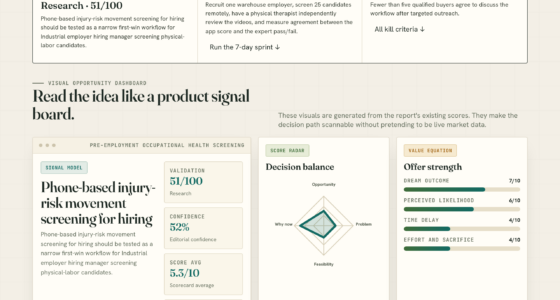
📊 Full opportunity report: The Dangers Of Collective Thinking In AI Models on ThorstenMeyerAI.com — validation score, market gap, and execution plan.
TL;DR
An increasing dependence on a few shared AI models is creating a collective lens that may homogenize perceptions of reality. This trend threatens to reduce interpretive diversity, heightening societal and market risks.
Recent developments reveal that a growing number of institutions and individuals are increasingly relying on a limited set of frontier AI models to interpret complex information. This reliance is creating a shared interpretive lens that risks reducing societal and market resilience by diminishing interpretive diversity, according to Thorsten Meyer.
Thorsten Meyer warns that the homogenization of interpretation through AI models—trained on overlapping data and tuned toward similar outputs—may lead to societal and economic vulnerabilities. As more sectors—from financial markets to newsrooms—depend on these models, their outputs become less diverse, making collective understanding more fragile.
He describes this phenomenon as a modern version of the Walter Cronkite problem, where a single trusted source shapes perceptions. The difference now is that AI models, not individuals, serve as the primary interpretive authority, creating a single point of failure for societal understanding.
This trend is not hypothetical; it is actively shaping market behavior, risk assessment, and public discourse, often with little awareness of the homogenization effect.
A failure mode is building quietly under the AI economy, and it has nothing to do with the models getting too smart. It’s the opposite: they’re becoming a single shared lens — one anchor through which vast numbers of people read the same events the same way at the same moment.
▲ Opinion & analysis · not investment adviceInterpreting the world is a Bayesian problem — the kind where diversity of prior isn’t a nicety but the mechanism. Feed the same input to the same model and you get the same read, delivered to millions as if it were the answer.
A market works because buyers and sellers disagree about what news means; the price is that disagreement, resolved. Collapse the diversity and you don’t get a smarter market — you get a violently compressed one.
Each person routing their thinking through the best model behaves rationally. The aggregate is a monoculture — efficient until one shared blind spot takes the whole field at once.
Not worse tools or fewer of them — many genuinely different ones. This is where an abstract worry meets a case I’ve made from a completely different starting point.
Keep the interpreters plural — that is the whole defense.
Implications of Reduced Interpretive Diversity
The reliance on similar AI models for interpretation risks creating a more brittle society and economy. Homogeneous interpretations can accelerate market crashes, distort risk assessment, and amplify societal polarization. When everyone acts on the same perceived reality, the ability to absorb shocks diminishes, increasing the likelihood of rapid, large-scale failures.
This trend challenges the foundational assumption that diversity of thought and disagreement are vital for resilience. As collective understanding becomes more uniform, the potential for synchronized errors and misjudgments grows, threatening stability across multiple domains.
As an affiliate, we earn on qualifying purchases.
Rise of Homogeneous AI-Driven Interpretation
Over recent years, AI models—especially large language models—have become central to processing and interpreting complex data in finance, media, and policymaking. These models are trained on overlapping datasets and optimized toward similar outputs, leading to a convergence in interpretation. This shift mirrors historical concerns about media homogenization but now occurs at an unprecedented scale and speed.
The phenomenon is reinforced by the commercial and strategic advantages of using proven models, which incentivizes repeated reliance. As a result, diverse perspectives are being replaced by a narrow interpretive framework, often without explicit awareness among users.
"The danger lives in the details. More and more people, and more institutions, now form their understanding of complex events by feeding the same raw material through the same two or three frontier models."
— Thorsten Meyer
As an affiliate, we earn on qualifying purchases.
Uncertainties Around Long-Term Impact
It remains unclear how widespread this homogenization will become in the future and what specific societal or economic thresholds might trigger systemic failures. The pace at which interpretive diversity diminishes and the potential for corrective measures are still uncertain.
Additionally, the extent to which different sectors can develop safeguards or diversify AI reliance is not yet known, leaving open questions about resilience strategies.
AI model interpretability analysis kit
As an affiliate, we earn on qualifying purchases.
As an affiliate, we earn on qualifying purchases.
Monitoring and Mitigating Homogenization Risks
Experts suggest increased awareness and deliberate diversification of AI tools and data sources as potential steps to counteract homogenization. Regulatory and industry standards may evolve to promote interpretive plurality.
Research into the long-term societal impacts of AI-driven consensus is expected to grow, alongside efforts to develop models that incorporate diverse perspectives, ensuring robustness against collective failures.
As an affiliate, we earn on qualifying purchases.
Key Questions
Why does reliance on the same AI models pose a risk?
Because it reduces interpretive diversity, making societal and market responses more uniform and fragile to errors or shocks.
How does this compare to past media homogenization?
While media homogenization was driven by a few dominant outlets, AI homogenization involves many sectors relying on similar models, amplifying the effect and speed of consensus formation.
Can this homogenization be reversed or mitigated?
Potentially, yes. Strategies include diversifying data sources, developing models that prioritize interpretive plurality, and increasing awareness of the risks among users and regulators.
What sectors are most affected by this trend?
Financial markets, news organizations, policymaking, and risk assessment sectors are most immediately impacted by homogenized AI interpretations.
What should users of AI models do now?
Users should be aware of the limitations of relying on a few models, seek diverse sources of analysis, and advocate for transparency and diversity in AI development.
Source: ThorstenMeyerAI.com