
🔍 Read the full analysis: Self-Checkout Kiosks: How The Customer’s Role Is Changing on ThorstenMeyerAI.com

Get business pricing on monitors, keyboards and dev gear
- Business-only prices and quantity discounts
- Tax-exempt purchasing
- Multiple users, one account, clear invoices
TL;DR
Self-checkout has made shoppers responsible for scanning and bagging items, while U.S. cashier employment fell from about 3.60 million in 2019 to about 3.09 million in 2025. The Bureau of Labor Statistics projects cashier employment to decline a further 6% from 2025 to 2035, though cashiers remain a large workforce and some retailers have pulled back on self-checkout.
Self-checkout has shifted scanning and bagging work from cashiers to shoppers, while the number of U.S. cashier jobs fell from 3,596,630 in May 2019 to 3,089,410 in May 2025, according to Bureau of Labor Statistics figures cited in a November 26 report by ThorstenMeyerAI.com. The BLS projects a further 6% decline in cashier employment between 2025 and 2035, but the occupation still accounts for more than three million jobs.
The BLS attributes the projected employment decline in part to self-service checkout stands and rising online sales. In a January 2026 review of its prior projections, the agency said self-checkout reduces labor needs because scanning and bagging are transferred to customers. Stores may also have one employee monitor several checkout stations, rather than assign a cashier to each register.
The report puts the observed drop in cashier employment at about 14% between 2019 and 2025, calculated from the two BLS figures. That period also included the pandemic and growth in online shopping, so the figures alone do not show how much of the decline was caused by self-checkout. The BLS projects about 200,600 fewer cashier jobs over the 2025–35 period; this is a forecast, not a count of jobs already lost.
Adoption is not moving in one direction everywhere. The report says some retailers, including Booths in England, Dollar General and Target in the United States, reduced or removed self-checkout in 2023 and 2024, citing issues such as service, losses and speed. It also describes continued uptake in Germany and Japan, though the figures it provides do not establish a common trend across all retailers or markets.
Infographic 01 · A short history of self-service
From the clerk to the customer, 1916 to today
Each step moved a piece of the work across the counter: first fetching the goods, then reading the price, then scanning and ordering.
How the customer took over the clerk's work
- Before 1916: a clerk fetched, weighed and wrapped every item at the counter.
- 1916, Piggly Wiggly (Memphis): shoppers take the goods off the shelves themselves and pass a checking station to pay. Clarence Saunders files his patent on 21 October 1916.
- 26 June 1974, Troy, Ohio: a ten-pack of Juicy Fruit gum is the first product scanned with a barcode. A machine now reads the price.
- 9 July 1984: David R. Humble and two colleagues file the CheckRobot patent: the shopper scans, a scale checks the weight, a tunnel stops unscanned items. Payment still goes to a cashier.
- From 1986: CheckRobot machines in several Kroger supermarkets, as reported by CNN (2022).
- 2018: McDonald’s has kiosks in nearly 17,000 restaurants; in France, Italy and Spain well over half of in-restaurant orders go through them (company filing).
Sources differ on the exact opening day of the first Piggly Wiggly (6 or 11 September 1916). The Kroger installation is reported second-hand; we did not retrieve the 1987 newspaper original.
Sources: C. Saunders, US Patent 1,242,872 (1916/17); Tennessee Encyclopedia; GS1 Belgium & Luxembourg; Humble et al., US Patent 4,676,343 (1984/87); CNN (2022); McDonald's Form 10-K 2018.
Powered by Thorsten Meyer AI
How Checkout Work Is Reassigned
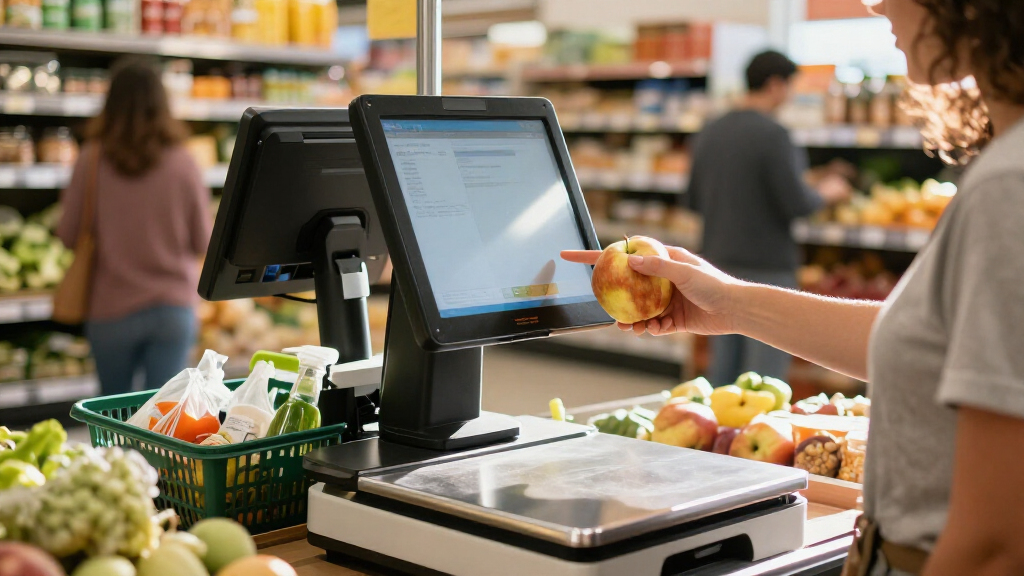
Self-checkout changes more than the equipment at the front of a store: it changes who performs routine checkout tasks. Customers scan, handle and bag their own purchases, while staff may supervise multiple stations or assist when a transaction needs attention. For shoppers, that can mean a quicker or more self-directed visit, but also a greater share of the work once done by employees.
For workers and employers, the shift is relevant because checkout is a large occupation, not a marginal job category. The latest cited BLS count remains above 3 million cashier jobs. Its forecast points to continued pressure, but does not mean the occupation is disappearing. Retailers’ decisions to scale back some machines also show that labor savings are only one factor: customer experience, losses and checkout speed can affect whether a store keeps the technology.
Products Worth Considering

Bose Smart Dolby Atmos Soundbar with Alexa, Voice Control, and Bluetooth

Logitech MX Master 4 for Mac

DJI Osmo Action 5 Pro 4K Waterproof Action Camera with Dual OLED Touchscreens, Froggi 47-Piece Sport Kit and SD Card
As an affiliate, we earn on qualifying purchases.
From Self-Service to Scanned Baskets
The transfer of retail work to shoppers predates computers. In 1916, Clarence Saunders filed a patent for a self-serving store, and his Piggly Wiggly grocery store in Memphis let customers select goods from shelves rather than ask clerks to fetch them. The patent described a customer route through the store and a checking station at the end. At that point, shoppers picked the goods; staff still handled checkout and payment.
Barcode scanning later made automated price reading possible. GS1 says the first product scanned using a barcode was a ten-pack of Wrigley’s Juicy Fruit gum at a Marsh supermarket in Troy, Ohio, on June 26, 1974. In 1984, David R. Humble and colleagues filed a patent for a system in which shoppers scanned items themselves. The report says a version was installed at several Kroger supermarkets, with machines introduced in 1986. Its early design still sent shoppers to a cashier to pay, a reminder that self-checkout’s division of tasks has changed over time.
“Self-checkout reduces the need for labor because the main task of scanning and bagging items is transferred to the customer.”
— U.S. Bureau of Labor Statistics, January 2026 review of prior projections
What the Employment Figures Cannot Show
The BLS employment totals show a decline in cashier jobs, but the figures cited do not isolate the effect of self-checkout from online sales, pandemic-era changes or other forces affecting retail. The forecast is a projection, not a guarantee, and the report does not provide a causal estimate of jobs lost specifically because a store installed kiosks.
The report also gives different 2025 cashier totals in different passages: 3,089,410 in its discussion of the BLS May employment survey and 3,106,300 elsewhere, attributed to the Occupational Outlook Handbook. The source does not explain the difference. The figures should not be treated as interchangeable without clarifying their definitions or data series. Retailers’ reasons for scaling back are described broadly, and the report does not provide comparable company-level data on costs, theft, wait times or customer satisfaction.
The Next BLS Employment Outlook
The BLS’s current outlook cited in the report covers 2025 to 2035 and forecasts a 6% reduction in cashier employment. Future employment data will show whether the occupation follows that projected path, but those totals will not by themselves identify the role self-checkout played.
For readers tracking the change, the clearest next indicators are updated BLS employment estimates and retailers’ decisions about how many self-checkout stations to operate. The report does not cite a specific upcoming policy, company rollout or new technology milestone. For now, the confirmed picture is mixed: shoppers perform more checkout tasks in self-service formats, cashier employment has declined, and the job remains widespread.
Key Questions
How many U.S. cashier jobs were there in 2025?
The report cites 3,089,410 cashiers in the BLS May 2025 employment survey. It also gives a separate 2025 total of 3,106,300 from the Occupational Outlook Handbook, without explaining the difference between the figures.
How much does the BLS expect cashier employment to decline?
The BLS projects a 6% decline from 2025 to 2035, or about 200,600 fewer jobs, according to the report. That is a projection, not a count of jobs already lost.
Did self-checkout cause the full drop in cashier jobs?
The figures cited do not establish that. The BLS names self-service checkout and increasing online sales as factors in its outlook, while the 2019–25 employment comparison also spans the pandemic and other retail changes.
Are retailers still expanding self-checkout?
Adoption is mixed. The report says some retailers reduced or removed machines in 2023 and 2024, while self-checkout and hybrid systems continue to be used in markets including Germany and Japan.
Source: ThorstenMeyerAI.com