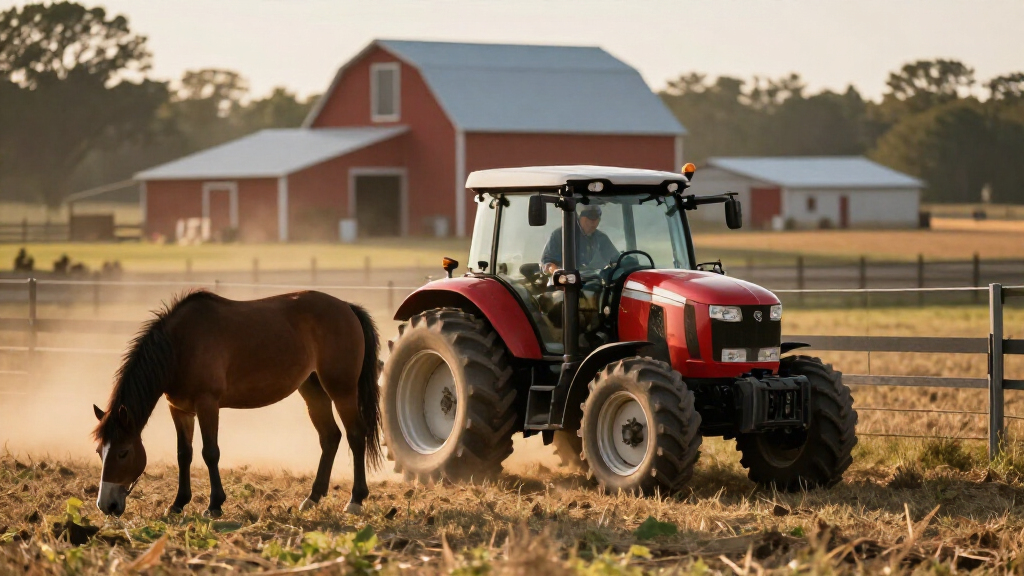

🔍 Read the full analysis: How Did Tractors Change The Future Of Working Animals? on ThorstenMeyerAI.com

Get business pricing on monitors, keyboards and dev gear
- Business-only prices and quantity discounts
- Tax-exempt purchasing
- Multiple users, one account, clear invoices
TL;DR
U.S. farm horses and mules peaked at 26.7 million in 1918, then fell to 3.1 million by 1960 as tractors and other machinery replaced animal power. Farmers largely stopped breeding work animals rather than retraining them, while farm employment also declined and agricultural output per worker rose. The comparison with modern automation is instructive but limited: machines displaced animal labor, while the effects of automation on people depend on different economic and political conditions.
U.S. farm horses and mules fell from a peak of 26.7 million in January 1918 to 3.1 million in 1960, as tractors and other machines took over much of the work of ploughing, planting and harvesting. The shift changed the animals’ role in agriculture and reduced the land devoted to their feed, offering a historical comparison for discussions of automation and jobs today.
The figures in the account, drawing on the U.S. Census Bureau’s Historical Statistics of the United States, Colonial Times to 1970, show that horses alone peaked at 21.4 million in 1915. Mules continued to increase for a few more years, bringing the combined number of farm horses and mules to 26.7 million on January 1, 1918. In 1915, about 93 million acres of harvested cropland grew feed for the animals—more than a quarter of the 340 million acres harvested that year.
Tractor numbers rose as the working-animal population declined. The account puts tractors on U.S. farms at about 1,000 in 1910, 246,000 in 1920, 920,000 in 1930 and 4.69 million in 1960. Farm horses and mules numbered 25.7 million in 1920, 19.1 million in 1930 and 3.1 million in 1960. Around 1955, tractors first outnumbered horses and mules, at 4.35 million against 4.31 million. The source cautions that the historical counts were taken at slightly different dates, and that the government’s animal estimates later counted horses and mules together.
The change extended beyond tractors. Combine harvesters, which cut, thresh and clean grain in one pass, rose from about 4,000 on U.S. farms in 1920 to 1.042 million in 1960, according to the account. Other machinery, along with fertilizer and improved seed, contributed to rising output: the Department of Agriculture’s estimate of how many people one farm worker supplied grew from 7.1 in 1910 to 47.1 in 1970. That measure includes people abroad supplied through exports.
From Animal Power to Farm Machinery
The tractor changed more than the source of power in the field. Animals required feed throughout the year, while a tractor used fuel when operating. As the working-animal population shrank, the land growing feed could be used for other crops: the account estimates that acreage devoted to horse and mule feed fell from about 93 million acres in 1915 to about 5 million in 1960. That was a major shift in how farmland was allocated.
Farm work changed alongside the animals’ decline. U.S. farm employment reached 13.6 million in 1916 and stood at 4.5 million in 1970, while the overall U.S. labor force doubled, according to the source. This does not mean every displaced farm worker moved directly into a new job or that machinery alone explains employment changes. It does show that agricultural mechanization took place alongside a broader movement of work toward cities and other industries.
The history matters to current automation debates because it shows that a technology can replace a form of labor while changing what land and workers are used for. But horses and people are not interchangeable cases. The account invokes economist Wassily Leontief’s 1983 comparison between workers and horses displaced by tractors, while noting a political difference Leontief identified: horses could not vote. The analogy can prompt questions about adjustment and power; it cannot, by itself, predict what will happen to human workers.
Products Worth Considering

Samsung Galaxy Tab A11 (2026) – 8.7 90Hz Android Tablet, 64GB/4GB Wi‑Fi, Octa-core MediaTek Helio G99, Dual Dolby Speakers, 20W Fast Charger

Amazon Kindle Paperwhite Signature Edition, 32GB (2024), Metallic Black

Amazon Kindle Paperwhite (2024), 16 GB, 7-inch Display, Black
As an affiliate, we earn on qualifying purchases.
The Tractor Adoption Curve
Gasoline tractors were available before World War I, but early models were heavy and expensive, making them better suited to large farms. In 1917, Ford introduced the Fordson. The Henry Ford museum describes it as “the first mass-produced and inexpensive lightweight tractor” and says it was built to meet small farmers’ needs. On February 21, 1920, the 100,000th Fordson left the assembly line, according to the account.
The Fordson was part of a wider change rather than the only cause of mechanization. Tractors spread over several decades, and machines for harvesting, picking corn, baling hay and milking followed. The historical figures show the crossing point around 1955, not an overnight replacement: farm horses and mules remained numerous into the middle of the century even as tractor ownership expanded.
Mechanization continues in a different form. The account says John Deere introduced a 16-camera autonomy kit in February 2025 for tillage on selected large tractors. It also reports that China said about 74% of ploughing, sowing and harvesting was mechanized in 2023. Those are distinct claims about modern agriculture; they do not show that all farm tasks are autonomous or that the U.S. historical pattern will be repeated elsewhere.
What the Horse Comparison Cannot Show
The historical counts document the decline in farm horses and mules, but the account does not provide a full breakdown of what happened to individual animals or how many were sold, slaughtered, or kept for other purposes. Its explanation is that farmers stopped breeding replacements and the working population aged out; the precise fate of each animal is not established.
The employment figures also do not isolate the effect of tractors from other causes, including other machinery, changes in farm size, improved seeds, fertilizer and shifts in the wider economy. The source describes farm employment falling while the national labor force grew, but it does not trace individual workers’ destinations or outcomes.
Modern autonomy remains limited in the examples provided. The account describes a system for tillage on selected large tractors and gives China’s reported mechanization share for three farm activities in 2023. It does not establish how many farms use autonomous equipment, how many workers are affected, or whether current systems can handle the range of tasks performed by people and animals in earlier agriculture.
Tracking Automation Beyond the Field
The next question is whether today’s farm technology expands from selected tasks to a broader set of operations. Adoption figures, the kinds of farms that can afford the equipment, and the work that remains difficult to automate will help show how far autonomous machinery is spreading. The account does not give a forecast or a date for wider use.
For readers weighing the comparison with human jobs, the historical record points to outcomes that need separate measurement: changes in employment, new work created elsewhere, movement between regions and industries, and who benefits from higher productivity. A future assessment would also need to distinguish a machine’s technical capacity from its actual use on farms. The decline of working animals is clear; what current automation will mean for workers remains an open question.
Key Questions
When did tractors first outnumber horses and mules on U.S. farms?
According to the account, they crossed around 1955: about 4.35 million tractors compared with 4.31 million horses and mules.
How many working horses and mules were on U.S. farms at the peak?
The combined peak was 26.7 million on January 1, 1918. Horses alone had peaked earlier, at 21.4 million in 1915.
What happened to farm horses as tractors spread?
The account says farmers largely stopped breeding replacements, and the working population aged out. It does not provide a complete record of the fate of individual animals.
Did tractors alone reduce the number of farm workers?
The source documents declining farm employment during a period of mechanization, but it does not attribute the entire decline to tractors. Combines, other equipment, improved seeds, fertilizer and wider economic changes also formed part of the shift.
Does the history predict what automation will do to human workers?
No. The horse comparison is an analogy, not a law or a forecast. The source notes that people differ from working animals, including because people can participate politically, and says modern farm robots still perform a limited range of tasks.
Source: ThorstenMeyerAI.com