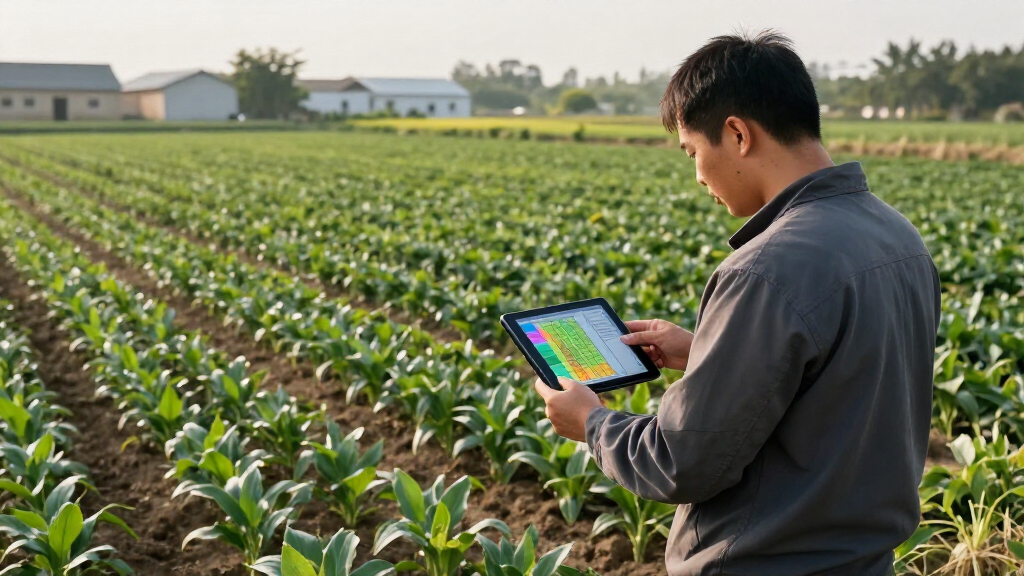
🔍 Read the full analysis: Agriculture Today: The Growing Conversation About AI on ThorstenMeyerAI.com

Get business pricing on monitors, keyboards and dev gear
- Business-only prices and quantity discounts
- Tax-exempt purchasing
- Multiple users, one account, clear invoices
TL;DR
A November 29, 2026, episode of Thorsten Meyer’s “Work After Work” series examines how AI and automation are changing agriculture. It points to widespread machine guidance across some major crop acres and growing use of milking robots, while labor-intensive strawberry harvesting remains difficult to automate; adoption differs sharply by farm size.
Agricultural automation is advancing unevenly: satellite-guided tractors and robotic milking systems are established on some farms, while strawberry harvesting still depends heavily on people, according to a report published November 29 by ThorstenMeyerAI.com. The article, part of Thorsten Meyer’s “Work After Work” series, describes how technology is changing farm tasks without making farm labor broadly automated.
In the United States, guidance systems were used on more than half of the acres planted to several major crops in the latest crop-specific years cited in the source: 58.4% of corn acres in 2016, 54.5% of soybean acres in 2018, 55.9% of winter wheat acres in 2017 and 64.5% of cotton acres in 2019. The figures are from USDA Economic Research Service data and refer to acres, not the share of farms adopting the technology.
Farm-level adoption is lower. USDA survey results cited in the report show 22% of U.S. farms used at least one precision agriculture practice in 2025, down from 27% in 2023. The source says the practices counted include GPS guidance, yield monitoring, soil mapping, variable-rate applications, drones, electronic tagging, precision feeding and robotic milking. Larger farms have adopted guidance more often: in 2016, the technology was used by 73% of the largest corn farms, compared with 10% of farms with 200 acres or fewer.
In livestock production, Germany had 8,800 dairy farms using automatic milking systems in 2023, or 19% of its dairy farms, according to Destatis, the country’s statistics office. Strawberry picking presents a different problem. The source cites a 2024 University of California cost study finding that harvest accounted for about two-thirds of costs for organic strawberries. It also reports that commercial strawberry robots are now operating on tabletop systems, while harvesting fruit grown in soil remains difficult to mechanize.
Infographic 01 · Precision farming
Most acres, not most farms
Satellite steering took over most of America’s big crop fields, but only about one US farm in five uses any precision farming. The big farms adopt first.
US corn · share of planted acres with auto-steer (ERS, ARMS)
Guidance systems by 2019 · share of planted acres (ERS)
US farms using any precision agriculture practice · share of farms (NASS)
US corn farms using guidance, 2016 · by farm size (ERS)
Germany, 2023 · dairy farms with milking robots (Destatis)
Acre shares (ERS, by crop and survey year) and farm shares (NASS) are different measures and not directly comparable. Before 2018, ERS “guidance” means auto-steer without lightbars. NASS counts GPS guidance, yield monitoring, soil mapping, variable rate, drones, electronic tagging, precision feeding and robotic milking.
Sources: USDA ERS, EIB-248 (2023); USDA ERS, Amber Waves (April 2023); USDA NASS, Technology Use (August 2025); Destatis press release 204 (23 May 2024).
Powered by Thorsten Meyer AI
Automation Favors Large Farms
The contrast between crop-acre figures and farm-level figures shows why automation statistics need careful interpretation. More than half of certain crop acres may receive guidance even as only about one in five U.S. farms reports using any precision practice. The report attributes that gap to the concentration of technology on larger operations, where the economic returns may be stronger.
For workers, this points to task-specific change rather than a simple replacement of farm labor. Guidance systems can steer machinery, and milking robots can take over part of a routine barn operation. But crops that require selective handling, such as soft fruit, remain labor-intensive. The difference matters to growers weighing equipment costs and to workers whose jobs depend on seasonal harvesting.
The report also gives scale to the continuing need for hired labor in the United States: the Department of Labor certified 398,258 H-2A temporary farm jobs in fiscal 2025, compared with just over 48,000 in fiscal 2005, according to the figures it cites. Those certifications do not by themselves establish how many workers were employed or how automation affected labor demand, but they underscore that mechanization has not removed the need for seasonal agricultural work.
Products Worth Considering

Samsung Odyssey G5 34-Inch Ultra-WQHD 180Hz Curved Gaming Monitor

Sony WH-1000XM4C Wireless Noise-Cancelling Headphones, Black

Samsung 32-Inch Odyssey G5 (G51F) QHD 180Hz Gaming Monitor
As an affiliate, we earn on qualifying purchases.
From GPS Guidance to Picking
The report traces precision farming’s development to equipment that measures field conditions and varies inputs. USDA’s Economic Research Service says yield monitors reached the market in 1993, followed by yield and soil maps; variable-rate technology arrived in 1995. Lightbars for steering appeared around the mid-1990s, with automatic steering emerging later in the decade. The U.S. government’s decision to end the intentional degradation of civilian GPS signals on May 1, 2000, improved satellite positioning for civilian uses, including farm machinery.
Adoption then rose quickly in some crops: the source says auto-steer was used on 5.3% of planted U.S. corn acres in 2001 and 58% in 2016. Dairy automation followed a separate path. Dutch company Lely says it installed a prototype milking robot on two farms in 1992 and launched the system commercially in 1995. These examples show that automation depends not only on software or AI, but also on machinery, crop conditions and whether a task can be performed reliably by equipment.
Strawberries illustrate the limits. A review of 50 harvesting robots spanning three decades, cited in the source, reported an average success rate of 66% and 33 seconds per fruit, and found no robot on the market at the time of the review. The source says commercial robots have since appeared in tabletop systems. That is a development, not evidence that robots have replaced hand harvesting across conventional fields.
“Most acres, not most farms.”
— Thorsten Meyer, ThorstenMeyerAI.com
Limits of the Adoption Data
The figures cover different years, countries and measures, so they do not provide a single current estimate of how much farm work AI has replaced. Crop guidance statistics describe the share of acres in particular crops, while the USDA’s 2023 and 2025 figures describe the share of farms reporting any of several precision practices. The source does not establish why reported farm use fell from 27% to 22% between those survey years.
It is also unclear how many strawberry robots are operating commercially, how much of the crop they harvest, or whether they reduce total labor costs under different growing conditions. The H-2A certification count measures jobs certified by the Department of Labor, not the number of workers ultimately hired or the effect of automation on those jobs. The source’s broader discussion of agriculture’s share of employment is incomplete in the material provided, so no further country comparisons can be stated here.
The Next Test Is Field Harvesting
The next measure of progress will be whether harvesting robots can move beyond tabletop systems and handle fruit grown in soil reliably and at a cost growers can support. The source does not give a timetable for that change or identify a specific upcoming product launch.
For broader adoption, the next questions are whether smaller farms can afford precision equipment and whether new systems can work across varied fields, crops and seasons. Future USDA surveys may show whether the reported decline in farm-level precision practice continues or reverses. Until then, the evidence in this report points to a sector where automation is expanding in particular tasks, while substantial parts of farm work remain human-led.
Key Questions
Is farming already automated?
Partly. Guidance systems steer machinery on many acres of major U.S. crops, and milking robots are used on some dairy farms. Strawberry harvesting, by contrast, still relies heavily on people.
How many U.S. farms used precision agriculture in 2025?
The USDA figure cited by Thorsten Meyer is 22% of U.S. farms, down from 27% in 2023. The survey groups several practices together, including GPS guidance and robotic milking.
Why can guidance cover many acres but fewer farms?
Larger farms tend to adopt guidance more often and operate more land. The report cites 2016 figures of 73% adoption among the largest corn farms and 10% among farms with 200 acres or fewer.
Are robots replacing strawberry pickers?
The source says commercial strawberry robots now operate on tabletop systems, but it does not show that they have replaced hand picking across soil-grown fields. The scale of their use and share of the harvest remain unclear.
Source: ThorstenMeyerAI.com