
TL;DR

Get business pricing on monitors, keyboards and dev gear
- Business-only prices and quantity discounts
- Tax-exempt purchasing
- Multiple users, one account, clear invoices
CircuitHub has publicly introduced The Grid, an automated Massachusetts factory that makes varied printed circuit board orders on shared equipment. The company says it has operated the system for five years, currently produces tens of millions of dollars in electronics annually, and plans to increase capacity fivefold this year; independent performance and capacity details were not provided in the announcement.
CircuitHub has publicly introduced The Grid, an automated electronics factory in Massachusetts that the company says builds printed circuit boards on demand for customer orders. The company says it has operated the system for five years and now plans to expand capacity as demand exceeds what it can currently produce, presenting the factory as a way to handle varied, lower-volume work in the United States.
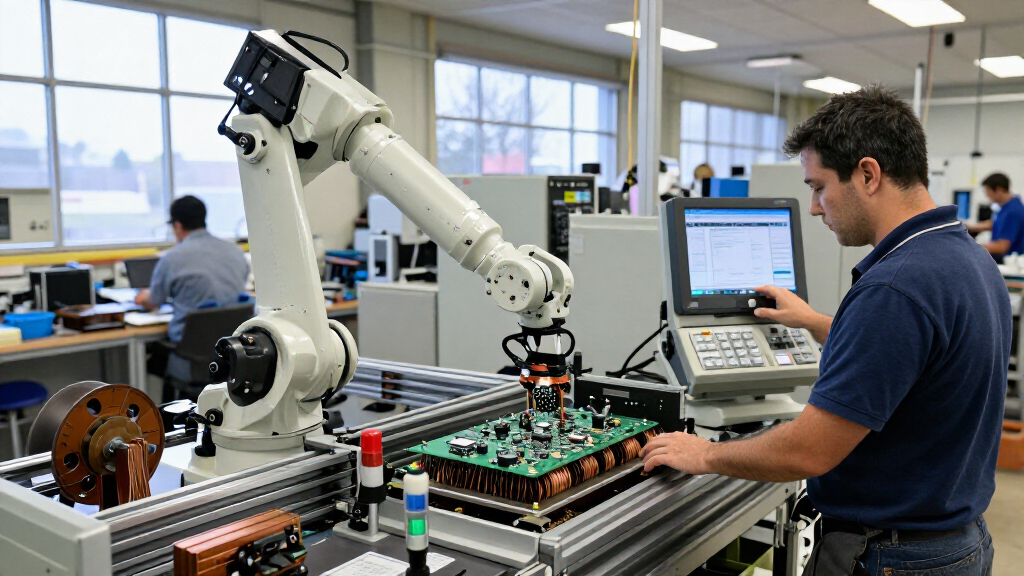
The Grid differs from a conventional production line, CircuitHub says, because it is designed to handle multiple board designs without stopping to reconfigure a line for each one. Levitating movers carry boards and components among equipment for solder-paste printing, component placement, reflow soldering and inspection. CircuitHub says software combining learned models, AI agents and traditional optimization schedules the work, while each board follows its own route through the factory.
The company says this setup allows prototypes and production batches to use the same equipment. It describes the system as suitable for orders with many designs and small quantities, rather than only large runs of a single product. CircuitHub says a leading electric-vehicle maker, a major AI laboratory and established technology companies already use The Grid; it did not name those customers in the report.
For a cost and delivery comparison, CircuitHub cites a five-board order for a four-layer motor controller with 118 components per board, including 38 unique parts. It says the order costs $630 and arrives in four days through The Grid, compared with about $465 and a nine-day median delivery from a typical quick-turn shop in Shenzhen after shipping and U.S. tariffs. These figures are the company’s example, not an independent market-wide comparison.
A U.S. Option for Small PCB Runs
Many hardware developers need boards in modest quantities, across several designs, and on timelines that can change during development. CircuitHub’s pitch is that automation can make this high-mix, low-volume work practical at a U.S. factory, a category the company says has generally been harder to automate than mass production of one standardized product.
The example order illustrates the tradeoff the company is asking customers to weigh: a stated $165 higher price than its Shenzhen comparison in exchange for five days less delivery time and domestic production. Faster access to boards can help teams test designs and make revisions sooner, but the value will depend on the order, the actual delivery schedule and the cost of delays for each customer. The announcement does not establish that The Grid is cheaper or faster for all board types or order sizes.
The broader supply-chain case is also relevant to companies that need small batches for research, test equipment, tooling or production support. If The Grid can reliably accommodate changing designs without extensive setup, it could offer an additional domestic source for those orders. The company’s disclosure, however, is not an independent assessment of how much manufacturing could move back to the United States.
Products Worth Considering

Apple iPad Air 11-inch (M2), 512GB, Wi-Fi, Space Gray

Jackery HomePower 3000 Portable Power Station with Two 200W Solar Panels

Anker SOLIX S2000 Portable Power Station, 2,010Wh, 1,500W
As an affiliate, we earn on qualifying purchases.
Why Varied Board Orders Are Hard
CircuitHub frames The Grid as a response to a production gap between low-volume, frequently changing orders and high-volume manufacturing. In the company’s account, a conventional production line is most efficient when it can make the same product repeatedly. Switching among designs can require setup and manual changeovers, making smaller batches more difficult to automate economically.
The company contrasts that challenge with factories producing very large quantities of a single item, where dedicated production lines can be worthwhile. It says typical hardware firms may instead need small counts of several boards, followed by a new revision soon afterward. Those orders have often been placed with overseas manufacturers or quick-turn services, according to CircuitHub.
CircuitHub says The Grid is not a new pilot: it has served customers for five years. The company reports that, across its business, it has shipped more than 2.2 million boards, placed over 150 million components and served more than 26,000 engineers. Those are company-reported cumulative figures; the announcement does not specify how much of that activity was produced by The Grid alone.
““This is The Grid, our factory-scale robot in Massachusetts that builds circuit boards on demand.””
— CircuitHub, in its announcement
Capacity Claims Need More Detail
The announcement does not disclose The Grid’s current production capacity, the volume of orders it turns away, or the amount of additional output expected from the planned expansion. CircuitHub says it intends to increase capacity fivefold this year, followed by another major increase in 2027, but it does not define the baseline, give a precise completion date or describe the investment and equipment involved.
The company also does not publish independent operating data, such as on-time delivery rates, defect rates, utilization, or the range of board designs and components the factory can process. Its cost and delivery example covers one specified order and one comparison with a typical Shenzhen quick-turn shop; the report does not provide the underlying quote details or a broader sample. The identities of the large customers cited by CircuitHub remain undisclosed.
Planned Production Expansion
CircuitHub says it plans to multiply The Grid’s capacity fivefold this year and make another large expansion in 2027. The company has not provided milestones or a detailed schedule, so it remains unclear when the added capacity will be available to customers or how much it will increase order throughput.
The next indicators to watch are whether the expansion reaches production, whether delivery times and pricing remain close to the company’s example as volume grows, and whether CircuitHub releases operating measures that allow customers to assess performance across different board orders. For now, the company is inviting hardware teams to request quotes and says it is hiring.
Key Questions
What is The Grid?
The Grid is CircuitHub’s automated PCB factory in Massachusetts. The company says robotic movers carry boards between machines that print solder paste, place components, solder and inspect finished boards.
Can The Grid make different board designs in one production run?
CircuitHub says boards can follow separate routes through the factory, allowing different designs to be produced without the usual per-design line changeovers. The announcement does not list technical limits on the designs or components it accepts.
How does the company’s price example compare with a Shenzhen order?
For a specified order of five four-layer motor-controller boards, CircuitHub reports a price of $630 with four-day delivery through The Grid. It compares that with about $465 and a nine-day median through a typical Shenzhen quick-turn shop, including shipping and U.S. tariffs. The figures describe one example, not all orders.
How long has The Grid been operating?
CircuitHub says it has been running The Grid for five years and serving customers during that period. The company has not disclosed the factory’s specific start date or a separate production total for The Grid.
What expansion has CircuitHub announced?
The company says it plans a fivefold capacity increase this year and another major increase in 2027. It has not specified the baseline capacity, exact schedule or expected production volume after those expansions.
Source: circuithub.com