![I 3D Printed Origami [video]](https://bestcadpapers.com/wp-content/uploads/2026/05/i-3d-printed-origami-video-featured-200x110.jpg)
TL;DR

Get monitors, keyboards and dev gear delivered free — and shop member deals
- Fast, free delivery on millions of items
- Access to Prime Big Deal Days deals on October 6–7
- Prime Video, Amazon Music and more included
Dell and Kioxia have announced a 2RU server capable of holding 10 PB of data, using high-capacity NVMe SSDs. This development highlights advancements in storage density and efficiency for large-scale data centers.
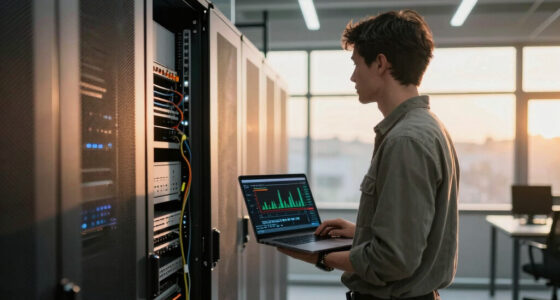
Dell and Kioxia have jointly announced a 2RU server that can store 10 petabytes of data, using Kioxia’s high-capacity LC9 NVMe SSDs. This development underscores a significant advancement in storage density for data centers, enabling more compact, high-capacity infrastructure for AI, big data, and backup applications.
The server, which is only 2 rack units high, incorporates Kioxia’s LC9 high-capacity QLC SSDs, with each drive offering 245.76 TB of storage. Dell has already integrated these SSDs into its PowerEdge R7725xd servers, which utilize AMD EPYC 9005 processors and support up to 5x 400 Gbps NICs for rapid data transfer. The combined configuration reportedly reaches nearly 10 PB of raw capacity in a single chassis.
According to Arun Narayanan, SVP of Compute and Networking at Dell, the system delivers high storage density and power efficiency, facilitating scalable AI infrastructure without sacrificing performance. Neville Ichhaporia, SVP and GM of Kioxia’s SSD business unit, emphasized that these servers enable customers to handle massive data ingestion, scale data lakes easily, and perform large backups within a compact footprint, improving total cost of ownership (TCO).
Why It Matters
This development matters because it demonstrates a substantial increase in storage density within a small form factor, potentially transforming data center design and operational costs. Achieving 10 PB in just 2U reduces physical space requirements and energy consumption, making large-scale data management more efficient and cost-effective for enterprise and hyperscale applications.
As an affiliate, we earn on qualifying purchases.
Background
Recent advancements in SSD capacity have seen companies like Micron, Sandisk, SK Hynix, and Samsung develop drives reaching hundreds of terabytes, with some aiming for 1 PB per drive. Dell’s partnership with Kioxia builds on prior efforts to integrate high-capacity SSDs into enterprise servers, reflecting a broader industry push toward denser, more efficient storage solutions for AI, cloud, and big data workloads.
“The Dell PowerEdge R7725xd combined with Kioxia’s high-capacity enterprise SSDs delivers the storage density and power efficiency our customers need to scale AI infrastructure without sacrificing performance.”
— Arun Narayanan, SVP of Compute and Networking at Dell
“With these servers, customers can deploy massive ingestion streams, scale data lakes effortlessly, and handle large backups in a fraction of the footprint, improving TCO to new levels.”
— Neville Ichhaporia, SVP and GM of Kioxia America SSD business unit
As an affiliate, we earn on qualifying purchases.
What Remains Unclear
It is not yet clear how this technology will scale in commercial deployments or how it compares in cost and performance to other emerging storage solutions, such as future PB-class drives or alternative architectures. Details about long-term reliability and real-world performance benchmarks are still emerging.
As an affiliate, we earn on qualifying purchases.
What’s Next
Next steps include broader industry adoption, further testing in real-world environments, and potential development of even higher-capacity drives. Dell and Kioxia may also announce additional models or configurations leveraging this high-density storage approach.
As an affiliate, we earn on qualifying purchases.
Key Questions
How does this 10 PB server compare to existing storage solutions?
It offers a significantly higher storage density within a much smaller footprint, potentially reducing physical space and energy costs compared to traditional large-scale storage arrays.
What applications will benefit most from this high-capacity server?
Applications involving AI, big data analytics, large-scale backups, and data lakes are prime candidates due to their need for massive, scalable storage in compact environments.
Are these SSDs more cost-effective than traditional HDDs?
While SSDs generally have higher per-terabyte costs, their performance and power efficiency can lead to lower total cost of ownership, especially in high-density, high-performance scenarios.
When will these servers be available for purchase?
Details about commercial availability are not yet confirmed; the announcement indicates ongoing development and testing phases.
Halloween Picks
halloween
As an affiliate, we earn on qualifying purchases.