
AI for reconstructing damaged artworks uses advanced algorithms to analyze patterns, colors, and textures, helping you restore and preserve masterpieces more accurately. By recognizing subtle details and predicting missing sections, AI accelerates the process and offers safe, non-invasive methods. While AI enhances restoration, human expertise remains essential to respect historical context. If you want to discover how these technologies are revolutionizing art preservation, you’ll find plenty more to explore ahead.
Key Takeaways
- Machine learning models analyze artwork patterns to accurately reconstruct damaged or missing sections.
- AI predicts and visualizes potential restorations, aiding restorers in assessing repair options.
- Advanced AI techniques enable non-invasive, data-driven restoration, conserving artwork integrity and authenticity.
- Human oversight remains essential to ensure AI-generated reconstructions respect historical and artistic context.
- AI accelerates restoration timelines, improves precision, and helps preserve cultural heritage for future generations.
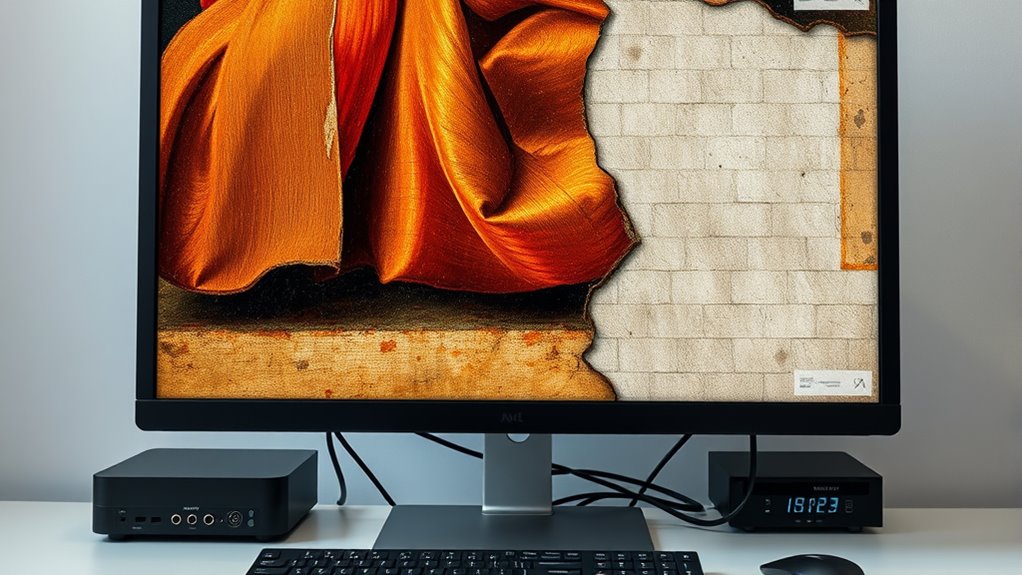
When artworks sustain damage over time, restoring their original beauty can be both challenging and delicate. You need precise methods that respect the artwork’s integrity while effectively repairing the damage. This is where advanced restoration techniques come into play, especially those enhanced by machine learning models. These models analyze patterns, colors, and textures within damaged pieces, helping restorers make informed decisions on how to reconstruct missing or deteriorated sections. Instead of relying solely on manual skills, which can sometimes be subjective or limited, machine learning models bring a data-driven approach that improves accuracy and consistency.
Using AI-powered restoration techniques, you can accelerate the restoration process while maintaining high standards of quality. These techniques often involve training machine learning models on vast datasets of artwork images, enabling the AI to recognize subtle details that might escape the human eye. When faced with a damaged painting, you feed the image into the model, which then predicts what the undamaged sections might have looked like. This process isn’t about replacing human expertise but augmenting it, providing restorers with a powerful tool to visualize potential reconstructions and guide their work. The models can suggest color matches, fill in missing fragments, and even simulate the original brushstrokes or textures, making the reconstructed sections blend seamlessly with the original.
Moreover, these AI-driven techniques allow for non-invasive restoration, which is vital for preserving the artwork’s authenticity. Traditional methods might require physical sampling or invasive procedures that risk further damage. In contrast, machine learning models analyze existing visual data, minimizing the need for physical intervention. This approach not only preserves the artwork’s integrity but also speeds up the restoration timeline, allowing museums and collectors to recover valuable pieces more efficiently.
However, it’s essential to understand that AI isn’t infallible. The effectiveness of these restoration techniques depends heavily on the quality and diversity of the data used to train the models. A well-trained model can greatly reduce guesswork, but it still requires skilled human oversight to guarantee the reconstruction respects the artwork’s historical and artistic context. When combined thoughtfully, these AI tools and traditional restoration techniques can achieve results that are both respectful and innovative, breathing new life into damaged masterpieces while safeguarding their legacy for future generations.

ADOBE PHOTOSHOP ELEMENTS 2026 USER GUIDE: A Practical Visual Manual To AI Photo Editing, Object Removal, Smart Fix, And Photo Restoration
As an affiliate, we earn on qualifying purchases.
As an affiliate, we earn on qualifying purchases.
Frequently Asked Questions
How Reliable Is AI in Accurately Restoring Original Artwork Details?
Artificial intelligence offers impressive restoration accuracy, but its reliability varies depending on the artwork and available data. You can trust AI to fill in missing details and enhance damaged sections, yet it may sometimes make assumptions that don’t perfectly match the original. While AI greatly aids restoration, you should still review its work critically to guarantee the accuracy aligns with historical and artistic contexts.
Can AI Reconstruct Missing Parts Without Historical Reference Images?
You might find that AI, fueled by artificial intuition and creative imagination, can often fill in missing parts even without historical reference images. While it doesn’t replace authentic historical insight, it offers a delightful sense of artistic intuition, helping to imagine what once was. This process, however, relies on algorithms that interpret patterns, so it’s more about inspired guesses than precise reconstructions. Still, it’s a fascinating blend of technology and artistry.
What Are the Ethical Concerns Regarding Ai-Altered Artwork Authenticity?
You should consider that AI-altered artwork raises ethical concerns about authenticity verification, as it can obscure the lines between original and modified pieces. When AI changes an artwork, it may conceal the artist’s original intent, making it harder to determine what truly reflects their vision. This challenges collectors and museums to ensure transparency and respect the creator’s original message, maintaining trust in art’s integrity.
How Does AI Handle Diverse Artistic Styles and Mediums?
Oh, AI effortlessly masters every artistic style and medium, right? In reality, it struggles with true artistic diversity and medium adaptation. You might think it captures delicate watercolor strokes or bold oil textures seamlessly, but often it oversimplifies or misinterprets unique nuances. While AI can mimic many forms, it still falls short of genuine creativity, reminding you that technology isn’t quite ready to replace the rich complexity of human artistry.
What Are the Limitations of AI in Restoring Highly Degraded Pieces?
You’ll find that AI faces conservation challenges when restoring highly degraded pieces, as it struggles with missing details and complex textures. Its limitations include potential inaccuracies due to artistic interpretation, which can lead to guesswork rather than precise restoration. AI may also misinterpret stylistic nuances, making it less reliable for highly damaged artworks that require careful, human-led conservation efforts to guarantee authenticity and integrity.
artwork damage reconstruction tools
As an affiliate, we earn on qualifying purchases.
As an affiliate, we earn on qualifying purchases.
Conclusion
As you stand before a damaged masterpiece, AI acts like a skilled detective, piecing together hidden clues to restore its original beauty. It breathes new life into shattered brushstrokes and faded colors, transforming broken fragments into a vivid story once more. With every reconstruction, AI proves it’s like a time traveler, bridging the past and present. Thanks to this technology, damaged artworks can rise from the ashes, shining brighter than ever before.

Paint Thickness Gauge CM-224 Auto – Digital Coating Thickness Meter for Cars and Automotive Inspection, Fe / Al / Fe+Zn Detection, 0.1 μm Resolution, Factory Calibrated, Large Backlit LCD
HIGH ACCURACY — READY TO USE FOR CAR INSPECTION: Professional paint thickness gauge with factory-calibrated accuracy for automotive…
As an affiliate, we earn on qualifying purchases.
As an affiliate, we earn on qualifying purchases.
non-invasive art restoration technology
As an affiliate, we earn on qualifying purchases.
As an affiliate, we earn on qualifying purchases.