
📊 Full opportunity report: Unlocking Authenticity: Real World VoiceEQ And The Future Of Voice AI on ThorstenMeyerAI.com — validation score, market gap, and execution plan.
TL;DR
The VoiceEQ benchmark, developed by a team on Hugging Face, assesses over 40 voice AI models using human ratings across 60+ metrics. It reveals that current systems excel in some areas but often miss nuanced acoustic cues, raising questions about their real-world readiness.
Real World VoiceEQ, a comprehensive human-evaluation benchmark for voice AI, has been launched by a team on Hugging Face. It tests more than 40 models across over 60 metrics, revealing that many leading systems perform less reliably in real-world conditions than traditional benchmarks suggest. This highlights the importance of comprehensive human evaluation, as detailed in the original analysis. This development underscores ongoing challenges in creating truly natural and dependable voice assistants.
The VoiceEQ benchmark evaluates voice models on a broad range of factors, including tone, emotion, speaker identity, background noise, pronunciation, and conversational behavior. You can learn more about the original VoiceEQ analysis. It is based on over 1 million human ratings collected from diverse demographics, speaking styles, and environments. The evaluation includes 785,000 text-to-speech ratings and 48,000 speech-to-speech ratings, all conducted via the team’s Kairos platform.
According to the authors, no single model dominated across all capabilities; instead, different models showed strengths in specific tasks. Some excelled in accurately reproducing content like names or references, while others produced more expressive speech but struggled with accuracy. This suggests that organizations may need to select models tailored to particular operational needs rather than relying on a single, all-purpose system.
Implications for Voice AI Development and Deployment
The VoiceEQ benchmark highlights significant gaps between current voice AI performance in controlled tests and their reliability in real-world scenarios. As models often miss nonverbal cues such as tone, hesitation, and emphasis—crucial for conveying confidence or emotion—these findings suggest that many systems may not yet deliver truly natural or trustworthy interactions. This has implications for sectors like healthcare, banking, and customer service, where accuracy and nuanced understanding are critical.
Furthermore, the results question the sufficiency of traditional metrics like word error rate and latency, which do not account for emotional tone, speaker identity, or background noise. The authors warn that improvements in these conventional measures may overstate practical readiness, emphasizing the need for more comprehensive evaluation methods.
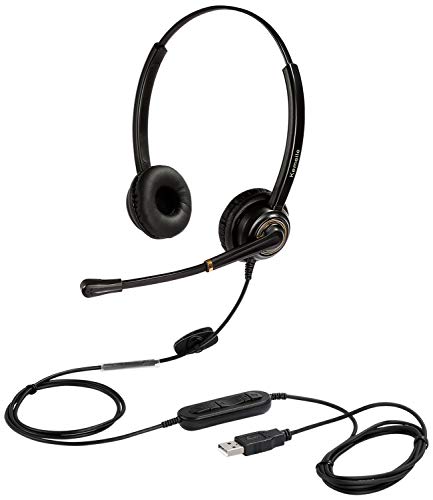
USB Headset with Microphone Noise Cancelling and Volume Controls, Computer PC Headphone with Voice Recognition Mic Works for Dragon Teams Zoom Skype Softphones Conference Calls Online Education etc
CRYSTAL CLEAR SOUND QUALITY: This USB computer headset with noise cancelling microphone and HD wideband speaker delivers you…
As an affiliate, we earn on qualifying purchases.
As an affiliate, we earn on qualifying purchases.
Limitations of Conventional Speech Benchmarks
Traditional benchmarks primarily measure word error rates and response latency, which do not capture the full complexity of human speech, such as emotional nuance, speaker variation, or background interference. Recent studies, including those underlying VoiceEQ, reveal that models with low word error rates can still falter in noisy environments or when interpreting tone and hesitation. Prior research has shown that transcription errors increase significantly with background noise, but existing tests often overlook these challenges, leading to overly optimistic assessments of model capabilities.
The VoiceEQ project builds on this understanding by providing a more detailed, human-rated evaluation framework. Its findings suggest that current models are often tuned for performance on standard benchmarks but lack robustness in diverse, real-world scenarios, highlighting the ongoing need for comprehensive testing.
“Voice models have become better at speaking than actually listening.”
— Thorsten Meyer, Lead Researcher

Tonfarb 136GB Digital Voice Recorder with Playback,9000 Hours Audio Recording Device,Voice Activated Recorder with Noise Reduction,A-B Repeat,MP3 Player,Password for Lecture Meeting/Classes/Interviews
【PCM Recording and Automatic Noise Reduction】:This digital voice recorder is equipped with advanced dual noise reduction microphones and…
As an affiliate, we earn on qualifying purchases.
As an affiliate, we earn on qualifying purchases.
Unverified Aspects and Future Validation Needs
Details about the full rankings of models, sampling procedures, and statistical measures remain undisclosed. It is unclear how often the benchmark will be updated, whether results are reproducible, or if vendors had access to test data. The claim that models are tuned to benchmarks is preliminary, and independent verification of the findings has not yet been published. Further research is needed to confirm these results and assess their generalizability across different voice applications.

Translator Pen, Scan Reader Pen, Language Translator Device
【Speech to Text】The translation pen not only supports scanning translation, but also supports 112 online real-time two-way voice…
As an affiliate, we earn on qualifying purchases.
As an affiliate, we earn on qualifying purchases.
Next Steps for Voice Model Evaluation and Improvement
Researchers and developers are expected to scrutinize the full methodology once it is publicly available, aiming to reproduce results and identify specific weaknesses. Future updates may assess whether newer models improve in tone, hesitation, and emotional nuance, moving beyond transcript accuracy. Industry stakeholders will likely incorporate VoiceEQ metrics into their testing processes to better gauge real-world readiness and guide model development toward more natural, reliable voice interactions.

YoLink SpeakerHub – Smart Home Speaker Hub, Plays Tones/Alarms and Your Text-to-Speech Custom Messages, Voice Announcements, Audio Voice Alert, Spoken Alerts, LoRa-Powered ¼ Mile Range, WiFi Required
Audible Notifications – be informed of system alerts and events with your selected sounds/tones as well as text-to-speech…
As an affiliate, we earn on qualifying purchases.
As an affiliate, we earn on qualifying purchases.
Key Questions
What is the main purpose of the VoiceEQ benchmark?
It aims to evaluate how well voice AI systems recognize, generate, and respond to acoustic and conversational cues beyond simple transcription accuracy, focusing on real-world speech qualities like emotion and tone.
How many models and metrics does VoiceEQ assess?
It evaluates over 40 voice models across more than 60 metrics, based on over 1 million human ratings collected during development.
Does the benchmark identify a single best voice model?
No, the results show different models excel in different capabilities; no one system dominates across all evaluated areas.
Why are traditional metrics like word error rate insufficient?
Because they do not capture emotional nuances, speaker identity, background noise, or hesitation, which are essential for natural and reliable voice interactions.
What remains uncertain about the VoiceEQ findings?
Full rankings, statistical robustness, update frequency, and independent verification are not yet available, so the results should be considered preliminary pending further validation.
Source: ThorstenMeyerAI.com