
📊 Full opportunity report: The SSD Squeeze: Why Storage Joined the Party on ThorstenMeyerAI.com — validation score, market gap, and execution plan.

Get business pricing on monitors, keyboards and dev gear
- Business-only prices and quantity discounts
- Tax-exempt purchasing
- Multiple users, one account, clear invoices
TL;DR
Storage, especially SSDs, is experiencing a significant price increase driven by AI’s demand and wafer competition among memory makers. This shortage affects enterprise, consumer, and industrial markets, with prices expected to remain high.
SSD prices have surged by up to 100% or more in 2026 as supply shortages driven by AI demand and wafer competition tighten the market, impacting both enterprise and consumer sectors. This development marks a significant shift from the decade of declining storage costs, signaling a new era of higher prices and constrained availability.
In 2024, the average price of a 2TB NVMe SSD was around $120–150, but by 2026, it has doubled or tripled, with enterprise SSD contract prices jumping over 50% in a single quarter at the start of the year. Major manufacturers like Samsung, SK Hynix, and Micron have reduced their NAND wafer targets, citing strategic prioritization and profitability, leading to a supply crunch.
Two main factors drive this shortage: first, NAND production shares fabs with high-margin HBM and DRAM, which are prioritized for high-performance memory needs. Second, AI applications now consume enormous amounts of storage, with high-end AI servers requiring over 1,000TB of NAND, and inference workloads demanding fast, high-IOPS SSDs for vector database querying and model caching. This surge in AI-driven storage demand is forecasted to boost NAND market revenue by over 100% in 2026.
Industry insiders confirm that new fabs are at least two to three years away, and existing capacity is being deliberately scaled back or allocated to higher-margin enterprise customers. This strategic restraint is driven by the high profitability of current shortages, especially for memory firms like Samsung, which reports record profits largely due to this scarcity.
The SSD squeeze: storage joined the party
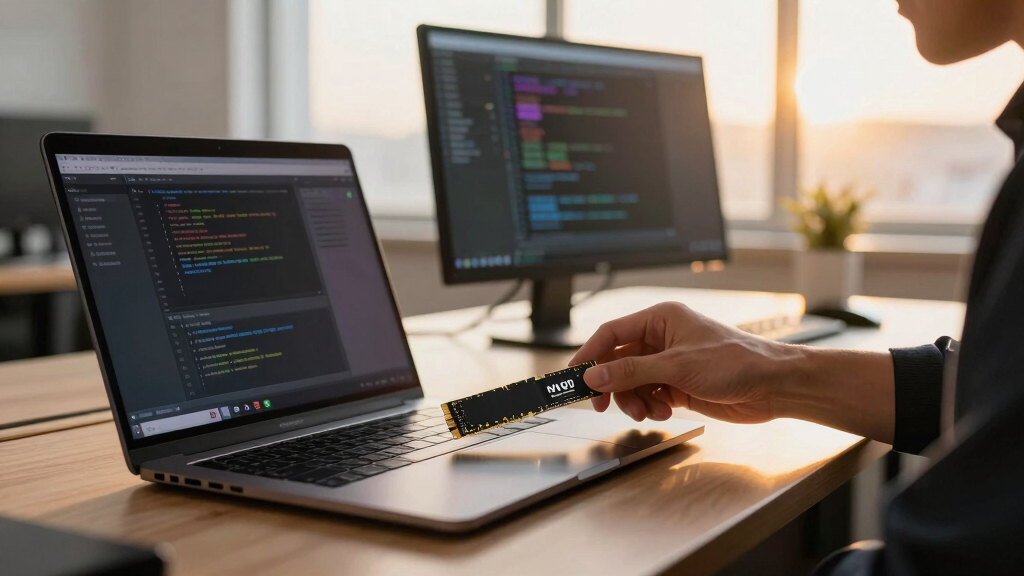
Storage was the last cheap thing in computing. Not anymore — a 2TB NVMe that was $120–150 in 2024 now lists at $300–480. And this time flash isn’t only collateral damage: AI eats storage directly.
both ways
Flash got hit twice — once as collateral sharing fabs with HBM, once directly as AI inference turned fast storage into something it consumes by the petabyte. That second force won’t fade; it grows with every model, every RAG pipeline, every cache that must live somewhere fast. Buy what you need now; favor TLC with DRAM cache, don’t overpay for Gen 5, watch for counterfeits. Relief isn’t forecast before late 2027. When the cheapest component in computing has a two-year waitlist, “commodity” no longer fits. Next: The High-End PC & Workstation Tax.
Impacts of Storage Shortage on Tech Markets
This shortage fundamentally alters the economics of storage hardware, affecting consumers, enterprises, and AI developers. Rising costs mean fewer affordable options for consumers and longer lead times for industrial and automotive buyers. For AI, the increased storage costs and scarcity could slow deployment and innovation, while for manufacturers, the focus on higher margins may delay capacity expansion. Overall, this marks a shift from the era of cheap storage to one where supply constraints and strategic prioritization dominate pricing and availability.
As an affiliate, we earn on qualifying purchases.
NAND Market Trends and AI’s Growing Storage Role
For over a decade, NAND flash memory prices steadily declined, making storage a negligible cost factor in consumer and enterprise builds. However, starting in late 2025 and into 2026, prices have surged due to a combination of wafer competition—where NAND shares manufacturing lines with high-margin HBM and DRAM—and a sharp increase in AI’s storage requirements. High-end AI models demand tens of terabytes of fast NAND, and inference workloads are accelerating this trend. Industry reports indicate that NAND contract prices have multiplied four to four-and-a-half times in just nine months, reflecting a market under stress.
Major memory manufacturers have scaled back wafer production targets, citing strategic focus on profitability, with some firms prioritizing enterprise over retail markets. This strategic restraint is not driven by supply chain disruptions but by deliberate capacity management, aiming to maximize margins amid high demand.
“Our entire 2026 NAND production is sold out, and we are prioritizing server and enterprise customers over retail, which is driving prices higher.”
— A senior executive at Phison
As an affiliate, we earn on qualifying purchases.
Extent and Duration of the Storage Shortage
While market trends indicate a persistent shortage through 2026, the exact duration remains uncertain, especially as new fabs are still years from operational status. The degree to which current high prices are driven by deliberate capacity restraint versus genuine supply limitations is also not fully clear. Additionally, how long manufacturers will continue to prioritize high-margin enterprise and AI applications over consumer markets remains open to change.
As an affiliate, we earn on qualifying purchases.
Market Outlook and Capacity Expansion Plans
Industry analysts expect that new NAND fabs will take at least two to three years to become operational, meaning high prices and supply constraints may persist through 2027. Manufacturers may continue to prioritize high-margin segments, but eventual capacity expansion—either through new facilities or process improvements—could alleviate shortages. Buyers should prepare for sustained higher costs and longer lead times, especially for enterprise and AI storage solutions.
fast NVMe SSD for gaming and content creation
As an affiliate, we earn on qualifying purchases.
As an affiliate, we earn on qualifying purchases.
Key Questions
Why are SSD prices rising so rapidly in 2026?
Prices are rising due to a combination of deliberate supply constraints by manufacturers, increased demand from AI applications, and competition for wafer space with high-margin memory types like HBM and DRAM.
How long will the storage shortage last?
Most industry forecasts suggest shortages may continue into 2027, as new fabs are still at least two years away from full production, and capacity expansion is limited by strategic priorities.
Who is most affected by the rising storage costs?
Enterprise buyers, industrial and automotive sectors, and consumers facing higher drive prices and longer lead times are most affected. High-demand AI applications are also contributing to the scarcity.
Will new manufacturing capacity eventually ease the shortage?
Yes, but only once new fabs become operational in the next two to three years. Until then, prices and shortages are likely to persist, especially as manufacturers prioritize higher-margin markets.
Are all types of NAND flash equally affected?
No, high-end TLC and pSLC NAND are more affected due to their use in industrial and automotive applications, where lead times have stretched significantly. QLC NAND, used mainly for bulk storage, is also impacted but to a different extent.
Source: ThorstenMeyerAI.com
Columbus Day / Indigenous Peoples' Day Picks
long weekend sales
As an affiliate, we earn on qualifying purchases.