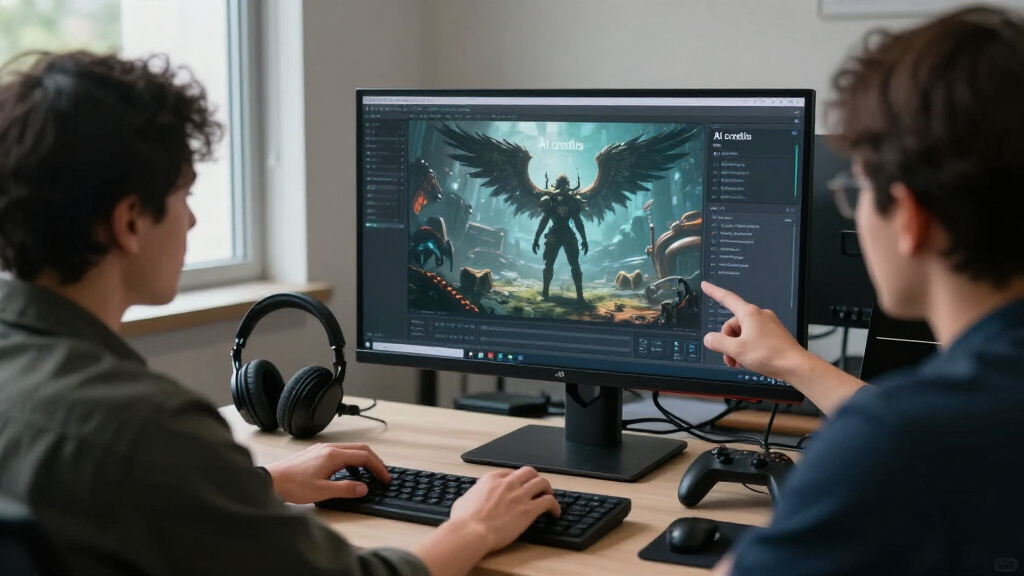

🔍 Read the full analysis: The Art Of AI Credits In “After Action — Wing V Debrief Theater” on ThorstenMeyerAI.com

Get business pricing on monitors, keyboards and dev gear
- Business-only prices and quantity discounts
- Tax-exempt purchasing
- Multiple users, one account, clear invoices
TL;DR
“After Action — Wing V Debrief Theater” is an AI-built exhibition piece, not a real company or an account of military activity. Its live-site concept presents 24 web experiences through a navigable cinematic credit roll, with code-built sand-table scenes and a stationary linked index.
“After Action — Wing V Debrief Theater” presents credits for 24 web experiences as a continuous, interactive film roll, according to the original analysis published by ThorstenMeyerAI.com. The AI-built exhibition is explicitly fictional: it is not a real company or an account of military activity, but a website that uses a nearly empty cinema and miniature sand-table scenes to frame a collection of digital work.
Instead of arranging the projects as a gallery of cards, the site makes the credit roll its main navigation. JavaScript tracks elapsed time and moves a continuous strip with a transform. Chapter stops coordinate the time display, locator line, chapter label and jump controls, letting visitors pause the sequence or move between sections. The moving names are removed from keyboard focus; a stationary linked register after the theater provides another way to reach the same material.
The visual direction combines cinema black, beam-white, sand amber and credit gold, with compressed display lettering for titles and monospace type for controls and explanatory text. Letterbox bars, grain, registration marks and a projected beam make the browser resemble a screening space. Every eight productions, the roll gives way to CSS-built miniature scenes: terrain panels, contour effects and raised markers suggest a shield formation, a catapult’s arc and two keys approaching a lock.
The source says motion is limited by page visibility and user settings: the animation pauses when the page is hidden, and reduced-motion users receive a manual-scroll option. A scene activates when it enters the viewing area. The described build uses a local still image for its hero rather than the intended ambient video, with layered visual effects; the miniature terrain and atmospheric elements are generated in code. Optional synthetic projector audio starts off and stops when disabled. A plain-text index offers a non-moving route through the projects.
AI Exhibition · Interface Study
The Art of AI Credits in “After Action”
A fictional theater turns 24 web experiences into one navigable cinematic credit roll. The concept frames digital work as an exhibition, using chapter stops, miniature sand-table scenes and a stationary linked index.
01 / The interface
Credits become navigation
Instead of presenting projects as a grid of cards, the exhibition makes its credit sequence the main way through the collection. Visitors can follow the moving reel, jump between chapters or use the fixed register.
A film-like roll
JavaScript tracks elapsed time and moves a continuous strip. A time display, locator line, chapter label and jump controls coordinate at each stop.
Chapters with control
Visitors can pause the sequence or move between sections. The design makes the production list an active interface rather than end credits.
A linked register
A plain-text index after the theater offers a still route to the same projects. The moving names are removed from keyboard focus.
02 / The viewing sequence
A collection in chapters
The roll alternates between groups of productions and code-built miniature scenes, turning navigation into a paced exhibition experience.
Enter the theater
Cinema black, beam-white, sand amber and credit gold establish the screening-space mood.
Follow eight credits
A continuous moving track carries the names, with chapter stops and jump controls.
Pause for a miniature
CSS terrain panels, contour effects and raised markers suggest small mechanical scenes.
Browse the full index
The stationary linked register provides another way to reach each experience.
03 / Art direction & access
Atmosphere with alternate routes
The visual language borrows from cinema, while the described controls offer multiple ways to move through the work.
Screening-space details
Compressed display lettering gives titles a theatrical feel; monospace type handles controls and explanatory text. Letterbox bars, grain, registration marks and a projected beam add depth. The described build uses a local still image for its hero because the intended ambient video was unavailable. Miniature terrain and atmospheric layers are generated in code.
- ✓Stationary linked index for a non-moving route
- ✓Chapter controls to pause or jump through the sequence
- ✓Manual-scroll option described for reduced-motion users
- ✓Animation pauses when the page is hidden
- ✓Optional synthetic projector audio starts off and stops when disabled
04 / What the source establishes
Build details still unverified
The supplied ThorstenMeyerAI.com account describes a live-site concept and its intended behavior. It does not include independent technical testing, user evaluations or measured frame-rate results.
Read the claims in context
The art-direction brief specifies a single-page build with HTML, CSS and JavaScript, responsive layouts, keyboard focus styles and reduced-motion behavior. The supplied material does not include screenshots or test reports showing that each target was met. It also does not establish who implemented each part, when the site was published, or whether it has changed since the description. No real organization or military activity is substantiated.
What is “After Action — Wing V Debrief Theater”?
An AI-built fictional exhibition presenting a theater and credits for 24 web experiences.
What happens between credit sections?
After every eight productions, a CSS-built sand-table scene appears.
Does the described build use ambient video?
No. The intended video was unavailable, so a locally stored still image is used.
What is the best next check?
Visit the live site to examine how the credit roll, controls, miniatures and register currently behave.
Credits Become the Interface
The project’s design makes a production list into an active navigation system, rather than treating credits as information that appears after the main experience. Visitors can follow the sequence as a reel, jump between chapters or use the fixed register. That approach matters for creative websites with many related projects: presentation and access are built into the same structure, rather than relying on a visual effect alone.
It also makes the limits and choices of AI-assisted web production visible. The exhibition pairs an art direction brief with a described implementation using browser technologies, while distinguishing code-generated scenes from a locally stored hero image. Its fictional military framing is presented as visual metaphor, not evidence of real operations. The result is best understood as an experiment in interface and exhibition design, not as reporting about a company or military program.
The accessibility details are relevant because a fast-moving credit sequence can be difficult to use. The stationary index, chapter controls, reduced-motion alternative and pause behavior provide different ways to browse. The supplied material describes those features, but does not provide independent testing results or performance measurements.
interactive cinematic credit roll display
As an affiliate, we earn on qualifying purchases.
As an affiliate, we earn on qualifying purchases.
A Fictional Wing V Collection
The source identifies After Action as room 125 of 175 in a larger exhibition and describes it as a finale imagining how 24 web experiences might take their final bow. The projects are named as productions in the Wing V theater; the supplied text does not establish that Wing V is a real organization. It characterizes the setting as a fictional cinema and the miniature machinery as a way to emphasize interaction design rather than harm.
The included art-direction brief calls for a single-page site built with HTML, CSS and JavaScript, without frameworks or external requests. It names all 24 project slugs, asks for a plain-text index, and specifies responsive layouts, keyboard focus styles and reduced-motion behavior. The source also says the atmospheric video intended for the theater was unavailable in the described build, so a local still image is used instead. This distinction is part of the account of the current implementation, not proof that every requested design or technical target has been independently verified.
““the credits treating websites as films””
— The supplied art-direction brief
As an affiliate, we earn on qualifying purchases.
Build Details Still Unverified
The supplied material describes the live-site concept and its intended behavior, but it does not include independent technical testing, user evaluations or measured frame-rate results. Although the brief specifies responsive checks at three screen widths and other quality targets, the source does not provide screenshots or test reports demonstrating that each target was met.
It is also not clear from the supplied text when the site was published, who implemented each part of the final build, or whether the live version has changed since the description was written. The unavailable ambient video is identified as a limitation of the described build; the source does not say whether that asset has since been added. No further claims about an actual organization or military activity are substantiated by the material.
As an affiliate, we earn on qualifying purchases.
The Live Site Is the Next Check
The source directs readers to visit the live After Action site, where the credit roll, chapter controls, miniatures and linked register can be examined directly. A visit can clarify how those elements behave in a browser, including whether the described still-image treatment and motion alternatives remain in place. The source does not announce a release date, a scheduled update or a follow-up event, so any changes beyond the described build remain unknown.
As an affiliate, we earn on qualifying purchases.
Key Questions
What is “After Action — Wing V Debrief Theater”?
It is an AI-built exhibition piece that presents a fictional theater and a credit roll for 24 web experiences. The source says it is not a real company or an account of military activity.
How does the credit roll work?
The site moves one continuous track using JavaScript and offers chapter stops, a time display, a locator and jump controls. A stationary linked register provides another route to the projects.
What happens between sections of credits?
After every eight productions, the sequence gives way to a small, CSS-built sand-table scene. The examples described include a shield formation, a catapult’s arc and two keys moving toward a shared lock.
Does the described build use video or images throughout?
No. The source says the intended ambient video was unavailable, so the theater uses a locally stored still image with visual effects. The miniature scenes and atmospheric layers are described as code-generated.
What accessibility options are described?
The moving names are not placed in keyboard focus, and a linked register offers stationary navigation. The source also describes chapter controls, a manual-scroll option for reduced-motion users and animation that pauses when the page is hidden.
Source: ThorstenMeyerAI.com
Fall Picks
fall essentials
As an affiliate, we earn on qualifying purchases.
![I 3D Printed Origami [video]](https://bestcadpapers.com/wp-content/uploads/2026/05/i-3d-printed-origami-video-featured-560x300.jpg)