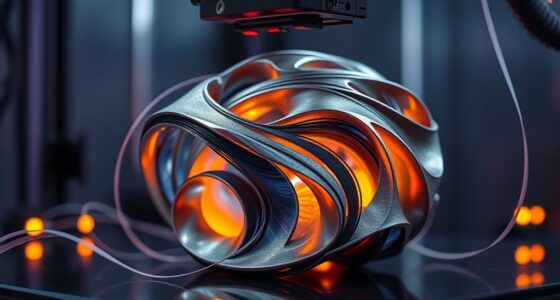
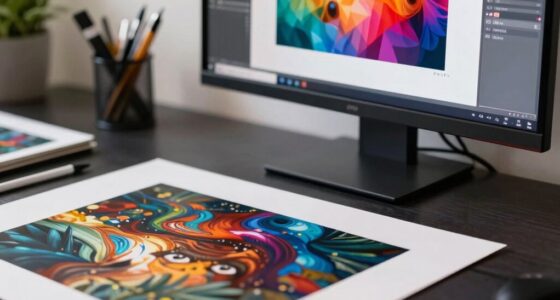
Multi‑material 3D printing allows you to create prototypes with multiple materials in a single build, making them more realistic and functional. You can combine flexible, rigid, or conductive materials to test various properties and simulate real-world conditions. This technology speeds up your development process by reducing assembly steps and enabling quick iteration. If you keep exploring, you’ll discover how to harness these advanced capabilities for more precise and impactful prototypes.

Get business pricing on monitors, keyboards and dev gear
- Business-only prices and quantity discounts
- Tax-exempt purchasing
- Multiple users, one account, clear invoices
Key Takeaways
- Multi-material 3D printing enables the creation of complex prototypes with integrated aesthetic and functional features in a single build.
- It allows seamless color blending and realistic visual effects, improving prototype presentation and stakeholder communication.
- Customizable mechanical properties through different materials support functional testing and performance evaluation.
- The technology accelerates prototyping workflows by reducing assembly steps and enabling rapid iteration of material combinations.
- Ongoing advancements provide greater control over material placement, enhancing prototype fidelity and real-world simulation capabilities.

Have you ever wondered how 3D printing is evolving beyond single-material models? Today’s multi-material 3D printing opens a world of possibilities, especially when it comes to prototyping. Instead of creating separate parts or relying on post-processing, you can now design complex prototypes that incorporate multiple materials in a single build. This advancement allows you to simulate real-world product conditions more accurately, saving time and reducing costs. One of the most exciting aspects of multi-material printing is color blending. By combining different filaments, you can produce prototypes with seamless color transitions, giving you a more realistic visual impression of your final product. This is especially valuable when demonstrating aesthetics or branding details to clients or stakeholders. Instead of painting or assembling separate components, you get a unified piece that clearly showcases your design intent.
Multi-material 3D printing enables seamless color blending and complex prototypes in a single build.
Beyond aesthetics, multi-material printing considerably impacts the mechanical properties of your prototypes. You can strategically incorporate flexible, rigid, or even conductive materials within a single print. This means you’re no longer limited to uniform properties throughout your model; instead, you can engineer specific areas to be more durable, elastic, or lightweight. For instance, a prototype of a wearable device could have a soft, flexible exterior combined with a rigid internal support structure. This level of customization helps you evaluate how different material combinations perform under real-world conditions, leading to better-informed design decisions before moving to production.
The ability to blend colors and tailor mechanical properties simultaneously makes multi-material 3D printing a powerful tool for prototyping. You can quickly iterate designs, testing how different material combinations influence function and appearance. This flexibility accelerates the development process, allowing you to experiment with various configurations without the need for multiple print runs or complex assembly steps. Additionally, advances in multi-material printers now enable more precise material placement, ensuring that your prototypes accurately reflect the intended design and functional requirements.
In essence, multi-material 3D printing pushes the boundaries of what you can achieve in prototyping. It combines aesthetic versatility through color blending with functional adaptability thanks to varied mechanical properties. This technology empowers you to create more realistic, functional, and visually appealing prototypes in a single print, streamlining your workflow and enhancing your ability to communicate complex ideas effectively. As it continues to evolve, expect even more innovative solutions that will further integrate multiple materials seamlessly, making your prototypes more sophisticated and closer to final products than ever before. Additionally, understanding the multi-material capabilities of your printer allows for more precise control over the final outcome, further expanding the possibilities of your designs.
As an affiliate, we earn on qualifying purchases.
Frequently Asked Questions
What Are the Best Multi-Material 3D Printers for Small Businesses?
You should consider the Ultimaker S5 or the Prusa Multi-Material Upgrade, as they offer excellent material compatibility and reliable print speed. These printers are user-friendly, versatile, and perfect for small businesses needing multi-material prototypes. They enable you to create complex, multi-material parts efficiently, saving you time and resources. Both options provide high-quality results, making them ideal choices for your prototyping needs.
How Do Multi-Material Printers Handle Complex Geometries?
Multi-material printers handle complex geometries by using advanced print resolution and material compatibility features. You can print intricate designs with precision, as the printer switches between materials seamlessly. The high print resolution allows for detailed features, while compatibility guarantees you use various filaments to achieve desired properties. This combination enables you to create complex, multi-material parts efficiently, making your prototypes more functional and realistic.
What Post-Processing Steps Are Needed for Multi-Material Prints?
Imagine your multi-material print is a sculpture needing polish. You’ll likely start with removing support structures, then inspect for any material adhesion issues. Surface finishing involves sanding or smoothing to enhance appearance and function. Sometimes, you might need to apply a sealant or paint for durability. Just like polishing a statue, proper post-processing guarantees your multi-material print looks professional and performs reliably.
How Cost-Effective Is Multi-Material 3D Printing for Prototypes?
Multi-material 3D printing can be cost-effective for prototypes if you value material diversity and detailed testing. While initial costs are higher than single-material prints, it reduces the need for multiple printing setups and assembly steps. A cost comparison shows savings in time and labor, especially when testing complex designs with different properties. Overall, it offers a versatile, efficient solution that can justify the investment for advanced prototyping needs.
Can Multi-Material 3D Printing Be Used With Biodegradable Materials?
Imagine a 3D printer weaving together vibrant, biodegradable filaments that dissolve into the earth. Yes, multi-material 3D printing can use eco-friendly materials, including biodegradable filaments. These materials are designed to break down naturally, making your prototypes not only innovative but also environmentally conscious. By choosing biodegradable options, you contribute to reducing plastic waste, turning your prototypes into sustainable solutions that support a greener future.
multi-material 3D printing filament
As an affiliate, we earn on qualifying purchases.
As an affiliate, we earn on qualifying purchases.
Conclusion
With multi-material 3D printing, you gain endless creative possibilities for prototypes, blending different materials seamlessly. This tech revolutionizes how you approach design, making complex, functional models more accessible than ever—kind of like having your own 3D printing Bat-Signal. Embrace this innovation, and you’ll stay ahead in the game, turning ideas into reality faster than you can say “HoloLens.” So go ahead, push boundaries, and bring your visions to life with multi-material 3D printing.
As an affiliate, we earn on qualifying purchases.
color blending 3D printing filament
As an affiliate, we earn on qualifying purchases.
As an affiliate, we earn on qualifying purchases.
Fall Picks
fall essentials
As an affiliate, we earn on qualifying purchases.