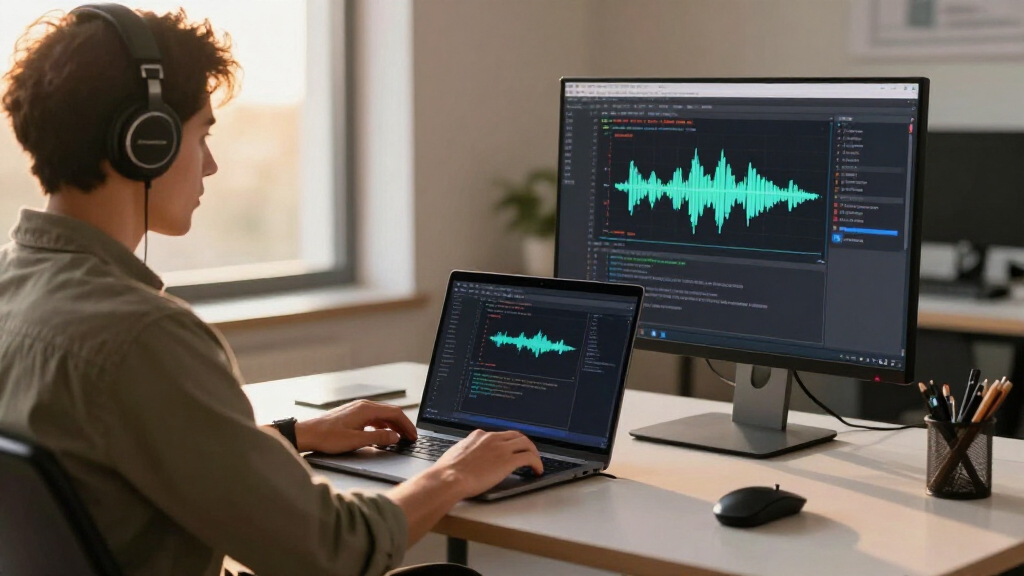

📊 Full opportunity report: MiniMax H3: The AI Transformer With Sound — Breaking Down 'Open' Access on ThorstenMeyerAI.com — validation score, market gap, and execution plan.

Get business pricing on monitors, keyboards and dev gear
- Business-only prices and quantity discounts
- Tax-exempt purchasing
- Multiple users, one account, clear invoices
TL;DR
MiniMax H3, a new AI model, was launched on July 31, 2026, providing 2K video with integrated sound via an API. Its architecture predicts audio and video jointly, improving lip-sync quality. However, full open access remains limited, with only base model weights available and a hosted upscaling stage.
On July 31, 2026, MiniMax officially launched its H3 model, a multimodal AI system capable of producing 2K video with synchronized sound through a single network. This development marks a significant shift in AI video generation, emphasizing joint audio-visual prediction within one architecture, rather than separate staged processes.
The MiniMax H3 model is built on the H3-Omni-Transformer, featuring 33 billion parameters, 50 layers, and rotary position embeddings across time, height, and width. It processes text, images, video, and audio as a unified context, predicting both audio and video latents simultaneously. The output includes clips of 4 to 15 seconds, at approximately 24 frames per second, with native stereo sound generated in the same pass as the video.
Confirmed details include the model’s API deployment under the ID MiniMax-H3, and the output resolution of 2K, with clips delivered via the API. The base model generates 768-pixel short edges, with a separate hosted upscaling stage, H3-Regenerate-2K, used to produce full 2K resolution. The base model weights are not publicly available; only the upscaling stage remains hosted by MiniMax. The cost for each 2K generation is estimated at around one dollar.
MiniMax describes H3 as a general-purpose multimodal generator, capable of understanding and referencing multiple media types in natural language prompts, such as matching camera movements from one video, syncing vocals with images, or referencing specific audio cues. This integrated approach aims to simplify workflows that traditionally rely on multiple separate models and pipelines.
MiniMax H3 predicts picture and stereo audio in the same pass, from one dense network — a cleaner answer to audio-visual coherence than the stitched pipelines it competes with. Its openness is narrower than the headlines suggest.
▲ No independent benchmarks yet · all quality claims trace to MiniMaxThe conventional way to get a scored, talking clip stitches four models and prays they align. Every seam is a place for drift. H3 predicts both latent streams jointly.
Each junction is a seam where a syllable lands a frame late or a footfall misses the step.
one dense sequence →
Jointly predicted. The model isn’t aligning two artifacts after the fact — it produces one that was audio-visual from the start.
The openness is real but heavily qualified — and the qualifications are exactly the ones a sovereignty-minded builder needs to see.
- Generates at a 768-pixel short edge
- A local render can be entirely local
- Community testing: 24GB+ VRAM to run
- Good fit for previs, animatics, draft passes
- Feeds the 768p result back through to upscale
- Stays on MiniMax’s servers
- Any delivery-grade output makes a round-trip
- DSGVO note: consider data routing for EU work
Two more catches: weights were promised “in the coming days,” not shipped — no H3 repo existed on MiniMax’s Hugging Face at launch. And the licence is custom, not OSI open source. “Open-weight base model under a custom licence” is a different thing from “open source.”
Launch coverage is conflating three near-identical labels. Trace any claim to MiniMax’s own H3 docs before trusting it.
Native single-pass audio removes an entire fragile stage from a generative-media pipeline. The catches are real and worth pricing.
- Single-pass audio kills a fragile stage — no separate speech, Foley, and sync sub-models to maintain.
- Sensible pipeline split: local 768p base for iteration, hosted 2K for finals only.
- Unified reference model folds camera, character, and audio references into natural language.
- Among the strongest open-weight video options if the base is previs-grade.
- Weights promised, not shipped. Verify the HF repo exists before planning around it.
- 2K is hosted — delivery-grade output requires a mandatory server round-trip.
- No independent benchmark — “comparable to proprietary” is untested by anyone neutral.
- Custom licence — commercial-use rights unanswered until the file is public.
The word “open” needs the asterisk every time.
Why Joint Audio-Visual Prediction Represents an Architectural Shift
The MiniMax H3 model's key innovation is its ability to generate synchronized audio and video in a single process, reducing alignment errors common in traditional pipelines. This approach offers potential improvements in lip-sync accuracy and sound-motion coherence, which are critical for realistic video generation. While performance claims are vendor-attested and lack independent benchmarks, the architecture itself is a notable technical advance, emphasizing integrated multimodal processing.
Despite the innovation, the open access is limited: only the base model weights are available, and the full 2K pipeline relies on a hosted upscaling stage. The licensing is custom, not open source, which constrains commercial use without explicit permission. This nuanced openness affects how developers and companies can integrate H3 into their products, balancing innovation with control.
As an affiliate, we earn on qualifying purchases.
Background on Multimodal Video Generation and Open Access Promises
Prior to H3, AI video models typically relied on multi-stage pipelines, combining separate text-to-video, image reference, and audio synthesis models. These pipelines often introduced synchronization issues and complex workflows. The industry has long sought more integrated solutions that can predict audio and video jointly, with some efforts from startups and research labs demonstrating promising results but lacking commercial deployment.
MiniMax's announcement builds on this background, emphasizing the architectural shift to a single transformer that handles multiple modalities simultaneously. The company initially promoted the model as 'open,' but the actual release includes only the base weights under a proprietary license, with the full 2K pipeline and training data remaining restricted. This reflects ongoing tensions between openness and control in AI model deployment.
"The core innovation of H3 is predicting audio and video jointly, which fundamentally improves lip-sync accuracy and sound-motion coherence."
— Thorsten Meyer, AI researcher
synchronized sound video generator
As an affiliate, we earn on qualifying purchases.
As an affiliate, we earn on qualifying purchases.
Remaining Questions About Performance and Access
It is not yet clear how H3's performance compares to established benchmarks, as no independent evaluations or third-party scores have been published. The quality of generated videos, especially in complex or long-form scenarios, remains to be tested. Additionally, the full open access to the model weights and pipeline is limited; the base model is not fully open source, and the licensing details may restrict commercial use. The impact of these restrictions on broader adoption is still uncertain.
As an affiliate, we earn on qualifying purchases.
Next Steps for Developers and Industry Watchers
MiniMax is expected to release the full 2K pipeline and possibly more detailed benchmarks in the coming months. Developers interested in integrating H3 will need to work through the API, as local full-resolution generation is currently restricted. Observers will be watching for independent performance evaluations, broader licensing clarifications, and potential open-source releases of the full model weights. Further improvements and extensions to the model are likely as the technology matures.
As an affiliate, we earn on qualifying purchases.
Key Questions
Can I run MiniMax H3 locally at full resolution?
Currently, only the base model weights are available for local use; the full 2K pipeline, including upscaling, remains hosted by MiniMax. Full local resolution generation is not yet possible.
Is the H3 model open source?
No, the base model weights are distributed under a custom license, not an OSI-approved open source license. This limits certain uses, especially commercial deployment.
How does H3 improve over previous models?
H3 predicts audio and video jointly within a single transformer, which reduces synchronization errors and improves lip-sync and sound-motion coherence, unlike traditional multi-stage pipelines.
What are the limitations of MiniMax H3 at launch?
The full 2K pipeline is not publicly available; only the base model can be run locally. Performance benchmarks are not yet independently verified, and licensing restrictions may limit commercial use.
Source: ThorstenMeyerAI.com
Fall Picks
fall essentials
As an affiliate, we earn on qualifying purchases.