
📊 Full opportunity report: Exploring The Impact Of AI And Real-Time Simulation On Surgical Robots on ThorstenMeyerAI.com — validation score, market gap, and execution plan.

Get business pricing on monitors, keyboards and dev gear
- Business-only prices and quantity discounts
- Tax-exempt purchasing
- Multiple users, one account, clear invoices
TL;DR
NVIDIA has launched Cosmos-H-Dreams, a generative simulator capable of producing surgical videos from robot commands in real time. The system is designed for research and development, but its clinical accuracy and performance metrics are not yet confirmed.
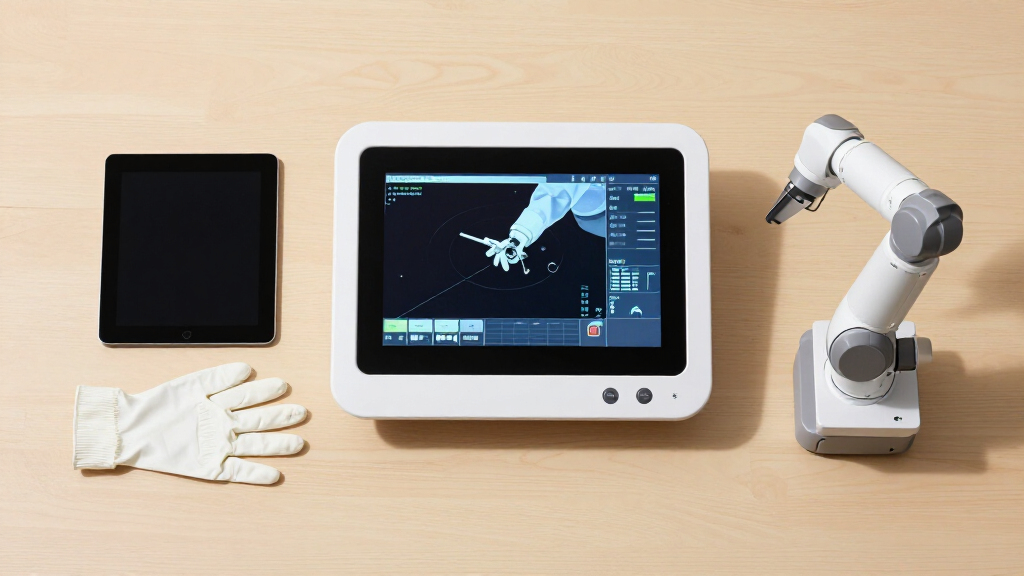
NVIDIA has introduced Cosmos-H-Dreams, a real-time, action-conditioned surgical video simulator designed to generate visual scenes based on live robot commands. The company claims the system can operate on a single RTX PRO 6000 GPU, enabling faster testing and development of surgical control policies. This development is significant for the field of robotic surgery research, as it could reduce reliance on physical experiments and improve simulation-based training.
The new system, Cosmos-H-Dreams, is a distilled version of NVIDIA’s earlier Cosmos-H-Surgical-Simulator, based on the Cosmos-Predict2.5-2B model. It processes sequential actions and generates corresponding video frames in real time, supporting applications like tabletop suturing with the da Vinci Research Kit. NVIDIA states that the simulator is trained with diverse data, including successful and failed procedures, to better represent the consequences of poor actions, which could enhance the realism of training scenarios.
NVIDIA reports that Cosmos-H-Dreams employs advanced techniques such as causal attention, streaming key-value caches, and self-forcing distillation, allowing it to generate high-quality frames with minimal denoising steps. The system is integrated with the FlashDreams streaming-inference library, facilitating fast, continuous simulation. The company also demonstrated its connection with the Versius surgeon controller, although there is no indication that it is being used in clinical settings or for autonomous surgery.
Performance metrics such as frame rate, latency, and image quality have not been disclosed, nor has there been independent validation or peer-reviewed testing. The system is positioned as a research tool, with further testing needed to confirm its reliability and safety in real surgical environments.
Potential Impact on Surgical Robotics Development
This development could significantly accelerate the testing and validation of control policies for surgical robots by providing fast, cost-effective, and repeatable simulation environments. If validated, Cosmos-H-Dreams could reduce the need for costly physical experiments, minimize risks to biological material, and facilitate rapid iteration in surgical tool design and training. However, without independent validation or clinical testing, the system’s accuracy in predicting real tissue behavior and safety-critical events remains unconfirmed, limiting immediate clinical application.
Products Worth Considering

Amazon Kindle Paperwhite (12th Generation, 2024), 16 GB, 7-inch Display, Jade

Bose QuietComfort Wireless Noise-Cancelling Over-Ear Headphones, Black

Anker SOLIX C200 DC Portable Power Station, 192Wh, 200W
As an affiliate, we earn on qualifying purchases.
Background of AI and Simulation in Surgical Robotics
Over recent years, advancements in AI and simulation have aimed to improve the safety, efficiency, and precision of robotic surgery. Prior systems relied heavily on physics-based models, which are complex and computationally intensive, often limiting real-time application. NVIDIA’s Cosmos-H-Dreams builds on earlier research into generative models that learn visual dynamics directly from video data, offering a potentially faster and more flexible approach. The company’s previous Cosmos-H-Surgical-Simulator supported offline policy evaluation, but the new streaming version aims to enable real-time closed-loop control, a critical step toward autonomous or semi-autonomous surgical systems.
While the technology shows promise, it has yet to undergo rigorous validation in clinical or preclinical settings, and its ability to accurately simulate tissue deformation, tool interactions, and other complex phenomena remains to be demonstrated in independent studies.
“Cosmos-H-Dreams represents a significant step toward real-time, visual simulation of surgical environments, but its clinical reliability is still to be confirmed.”
— Thorsten Meyer, AI researcher
Unresolved Questions About Validation and Deployment
It is not yet clear how well Cosmos-H-Dreams performs in terms of latency, stability, and physical accuracy, especially in complex surgical scenarios beyond tabletop suturing. The absence of peer-reviewed validation or independent testing raises questions about its readiness for clinical use. Additionally, details about hardware performance on systems other than the RTX PRO 6000, and whether the simulator can reliably predict tissue behavior or safety-critical events, remain unknown.
Next Steps for Validation and Clinical Testing
Future developments will likely focus on rigorous validation of Cosmos-H-Dreams in simulated and real surgical environments, including closed-loop control trials. Independent researchers will need to evaluate its performance, safety, and transferability to actual robotic systems. NVIDIA may also expand access, clarify hardware requirements, and specify supported platforms, moving toward potential clinical or commercial applications pending validation results.
Key Questions
What is NVIDIA Cosmos-H-Dreams?
It is an action-conditioned generative simulator that produces surgical video from robot commands, designed for research and development in robotic surgery.
Can Cosmos-H-Dreams operate autonomously on real surgical robots?
No, the system currently generates visual simulations based on robot commands; it is not yet designed for autonomous clinical operation.
What hardware is required to run Cosmos-H-Dreams?
The simulator is reported to run in real time on a single RTX PRO 6000 GPU. Performance on other hardware has not been disclosed.
Is Cosmos-H-Dreams validated for medical use?
No, it is currently a research tool, and its physical and clinical accuracy has not been independently validated or peer-reviewed.
What are the main limitations of the current system?
Performance metrics such as latency and image quality are undisclosed, and the system’s ability to accurately simulate complex tissue interactions remains unproven.
Source: ThorstenMeyerAI.com