TL;DR

Get business pricing on monitors, keyboards and dev gear
- Business-only prices and quantity discounts
- Tax-exempt purchasing
- Multiple users, one account, clear invoices
Google announced two new AI-assisted artworks by Xin Liu and Eunjo Lee, created during an online residency with LAS Art Foundation and Google Arts & Culture. The works, ‘nom nom’ and ‘In Your Eyes, Before My Own,’ explore collective intelligence, philosophy and psychology through Google AI tools.
Google announced on September 29, 2026 two new artworks by artists Xin Liu and Eunjo Lee, created during an online artist residency run by LAS Art Foundation in collaboration with Google Arts & Culture Lab. The commissions — Liu’s “nom nom” and Lee’s “In Your Eyes, Before My Own” — use Google AI tools to examine questions of philosophy, psychology, artificial life and consciousness, according to a report by Freya Salway, Head of the Google Arts & Culture Lab, on Google’s company blog.
The residency, conducted online, was designed to support artists exploring digital world building and the simulation of living systems, according to Google’s announcement. Liu and Lee were selected, in the company’s description, “for their exceptional technical skill and artistic imagination.”
Liu’s work, “nom nom” (2026), investigates how collective intelligence arises when millions of small particles interact. Google said the artist drew on research into artificial life and emergent computation by Google researchers Blaise Agüera y Arcas and Alexander Mordvintsev, and on the concept of Neural Cellular Automata (NCAs) — models in which millions of particles form, compete and dissolve into a self-organizing ecology.
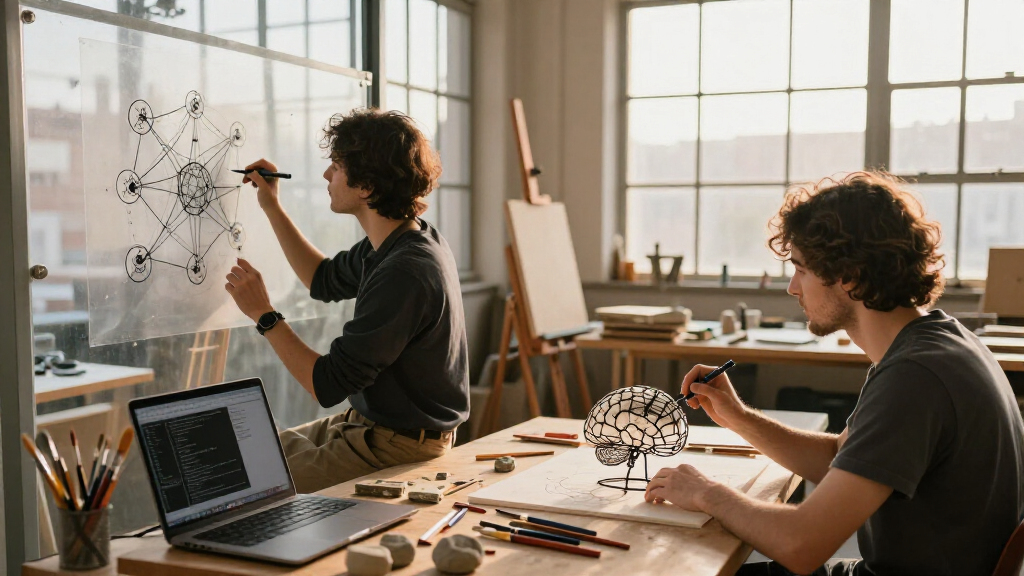
Lee’s “In Your Eyes, Before My Own” (2026) uses what the artist calls a “techno-alchemy” process bridging ancient philosophy, linguistics and modern psychology. According to Google’s report, Lee converted hand-drawn sketches into 3D assets using Nano Banana and Veo, layered motion-captured choreography onto characters, and mapped Korean Hangul phonetics onto the 3D environment to create a linguistic system reflecting the landscape’s geometry. Both works were commissioned by LAS Art Foundation in collaboration with Google Arts & Culture.
Why These Commissions Matter
The announcement is a high-profile example of a major technology company directly commissioning artists to interpret frontier AI research for a public audience. The works translate technically dense concepts — emergent computation, cellular automata, generative video tools — into artistic experiences, at a moment when public debate about AI is largely dominated by product launches and policy disputes.
The residency also functions as a showcase for Google’s own AI tools, including Veo and Nano Banana, which were used in Lee’s production pipeline. Readers following AI should note the dual character of the announcement: it is simultaneously a cultural program and a demonstration of the company’s generative AI capabilities in creative work. Google described the residency’s guiding question as how artists can use technology to deepen understanding of life, matter and consciousness.
The Residency and Its Research Roots
The Online Artist Residency is a program by LAS Art Foundation, a Berlin-based contemporary art institution, run in collaboration with the Google Arts & Culture Lab, the experimental arm of Google’s decade-old arts partnership initiative. According to Google’s announcement, the program’s brief was to support digital world building and simulation of living systems.
Liu’s work is grounded in research by two established Google researchers. Alexander Mordvintsev is known for his work on neural cellular automata, and Blaise Agüera y Arcas has published widely on artificial life and machine intelligence. Their research supplied the conceptual framework for “nom nom,” making the artwork a direct bridge between Google’s internal research and its public cultural programming.
“I want to explore an image of intelligence distributed across millions of tiny neural networks that react only to their surroundings — not as a singular mind above the world, but as a living ecology of fragments.”
— Xin Liu, artist
What Google’s Announcement Leaves Out
Google’s blog post does not specify where the artworks can be viewed beyond a guided video for “nom nom,” the duration of the residency, or how the artists were selected in practice. The announcement also notes that portions of the published article were generated with experimental Google AI, and the company itself flags that generative AI output is experimental. No independent commentary on the works was included in the source material, so critical reception remains unknown.
Future Residencies and Public Access
Google indicated readers can sign up for its newsletters for updates on Arts & Culture programs, suggesting further residency cycles or related commissions may follow, though no future residency dates or participants have been announced. The two commissioned works are dated 2026, and wider exhibition plans by LAS Art Foundation — if any — have not been detailed in the announcement.
Key Questions
What are the two new artworks announced?
“nom nom” by Xin Liu, exploring collective intelligence through Neural Cellular Automata, and “In Your Eyes, Before My Own” by Eunjo Lee, combining Hangul linguistics, motion capture and 3D generation.
Who organized the residency?
The Online Artist Residency was run by LAS Art Foundation in collaboration with the Google Arts & Culture Lab, according to Google’s September 29, 2026 announcement.
Which AI tools were used?
Google said Eunjo Lee used Nano Banana and Veo to convert hand-drawn sketches into 3D assets; Xin Liu’s work built on Neural Cellular Automata research by Google researchers Blaise Agüera y Arcas and Alexander Mordvintsev.
Where can the artworks be seen?
Google’s announcement includes a guided video for “nom nom.” Details on full public viewing or exhibition venues were not provided.
Source: rss
Fall Picks
fall essentials
As an affiliate, we earn on qualifying purchases.