Digital twins are transforming heritage preservation by creating precise virtual replicas of historic sites and artifacts. Using advanced imaging techniques like photogrammetry and laser scanning, you can achieve highly detailed, authentic models that reflect original craftsmanship and materials. These digital twins help with restoration, research, and disaster mitigation while enabling immersive virtual tours and educational experiences. If you’re interested in understanding how these technologies protect cultural landmarks for future generations, there’s much more to explore.
Key Takeaways
- Digital twins create precise virtual replicas of heritage sites for detailed analysis and restoration planning.
- High-resolution imaging ensures historical accuracy in digital models, capturing intricate architectural details.
- They serve as digital safeguards, preserving cultural landmarks against natural disasters, war, or neglect.
- Virtual reconstructions enable accessible virtual tours, promoting public engagement and educational initiatives.
- Collaborative efforts enhance model fidelity, supporting ongoing conservation, research, and global heritage sharing.

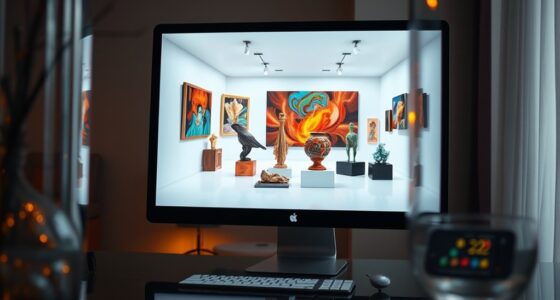
Digital twins are transforming heritage preservation by creating precise, virtual replicas of historic sites and artifacts. This technology allows you to explore, analyze, and restore cultural landmarks in ways never before possible. When it comes to virtual reconstruction, digital twins enable you to rebuild damaged or deteriorated structures with remarkable detail, filling in gaps left by time and erosion. This process involves capturing every aspect of a site or artifact, from its architecture to intricate decorative elements, guaranteeing that the digital model is as authentic as the real thing. As a result, you can visualize the original appearance of a heritage site, even if parts of it have been lost or altered over centuries.
Digital twins enable detailed virtual reconstructions of heritage sites, preserving and restoring cultural landmarks for future generations.
Maintaining historical accuracy is central to the effectiveness of digital twins in heritage preservation. By utilizing high-resolution imaging techniques like photogrammetry and laser scanning, you can produce models that capture the finest details. These methods help you ensure that every element of the virtual replica reflects the true historical context, materials, and craftsmanship. When you prioritize accuracy, the digital twin becomes a reliable resource for researchers, historians, and conservators who want to understand a site’s original design and significance. Moreover, historical accuracy enhances the educational value of virtual models, allowing future generations to experience these sites in their authentic form without risking damage to the originals. Additionally, knowing the importance of battery management allows you to keep digital and physical preservation tools operational over long periods.
Using digital twins for heritage preservation also provides a platform for ongoing collaboration. You can share these virtual reconstructions with experts worldwide, inviting feedback and collective input to improve the model’s fidelity. This collaborative approach helps you identify discrepancies, refine details, and ensure that the digital twin remains true to its historical roots. Additionally, digital twins serve as a safeguard against potential threats like natural disasters, war, or neglect. If a site is compromised, you can rely on the virtual reconstruction to provide an accurate, accessible record for future restoration efforts.
Beyond preservation, digital twins open new avenues for public engagement. You can create immersive virtual tours that allow visitors to explore heritage sites remotely, fostering appreciation and understanding without physical impact. This accessibility also supports educational initiatives, making history more tangible and engaging for learners of all ages. Ultimately, by combining virtual reconstruction with a focus on historical accuracy, you’re not just preserving the past—you’re ensuring it remains alive, accessible, and meaningful for generations to come.

EINSTAR Rockit 3D Scanner for 3D Printing, Blue Laser and Infrared Light Source Support Small to Large Object, 0.05 High Resolution, Marker-Free Function and 90 FPS Improve 3D Scanning Efficiency
- Wireless 3D Scanning: Built-in Wi-Fi for cable-free operation
- Long Battery Life: Up to 3 hours runtime with swappable battery
- Blue Laser Technology: 38 laser lines for fast, large-area capture
As an affiliate, we earn on qualifying purchases.
As an affiliate, we earn on qualifying purchases.
Frequently Asked Questions
How Affordable Are Digital Twin Implementations for Small Heritage Sites?
Digital twin implementations can be quite affordable for small heritage sites, especially when focusing on cost reduction strategies. You can start with scalable options, like basic 3D models and sensor integrations, which lower initial expenses. As your needs grow, you can expand gradually without overwhelming your budget. This flexible approach helps you leverage digital twin technology without significant financial strain, making preservation efforts more accessible and sustainable.
What Are the Privacy Concerns Related to Digital Twins of Heritage Sites?
You should be aware that privacy concerns with digital twins involve data security risks, like unauthorized access or data breaches. Ethical considerations also come into play, ensuring that the digital replica respects cultural sensitivities and ownership rights. To protect heritage sites, you need to implement strong data security measures and establish clear ethical guidelines, so the digital twin serves its purpose without compromising privacy or cultural integrity.
Can Digital Twins Predict Future Deterioration or Damage?
Yes, digital twins can predict future deterioration or damage through predictive analytics and damage modeling. By analyzing real-time data and historical patterns, you can identify potential risks before they occur. This proactive approach helps you plan maintenance and preservation efforts more effectively. Digital twins provide valuable insights, allowing you to anticipate issues and safeguard heritage sites for future generations.
How Do Digital Twins Integrate With Existing Preservation Technologies?
You can integrate digital twins with existing preservation technologies by ensuring data interoperability, allowing seamless sharing of information between systems. Using virtual reality, you can create immersive experiences that complement digital twin models, enhancing understanding and engagement. This integration helps you monitor heritage sites more effectively, combining real-time data with traditional methods, and ultimately supports better decision-making for preservation efforts without replacing existing technologies.
What Are the Long-Term Maintenance Costs of Digital Twin Systems?
Think of digital twin systems as a garden needing ongoing care. Your long-term maintenance costs involve regular updates, troubleshooting, and data management, which can be mapped through thorough cost analysis. With effective lifecycle management, you can predict expenses, optimize resources, and extend the system’s lifespan. While initial investments are high, proper planning reduces unforeseen costs, ensuring the digital twin continues to serve as a guardian of heritage for years to come.
photogrammetry software for heritage preservation
As an affiliate, we earn on qualifying purchases.
As an affiliate, we earn on qualifying purchases.
Conclusion
Think of digital twins as your virtual guardian for heritage sites, like a lighthouse guiding ships safely through storms. They allow you to monitor, preserve, and restore priceless structures with precision and ease, ensuring history endures for generations. By embracing this technology, you become part of a movement that safeguards our cultural treasures, transforming preservation into an active, ongoing journey. With digital twins, you hold the power to protect history as if it were your own, forever shining bright.
As an affiliate, we earn on qualifying purchases.
heritage site virtual tour equipment
As an affiliate, we earn on qualifying purchases.
As an affiliate, we earn on qualifying purchases.