
🔍 Read the full analysis: Can AI Help Bring Back Giant Kelp? A Tasmania Research Update on ThorstenMeyerAI.com

Get business pricing on monitors, keyboards and dev gear
- Business-only prices and quantity discounts
- Tax-exempt purchasing
- Multiple users, one account, clear invoices
TL;DR
Google said on Nov. 12 that AI tools and new Australian giant kelp genomes helped CSIRO analyze 600 wild specimens from Tasmania’s coast. The two Australian reference genomes are described in a peer-reviewed paper, but the specimen analysis and reported genetic isolation have not yet been independently documented in a paper or dataset. Scientists plan selective breeding and reef planting; whether the kelp will survive warmer summers is not yet known.
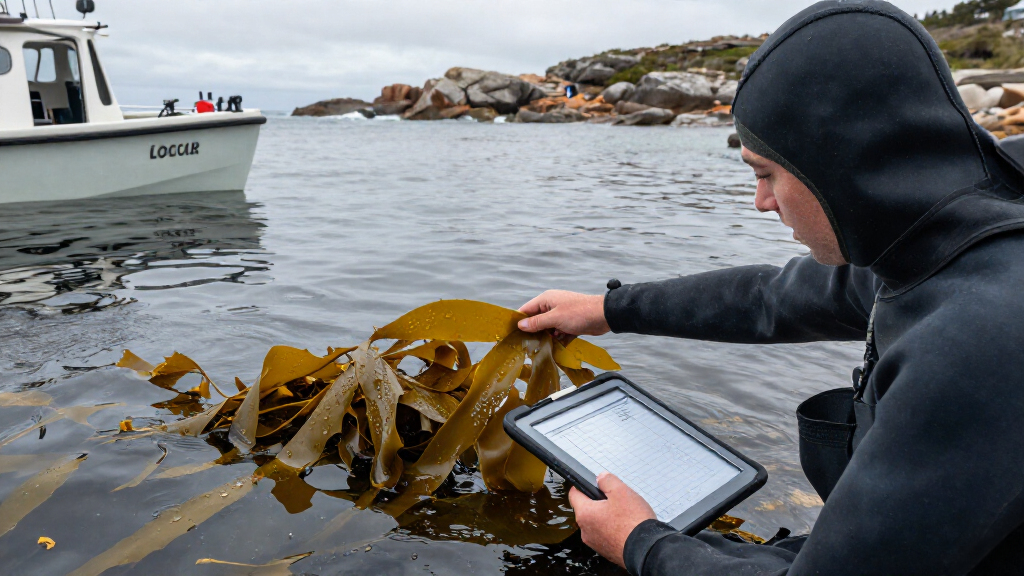
Google said Nov. 12 that its AI tools, alongside new Australian giant kelp reference genomes, helped Australia’s CSIRO analyze 600 wild specimens collected from 40 sites along Tasmania’s coast. The work is intended to help researchers select native kelp for selective breeding as forests that have declined by about 95%, according to CSIRO, face warmer, nutrient-poor water and sea urchins. Whether bred kelp can withstand warmer summers in the ocean has not yet been tested.
The project’s genomic work addresses a basic research problem: until this year, the available reference genome for giant kelp came from a Californian specimen. A reference genome gives scientists a guide for comparing DNA across samples. The peer-reviewed study, published in BMC Genomics in June 2026, reports two Australian genomes, sequenced from plants in Victoria and Tasmania. The study places 98–99% of each genome into 35 pseudo-chromosomes. The Australian genomes differ from one another by 0.2%, while the reported difference between the Australian and Californian references is 1.5%.
Google says its open-source tools helped build the reference genomes and that researchers adapted DeepVariant, a model whose standard versions are trained on human data, to analyze the 600 wild kelp samples. Google’s accompanying video also says DeepConsensus and DeepPolisher were used to correct errors in raw sequencing reads. According to Google, the specimen analysis found that remaining Tasmanian patches are genetically isolated. That finding, as well as the analysis of all 600 specimens, is currently reported in Google’s announcement and video; the source material says no paper or dataset for those results was found.
The AI does not plant kelp or test heat tolerance on its own. Scientists compare genetic data with results from laboratory tests, then can use that information to choose which native plants to cross. The planned work is selective breeding, not genetic modification. Researchers intend to grow young kelp from selected crosses and plant it on reefs, but the source material does not give a date for those trials.
Giant kelp · Tasmania · CSIRO with Google AI
From the reef to the lab and back: where the AI fits
Five steps, as described by CSIRO and Google. The AI works in steps 2 and 3; people do the diving, the lab work and the planting.
1Reef
Collect wild kelp
600 wild specimens from 40 sites along the Tasmanian coast, according to Google.
2Lab + AI
Build a local reference
Long-read DNA plus Google’s DeepConsensus and DeepPolisher: two Australian reference genomes, published in BMC Genomics.
AI step3AI
Read each plant
A version of DeepVariant trained for kelp finds where each specimen’s DNA differs.
AI step4Lab
Choose and cross
Distinct survivors with genetic variation and heat-tolerant traits are crossed. Selective breeding, not genetic modification.
5Reef
Replant and watch
Young kelp is attached to rocky reef in pilot tests. Warm summers show which plants survive.
Sources: Google blog post, Nov 12, 2026, and Google Research video; Scharfenstein et al., BMC Genomics, 2026; CSIRO, 2024, and CSIRO on Google Arts & Culture. The scene is a schematic, not a map or real data.
Graphic: Powered by Thorsten Meyer AI
From Genome Data to Reef Recovery
The update describes a potential tool for a restoration challenge, not a demonstration that AI can restore kelp forests. Better-matched reference genomes can help scientists interpret genetic differences among Australian plants, while analysis of wild samples may identify survivors worth testing in breeding work. That information could guide decisions about which kelp to cross and where restoration efforts might focus.
The stakes extend beyond the kelp itself. CSIRO describes giant kelp forests as habitat for marine life, including fish, octopuses, sea stars and sea lions, and says the ecosystem can disappear when the forests are lost. If the planned breeding and planting succeed, they could support a threatened marine community. For now, however, the available update establishes a research approach, not a recovery outcome: survival through warm summers remains the key test.
Products Worth Considering

Amazon Kindle Scribe Colorsoft 64GB with 11-Inch Color Display and Premium Pen, Graphite

LG UltraGear 27GX704A-B 27-Inch QHD OLED Gaming Monitor, 240Hz

Bose QuietComfort Ultra Earbuds (2nd Gen), Wireless Noise-Cancelling Earbuds with Immersive Audio and Wireless Charging Case, Black
As an affiliate, we earn on qualifying purchases.
Why Tasmania’s Kelp Declined
Giant kelp, Macrocystis pyrifera, is a large brown seaweed that forms underwater forests in cold, shallow seas. In Tasmanian waters, plants can grow to about 30 metres, according to the source material. CSIRO attributes the local decline to warmer, nutrient-poor water and invading sea urchins as the East Australian Current moves farther south. CSIRO also says warming in the Tasman Sea is twice the global average.
CSIRO puts the decline in Tasmanian giant kelp forests at about 95% in recent decades. A genome-study preprint, citing earlier research, gives a 95–98% loss of giant kelp cover in East Tasmania since 1940. The source material says the forest is listed as an endangered marine community type. The conservation work involving Google, CSIRO, the University of Tasmania’s Institute for Marine and Antarctic Studies and other partners was announced in 2024; its original plans included mapping kelp with satellite imagery as well as genomic research. The November 2026 update focuses on the genomics strand.
““trained a version of our AI model DeepVariant to analyze our wild samples””
— Google, in a video accompanying its Nov. 12, 2026 update
The Missing Field-Test Results
The central uncertainty is whether kelp selected through genetic analysis and selective breeding can survive in the warmer, nutrient-poor conditions associated with the decline. The source material says that the decisive test in the sea has not happened. It also does not state when the first bred kelp will be planted, how many reefs will be involved, or what criteria researchers will use to judge success.
The reported analysis of 600 specimens and the finding of genetic isolation are attributed to Google’s blog post and video, rather than a peer-reviewed publication or publicly identified dataset in the supplied material. The two reference genomes, by contrast, are described in a peer-reviewed paper, and the genomic data is public. The sample results should therefore be treated as an announcement-stage account until supporting methods and results are published. It is also not yet clear how the separate satellite-mapping strand has progressed.
Breeding and Reef Trials Ahead
Researchers plan to cross genetically distinct native kelp in the laboratory, raise young plants and plant them on reefs. The next useful milestones will be publication or release of the 600-specimen analysis, followed by details on breeding choices, planting locations and trial timing. Those details would let other researchers evaluate the findings and track the restoration work.
The longer-term measure is whether planted kelp establishes and persists through warmer summers, and whether restored patches help rebuild the wider forest ecosystem. The source material gives no confirmed timeline or projected survival rate. Until field results are available, the project remains an effort to inform restoration through genomics and AI, rather than evidence that the forests have begun to recover.
Key Questions
What did Google announce about Tasmania’s giant kelp?
Google said its AI tools and new Australian reference genomes helped CSIRO analyze 600 wild specimens collected from 40 sites along Tasmania’s coast. Google reported that remaining patches are genetically isolated, but the source material says those findings have not yet been published in a paper or dataset.
Does the AI test whether kelp can survive warmer water?
No. The AI is used to help analyze genetic data. Laboratory tests assess biological traits, and researchers can use genetic information to choose plants for breeding. Survival in warmer seas still needs field testing.
Is the kelp being genetically modified?
The planned approach is selective breeding: researchers intend to cross native kelp selected for breeding. The source material explicitly distinguishes this from genetic modification.
Which part of the research has been peer-reviewed?
The two Australian giant kelp reference genomes were reported in a peer-reviewed BMC Genomics paper published in June 2026. The 600-specimen analysis and the reported genetic isolation of remaining Tasmanian patches are described in Google’s announcement and video, with no paper or dataset identified in the source material.
When will kelp be planted on reefs?
Researchers plan to plant young kelp raised from selected crosses, but the source material gives no confirmed planting date. It also reports no field-trial outcome.
Source: ThorstenMeyerAI.com