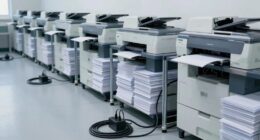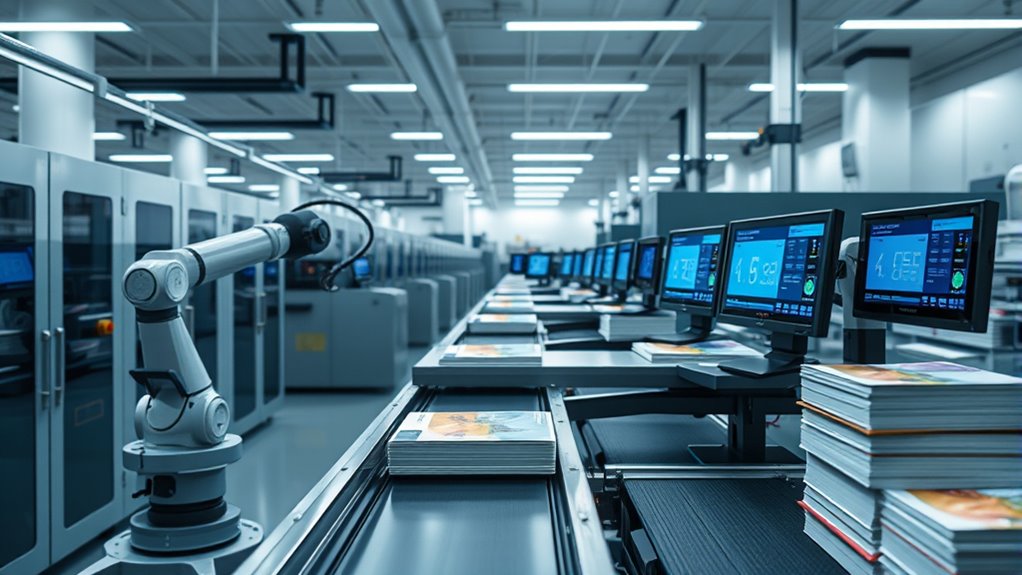

Automation in printing helps you streamline workflows by connecting all stages digitally, from design to delivery. It allows you to transfer files instantly, reduce delays, and cut down errors. Automated quality checks ensure consistent high standards while centralized controls make managing multiple machines easier. Real-time monitoring identifies bottlenecks and helps maintain smooth production. Embracing these innovations makes your printing process faster and more reliable—continuing will reveal even more ways automation can transform your operations.
Key Takeaways
- Digital integration connects production stages, enabling seamless file transfers and reducing workflow delays.
- Automated quality control systems ensure consistent color accuracy and print quality, minimizing human error.
- Centralized control platforms simplify operations, decreasing setup time and facilitating quick adjustments to changing demands.
- Real-time monitoring and reporting identify bottlenecks, optimize efficiency, and support proactive maintenance.
- Automation transforms printing into a smarter, faster industry, maintaining competitiveness through ongoing technological advancements.

Have you ever wondered how printing has transformed over recent years? The answer lies in the rise of automation, which has revolutionized workflows and made processes more efficient than ever before. At the core of this shift is digital integration, connecting various stages of production seamlessly. Instead of manually transferring files, adjusting settings, or coordinating between different machines, digital tools now enable you to automate these tasks. With integrated software, you can send files directly from design programs to the printing machinery, reducing delays and minimizing errors. This seamless communication helps maintain a consistent flow, ensuring that each project progresses smoothly from start to finish.
Automation also plays an essential role in quality assurance, a key aspect of any printing operation. Advanced systems can automatically check for color accuracy, registration, and print density, catching issues early before they become costly mistakes. By implementing automated quality control, you can considerably cut down on human error and ensure each print meets the highest standards. These systems continuously monitor the output, making real-time adjustments when necessary, which means you get consistent, high-quality results without constant manual intervention. This not only saves time but also boosts customer satisfaction, as clients receive flawless products every time.
Digital integration further simplifies complex workflows by centralizing controls. Instead of juggling multiple machines and software, you operate through a unified platform that manages everything from job setup to delivery. This consolidation reduces training time, decreases setup errors, and accelerates turnaround times. Automation also facilitates faster response to changes in demand or design updates. When new orders come in or modifications are required, you can adjust parameters digitally, and the system will automatically implement those updates across all relevant machines. This agility allows your operation to adapt quickly, keeping pace with market demands and customer expectations.
Moreover, automation enhances tracking and reporting capabilities. You can monitor production metrics in real time, analyze performance data, and identify bottlenecks or inefficiencies. This insight helps you optimize workflows further and plan maintenance proactively, preventing unexpected downtime. Over time, these data-driven decisions improve overall productivity and reduce waste, adding to the economic benefits of automation. Additionally, incorporating emotional support strategies can help your team adapt to technological changes with less stress and greater confidence.
In essence, embracing digital integration and automated quality assurance transforms your printing workflow into a smarter, faster, and more dependable process. It allows you to deliver consistent quality, respond swiftly to client needs, and operate with greater efficiency. As technology advances, automation will continue to redefine what’s possible in printing, helping you stay competitive in a rapidly evolving industry.
automatic color calibration printer
As an affiliate, we earn on qualifying purchases.
As an affiliate, we earn on qualifying purchases.
Frequently Asked Questions
How Does Automation Impact Job Roles in Printing Companies?
Automation changes your job roles by requiring workforce adaptation and skill development. You’ll find yourself focusing more on overseeing automated processes, troubleshooting, and maintaining equipment. While some manual tasks may diminish, new skills become essential, making your role more technical and strategic. Embracing these changes helps you stay relevant, increases efficiency, and opens opportunities for growth within the company. Automation ultimately transforms your responsibilities, making your work more dynamic and skill-driven.
What Are the Initial Costs Associated With Implementing Printing Automation?
You’ll need to conduct a thorough cost analysis to understand the initial costs of printing automation. The main expenses involve equipment investment, including new machinery, software, and integration tools. Additionally, consider training costs for your staff to operate the new systems efficiently. While the upfront investment might seem high, the long-term savings and productivity gains often justify the initial expenditure, making automation a smart move for your printing business.
How Secure Is Automated Data Handling in Printing Workflows?
Your data security in automated printing workflows is incredibly robust—almost impenetrable. You rely on data encryption to protect sensitive information and strict access controls to guarantee only authorized personnel can handle it. These measures create a fortress around your data, making breaches nearly impossible. While no system is entirely foolproof, implementing these security features greatly minimizes risks, giving you peace of mind knowing your information stays safe amid the automation revolution.
Can Small Businesses Benefit From Automation in Printing Processes?
Yes, small businesses can benefit from automation in printing processes. Automation helps you improve print quality consistently, reducing errors and waste. This leads to faster turnaround times and higher customer satisfaction. By streamlining workflows, you save time and resources, allowing you to focus on growing your business. Overall, automation enhances your efficiency, guarantees better print results, and keeps your customers happy with reliable, high-quality outputs.
What Are the Common Challenges Faced During Automation Integration?
You might face workflow bottlenecks during automation integration, causing delays and inefficiencies. Employee training is essential but can be challenging, as staff may resist change or need time to adapt to new systems. Ensuring clear communication, providing thorough training, and gradually implementing automation can help you overcome these challenges, making the progression smoother and maximizing your printing workflow’s efficiency.
DTF RIP Software V11 for Digital Factory Compatible with 8550 L1800 4900 7890 9890 P5000 P6000 P7000 P9000 Printers Includes USB Dongle(V11 Active Code Ver)
- Optimized for DTF Printing: Enhances workflow and print quality
- Advanced RIP Software: Includes CADlink Digital Factory V11
- Secure Activation: Comes with USB dongle
As an affiliate, we earn on qualifying purchases.
As an affiliate, we earn on qualifying purchases.
Conclusion
By embracing automation in printing, you empower your processes to be more precise, productive, and painless. Let technology transform tedious tasks into timely triumphs, turning workflow worries into wins. When you willingly welcome workflow wonders, you’ll witness a world of wholeness where efficiency and excellence seamlessly synchronize. So, step confidently into the future, and see how automation amplifies your achievements, allowing you to focus on what truly matters—delivering quality with quickness and quellless commitment.

ASsdhgTE 5.0 UF100 WiFi Biometric Face Attendance System Fingerprint Time Clock Employee Attendace Management Electronic Device
- Multi-Biometric Verification: Fingerprint, face, and RFID card support
- Accurate and Stable Operation: Reliable verification even in strong light or wet fingers
- Advanced Recognition Technology: Latest algorithms for efficient attendance management
As an affiliate, we earn on qualifying purchases.
As an affiliate, we earn on qualifying purchases.

Body Composition Analyzer Device Health Monitoring Fat Analyzer with Bluetooth/WiFi Sync & Real-Time Printing Professional Full Gym Scanner
- Advanced Body Composition Analysis: Multi-frequency bioimpedance technology
- High-Definition Touch Screen: 10-inch IPS display with multiple report formats
- Smart Recognition Features: Supports face recognition for easy login
As an affiliate, we earn on qualifying purchases.
As an affiliate, we earn on qualifying purchases.