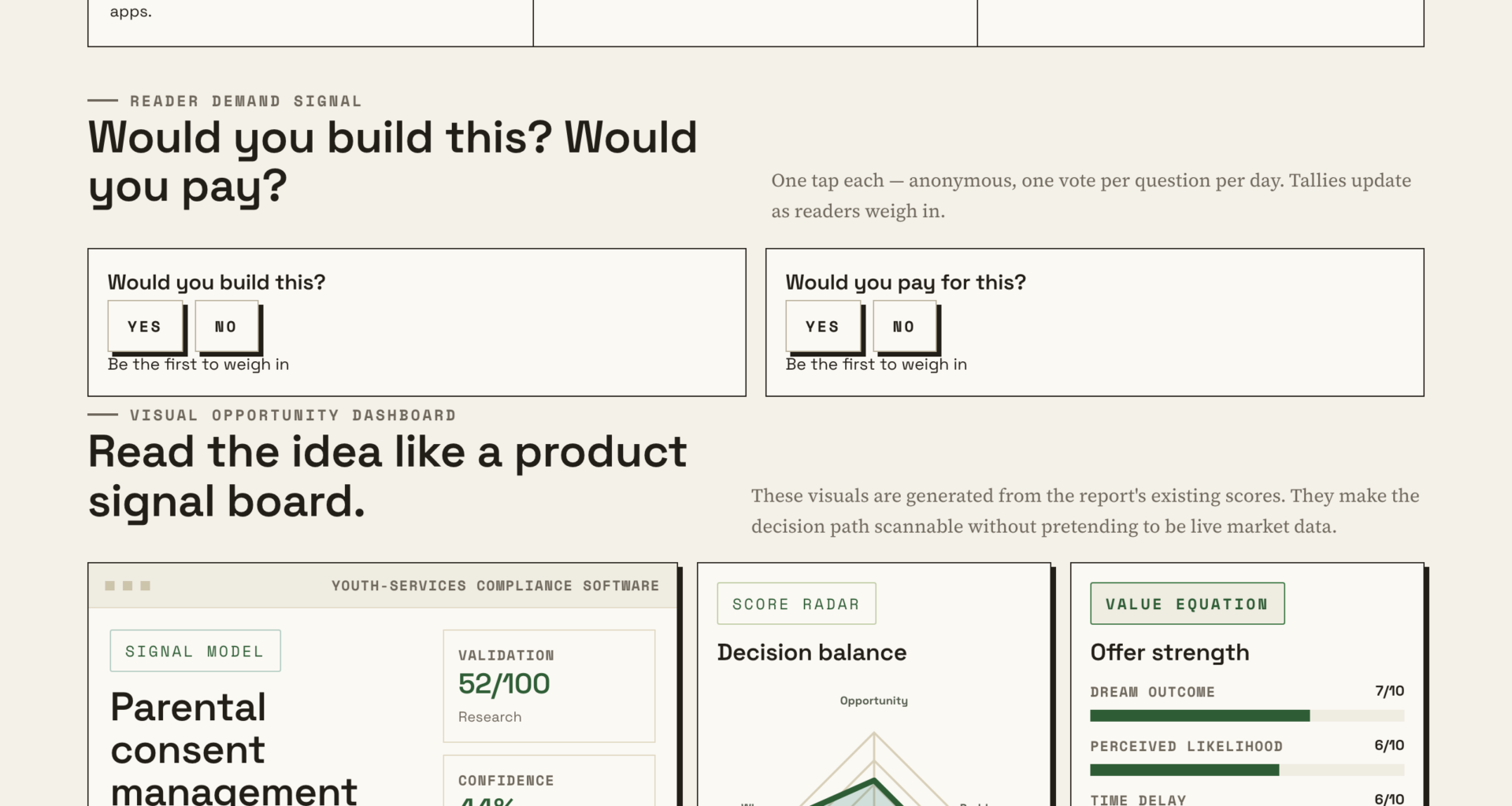

📊 Full opportunity report: Parental Consent Management: From Collection To Records on IdeaNavigator AI — validation score, market gap, and execution plan.

Get business pricing on monitors, keyboards and dev gear
- Business-only prices and quantity discounts
- Tax-exempt purchasing
- Multiple users, one account, clear invoices
TL;DR

IdeaNavigator AI has published a product thesis arguing that parental consent management is an underserved niche for small vendors serving children — camps, coaches, photographers, and youth apps. The proposed workflow would replace improvised paper and email consent with phone-based flows, per-child consent ledgers, expiry tracking, and audit exports, monetized as a monthly subscription tiered by active-child count.
IdeaNavigator AI has published a product thesis proposing that software vendors target parental consent management as a focused first product for small businesses that serve children — camps, coaches, photographers, and youth apps. The argument is that these vendors currently handle consent through improvised methods such as paper photo-release forms and waivers buried in email threads, leaving them with no verifiable record of which parent approved what. According to the thesis, expanding children’s privacy enforcement — including COPPA updates and new state laws — plus increasingly assertive parents are turning that gap into a financial risk, and a defensible consent record is becoming a purchase driver even for very small operators.
The proposal, framed as a narrow first-win workflow for a single buyer type, calls for vendor-branded consent flows that parents complete on their phones. The consent categories named are photo use, data collection, medical authorization, and liability — the four document types that kid-facing vendors most commonly collect at enrollment or season start. Identity verification would be scaled to what the thesis calls the risk tier of each consent type, meaning a photo release would carry lighter verification than a medical or liability authorization.
The core of the proposed product is not collection but record-keeping. Each child would have a per-child consent ledger — a running record of which parent approved which permission, when, and under what verification. The ledger would include expiry tracking, so seasonal or time-limited consents would flag automatically rather than silently lapsing. An instant audit export would let a vendor produce a complete consent history on demand, which the thesis positions as the key defense when a dispute or a regulatory inquiry arrives.
The suggested business model is a monthly subscription tiered by active-child count, which aligns cost with a vendor’s actual enrollment rather than flat per-seat pricing. The target market is described as youth-services compliance software. For validation, the thesis proposes deploying with ten camps and youth programs for a full season and measuring consent completion rates and time saved chasing parents, benchmarked against existing paper processes.
Why Small Youth Vendors Are Exposed
The thesis identifies a structural gap rather than a technology gap. Large platforms already operate consent infrastructure under regulatory obligation, but the small businesses named in the proposal — independent camps, solo coaches, freelance photographers, small youth apps — generally have no compliance function at all. According to IdeaNavigator AI, their consent practices consist of paper forms, email waivers, and no verifiable approval record, which means a single dispute over photo use or a COPPA question can expose gaps that are expensive to resolve after the fact.
The timing argument rests on two confirmed trends. First, children’s privacy enforcement is expanding: the Federal Trade Commission has pursued COPPA actions and issued updated rules, while multiple states have passed their own children’s and general privacy statutes. Second, parents are described as increasingly challenging photo and data use, meaning the risk is not purely regulatory but reputational and legal at the individual-dispute level. Together, these forces create demand for defensible records from buyers who previously saw consent as paperwork rather than liability.
The Paper-to-Digital Consent Shift
Consent collection in youth services has historically been a seasonal, manual process: forms handed out at registration, signed on paper, and filed in cabinets or scanned into folders. The known failure modes are familiar to anyone who has run such a program — lost forms, unclear versions, no record of which parent (in joint-custody or multi-guardian households) actually signed, and no systematic way to know when a permission expired.
The regulatory backdrop has tightened around that informal status quo. COPPA, the federal rule governing online data collection from children under 13, has been revised to broaden what counts as personal information and to strengthen parental consent requirements, and state-level privacy laws have added their own parental-rights and minors’ provisions. The thesis argues these developments moved consent from an administrative chore to a compliance question — the shift that makes a records-first product viable for buyers who were never software purchasers before.
Unproven Demand and Open Questions
The proposal is a thesis, not a launched product or validated company. No deployment has occurred; the ten-camp validation season is a proposed next step, and its two success metrics — consent completion rates and administrative time saved versus paper — have no measured baseline yet.
Several substantive questions remain open. Whether identity verification scaled to a risk tier satisfies actual COPPA or state-law standards for verifiable parental consent is a legal determination the thesis does not resolve, and regulators have historically set a high bar for what counts as adequate verification. It is also unclear whether small vendors will pay a recurring subscription for a records product when the pain is episodic — most experience a consent problem only during a dispute or audit, not continuously. Parent-side friction is another unknown: completion rates on a phone depend on parents actually engaging with yet another digital form. Finally, the competitive picture is not addressed; existing camp-management and registration platforms already include some form and waiver functionality, and the thesis does not say how a standalone consent ledger would compete with bundled features.
The Ten-Camp Validation Season
If a builder acts on the thesis, the immediate step is its proposed validation: recruit ten camps and youth programs, run a full season with the phone-based consent flows, and measure completion rates and time saved against each program’s prior paper process. Those results would determine whether the workflow earns its place as a first-win product or needs repositioning.
Observers of the youth-services software market can also watch the enforcement environment, since the thesis’s timing argument depends on it. Continued COPPA rulemaking, additional state privacy statutes, or a high-profile dispute involving a small vendor’s photo or data practices would each strengthen the demand case. Conversely, a quiet enforcement period would test whether the parent-challenge driver alone is enough to move small buyers toward paid consent records.
Key Questions
What exactly is being proposed?
A software product for small vendors who work with children — camps, coaches, photographers, youth apps — that replaces paper and email consent with phone-based consent flows, per-child consent ledgers, expiry tracking, and instant audit exports, sold as a monthly subscription tiered by active-child count.
Why is this being suggested now?
According to IdeaNavigator AI, children’s privacy enforcement is expanding through COPPA updates and state laws, and parents are increasingly challenging photo and data use, which pushes even small vendors toward keeping defensible consent records.
Is this a real product or company?
No. It is a published product thesis with no deployment, customers, or measured results. Validation is proposed as a season-long pilot with ten camps and youth programs measuring consent completion rates and time saved versus paper.
What consent types would the product cover?
The thesis lists four: photo use, data collection, medical authorization, and liability. Identity verification would be scaled to the risk tier of each consent type.
What are the main open risks?
Whether risk-tiered identity verification meets actual COPPA and state legal standards, whether small vendors will pay recurring fees for episodic pain, parent-side completion friction, and competition from bundled features in existing camp-management platforms.
Source: IdeaNavigator AI
Fall Picks
fall essentials
As an affiliate, we earn on qualifying purchases.