

📊 Full opportunity report: StreetComplete And OpenStreetMap: A Small-Step Guide To Better Mapping on IdeaNavigator AI — validation score, market gap, and execution plan.

Get business pricing on monitors, keyboards and dev gear
- Business-only prices and quantity discounts
- Tax-exempt purchasing
- Multiple users, one account, clear invoices
TL;DR
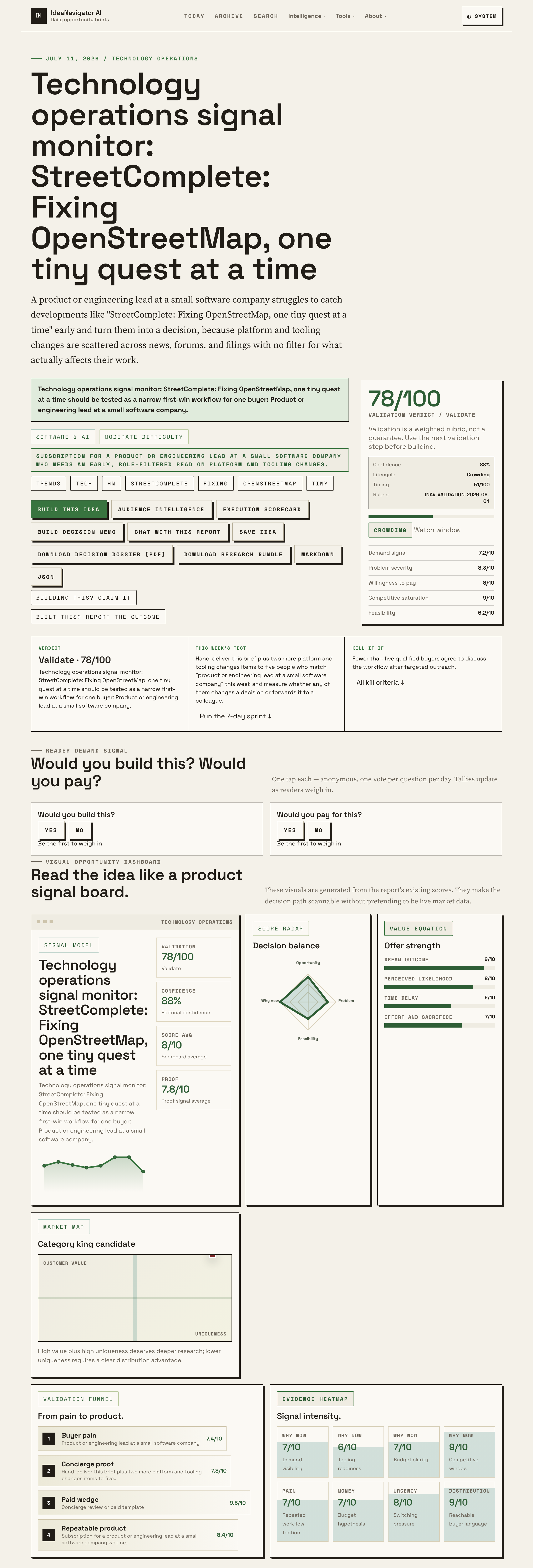
StreetComplete, an app that improves OpenStreetMap through small, gamified quests, is drawing renewed attention after a high signal score on Hacker News. Its step-by-step contribution model is being studied as a template for low-friction volunteer workflows, with implications for teams building crowdsourced data products.
StreetComplete, a mobile app that improves OpenStreetMap through tiny, location-based quests, has been flagged as a high-signal development after scoring 88/100 on IdeaNavigator AI’s technology operations monitor, which surfaced the project from Hacker News discussion. The app’s model — breaking a large, complex data-maintenance task into questions a contributor can answer in under a minute while standing on the street — is now being examined as a repeatable pattern for low-friction contribution workflows beyond mapping.
StreetComplete works by scanning OpenStreetMap data around a user’s location and generating targeted “quests”: simple questions such as whether a shop is still open, what surface a path has, or whether a road has a cycle lane. Each quest addresses a single missing or outdated data point. Users never face the full OpenStreetMap editing interface; the app presents one question at a time and records structured answers that feed directly into the map database.
The approach solves a long-standing problem for volunteer-driven geographic data: the gap between the small number of experienced mappers who use full-featured editing tools and the large number of people who walk past outdated map data every day. According to the framing in IdeaNavigator AI’s brief, the project is described as “fixing OpenStreetMap, one tiny quest at a time” — an acknowledgement that individual contributions are deliberately small but aggregate into substantial map improvements.
The current attention is not tied to a new app release. Rather, the 88/100 signal score reflects renewed visibility on Hacker News, where the project’s model was being discussed among technology practitioners. IdeaNavigator AI positioned the item specifically for product and engineering leads at small software companies, arguing that same-day, role-filtered awareness of tooling developments like this one can influence decisions faster than waiting for weekly roundups.
Why Micro-Contribution Design Is Drawing Attention
The significance of StreetComplete for a technical audience lies less in mapping itself and more in its interaction design. The app demonstrates that a project with a steep learning curve — OpenStreetMap editing traditionally requires understanding tags, editors, and community conventions — can be made accessible by reducing each contribution to a single answerable question. Product and engineering leads have taken note because the same pattern applies to bug reporting, data cleanup, and internal knowledge bases, where contribution friction is often the bottleneck.
There is also a data-quality angle. Because quests are generated only where OpenStreetMap data is demonstrably incomplete or outdated, effort is automatically directed at the highest-value gaps. That targeting mechanism — deriving tasks from data deficiencies rather than asking contributors to find work themselves — is the part of the model most frequently cited as transferable to other crowdsourced systems.
Finally, the episode illustrates a shift in how small engineering teams learn about tooling developments. IdeaNavigator AI’s brief argues that platform and tooling changes are now scattered across news sites, forums, and filings “with no filter for what actually affects their work,” and proposes role-filtered monitoring as the fix. The StreetComplete signal is being used as a test case for that workflow.
How the Signal Reached Engineering Teams
OpenStreetMap is a collaborative, openly licensed map of the world maintained by volunteers since 2004. Its completeness varies widely by region, and keeping features such as opening hours, surface types, and access restrictions current has always depended on contributors willing to edit manually. StreetComplete was built to lower that barrier, targeting what the project’s own description calls fixes made “one tiny quest at a time.”
The current wave of attention originated when Hacker News discussion of the project was picked up by IdeaNavigator AI’s technology operations signal monitor, which assigned the item an 88/100 score and matched it to the persona of a product or engineering lead at a small software company. The monitor’s stated purpose is to convert scattered tooling developments into short decision-oriented briefs — a “what-changed, why-it-matters, what-to-do” format — rather than raw links. As part of its validation plan, IdeaNavigator AI proposes hand-delivering such briefs to practitioners matching the target role and measuring whether any recipient changes a decision or forwards the brief to a colleague.
What the Signal Score Does and Doesn’t Show
Several things remain unclear. The 88/100 signal score is a proprietary measure from IdeaNavigator AI; the methodology behind the number has not been published, and it should not be read as a measure of StreetComplete’s adoption, data-quality impact, or user base. No download figures, contribution statistics, or release details were included in the material.
It is also not yet established whether the attention will translate into anything durable. IdeaNavigator AI itself frames its brief as a hypothesis to be tested — its stated validation step is delivering this and similar items to five matching practitioners and measuring whether anyone changes a decision or forwards the brief. Those results, if any, are not yet available. Whether the StreetComplete quest model actually transfers to non-mapping products remains an open question that only implementation would answer.
Validation Plans and Broader Adoption
According to IdeaNavigator AI’s brief, the immediate next step is its own validation exercise: hand-delivering this brief plus two more platform and tooling items to five people matching the target persona within the week, then measuring decision impact and forwarding behavior. The outcome of that test has not been reported.
For readers interested in the mapping side, StreetComplete remains freely available and actively developed, and OpenStreetMap contributions made through it are visible in the public database. Engineering teams watching the design pattern can expect further discussion of micro-contribution workflows on forums such as Hacker News, where similar tooling signals continue to surface. If the role-filtered monitoring model gains traction, more briefs in this format — covering developments beyond StreetComplete — are likely to follow.
Source: IdeaNavigator AI
Key Questions
What is StreetComplete?
StreetComplete is a mobile app that improves OpenStreetMap by asking users simple, location-based questions called quests — for example, whether a shop is still open or what surface a path has. Answers feed structured updates into the map database.
Why is StreetComplete in the news now?
The project gained renewed visibility through Hacker News discussion, which IdeaNavigator AI’s technology operations monitor scored at 88/100 and flagged as relevant to product and engineering leads at small software companies.
What does the 88/100 signal score mean?
It is a proprietary scoring measure from IdeaNavigator AI indicating how strongly an item surfaced on feeds like Hacker News. Its methodology has not been published, and it does not measure StreetComplete’s adoption or impact.
Do I need OpenStreetMap experience to use StreetComplete?
No. The app is built specifically for people without mapping experience — it presents one simple question at a time and handles the underlying data editing automatically.
Why would an engineering lead care about a mapping app?
StreetComplete’s quest-based contribution model — deriving small, targeted tasks from data gaps — is viewed as a transferable design pattern for reducing friction in bug reporting, data cleanup, and other crowdsourced workflows.
Source: IdeaNavigator AI
Fall Picks
fall essentials
As an affiliate, we earn on qualifying purchases.