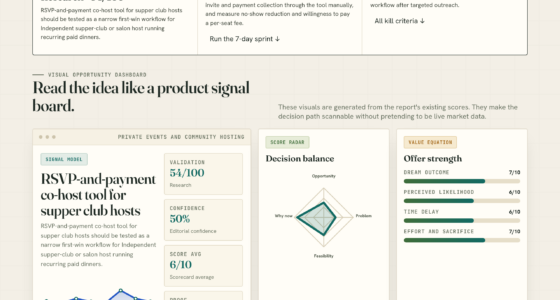

📊 Full opportunity report: Cloud’s Hidden Memory Bill on ThorstenMeyerAI.com — validation score, market gap, and execution plan.

Get business pricing on monitors, keyboards and dev gear
- Business-only prices and quantity discounts
- Tax-exempt purchasing
- Multiple users, one account, clear invoices
TL;DR
A global memory shortage is driving up cloud infrastructure costs in 2026, leading to hidden price increases for users. Major providers like AWS have raised prices, prompting reconsideration of cloud versus on-premises deployment.
Cloud service providers are raising prices in 2026 due to a significant memory shortage, marking a departure from their long-standing promise of continually decreasing costs. This development directly affects enterprise budgets and cloud users, who are increasingly paying more for memory-intensive workloads.
The shortage stems from a sharp increase in DRAM prices, which surged by 60–70% late in 2025, impacting server manufacturers like Samsung, SK Hynix, and Micron. These increased costs have cascaded through the supply chain, raising server prices by 15–25% and, ultimately, leading cloud providers to pass on a portion of these costs to customers. In early January 2026, AWS announced its first price hike in over two decades, raising GPU instance prices by approximately 15%. Other providers, including Azure and GCP, are expected to follow with similar increases in Q2–Q3 2026, though they have not yet publicly confirmed specific figures.
The hidden nature of these increases is notable; they are not itemized explicitly but instead appear as small, incremental adjustments across various services and regions. Memory-optimized instances and in-memory database services are most affected, with price hikes of 5–10%. Discounted or reserved instances do not shield customers from these increases, as the underlying costs rise proportionally, leading to higher absolute payments even with discounts.
Cloud’s hidden memory bill
Thought the cloud lets you dodge the squeeze — you rent the RAM, you don’t buy it? You’re still paying for every gigabyte. You’ve just stopped being able to see the bill.
No escape from the shortage anywhere — on-prem servers also cost +15–25%. But providers hedge scarce hardware better than you can, and you can’t buy half a cluster for two weeks.
8×H200 ≈ $15–20/hr owned (3-yr amortized) vs $39.80 rented — roughly half. 83% of CIOs plan to repatriate some workloads. Hybrid is the new default.
The cloud doesn’t make the memory tax disappear — it launders it, turning a violent fab shortage into a few innocuous percentage points scattered across a bill you can’t easily audit. “I’m in the cloud, I’m safe” is the most expensive misconception in this series. Refuse to pay for idle RAM, sort each workload to its cheapest venue, and lock pricing before the Q2–Q3 adjustment. The escape hatch was never cloud-vs-on-prem — it’s discipline-vs-drift. Next: the local-inference rig.
Impacts of Memory Shortage on Cloud Pricing Strategies
This shortage and resulting price hikes challenge the long-held expectation that cloud costs will decline over time. Enterprises relying on cloud services face increased operational expenses, especially for memory-heavy workloads. The rising costs are prompting many CIOs to reconsider their infrastructure strategies, with a growing trend toward hybrid models that balance on-premises ownership with cloud elasticity. The shift could reshape cloud market dynamics and influence enterprise IT planning in the coming years.
Products Worth Considering

Samsung 32-Inch Odyssey OLED G8 (G80SH) 4K Gaming Monitor

Sony WH-1000XM6 Wireless Noise-Canceling Over-Ear Headphones, Blue, Bundle

Apple iPad Air 13-inch (M4), 128GB, Wi-Fi 7, Space Gray
As an affiliate, we earn on qualifying purchases.
2026 Memory Market Disruptions and Cloud Cost Trends
In late 2025, DRAM prices surged by 60–70%, driven by supply constraints at major memory chip manufacturers. This spike followed years of relatively stable prices, but the scarcity has persisted into 2026, with OEM server prices increasing accordingly. Cloud providers, which buy servers from these OEMs, have absorbed part of the cost increases but are also passing some on to customers. Historically, cloud providers promised cost reductions, but the current environment has disrupted that trend, leading to the first price hikes in over 20 years. The full impact is still unfolding, with industry analysts projecting further adjustments in the coming months.
“We continually evaluate our pricing to reflect market conditions, and recent increases are necessary due to hardware cost pressures.”
— AWS spokesperson
Extent and Duration of Cloud Price Increases Unclear
While specific increases have been announced for early 2026, the full extent and duration of the price hikes remain uncertain. It is not yet clear whether cloud providers will stabilize prices or continue to raise them through the year as supply constraints persist. Additionally, the impact on different regions and service tiers varies, complicating precise forecasting.
Monitoring Price Trends and Strategic Shifts in Cloud Usage
Expect further price adjustments in the coming months, particularly in Q2 and Q3. Enterprises are advised to audit their memory usage and consider hybrid or on-premises solutions for steady workloads. Industry analysts anticipate a continued shift toward hybrid models, balancing cloud elasticity with cost predictability, as organizations adapt to the new cost landscape.
Key Questions
Why are cloud prices increasing now?
Prices are rising due to a global shortage of DRAM chips, which has increased manufacturing costs for server hardware, leading cloud providers to pass some of these costs to customers.
Will the price hikes continue beyond 2026?
The future trend is uncertain; price stabilization depends on supply chain improvements and market dynamics, but further increases are possible if shortages persist.
How can enterprises mitigate these rising costs?
Auditing memory usage, optimizing workloads, and adopting hybrid deployment models can help manage costs amid ongoing price pressures.
Are all cloud providers affected equally?
While all major providers are impacted by the memory shortage, the extent of price increases may vary depending on their supply chain relationships and pricing strategies.
Source: ThorstenMeyerAI.com