
TL;DR
Mistral positions itself around sovereignty, open weights, and efficiency—aiming to serve regulated European markets. While strong on control and local deployment, questions remain if it can keep pace with giants like OpenAI and Anthropic on model quality and reasoning.
Here’s a secret: in AI, size isn’t everything anymore. What matters now is control, compliance, and local deployment. Mistral isn’t trying to build the biggest models; it’s crafting a different game—one rooted in European sovereignty and open weights.
At their recent summit, Mistral made it clear: they’re not just about models. They’re offering a full-stack, self-hosted AI ecosystem aimed at regulated industries. But the big question remains: is this a strategic masterstroke, or a sign they’ve already fallen behind?
Different game, or already lost?
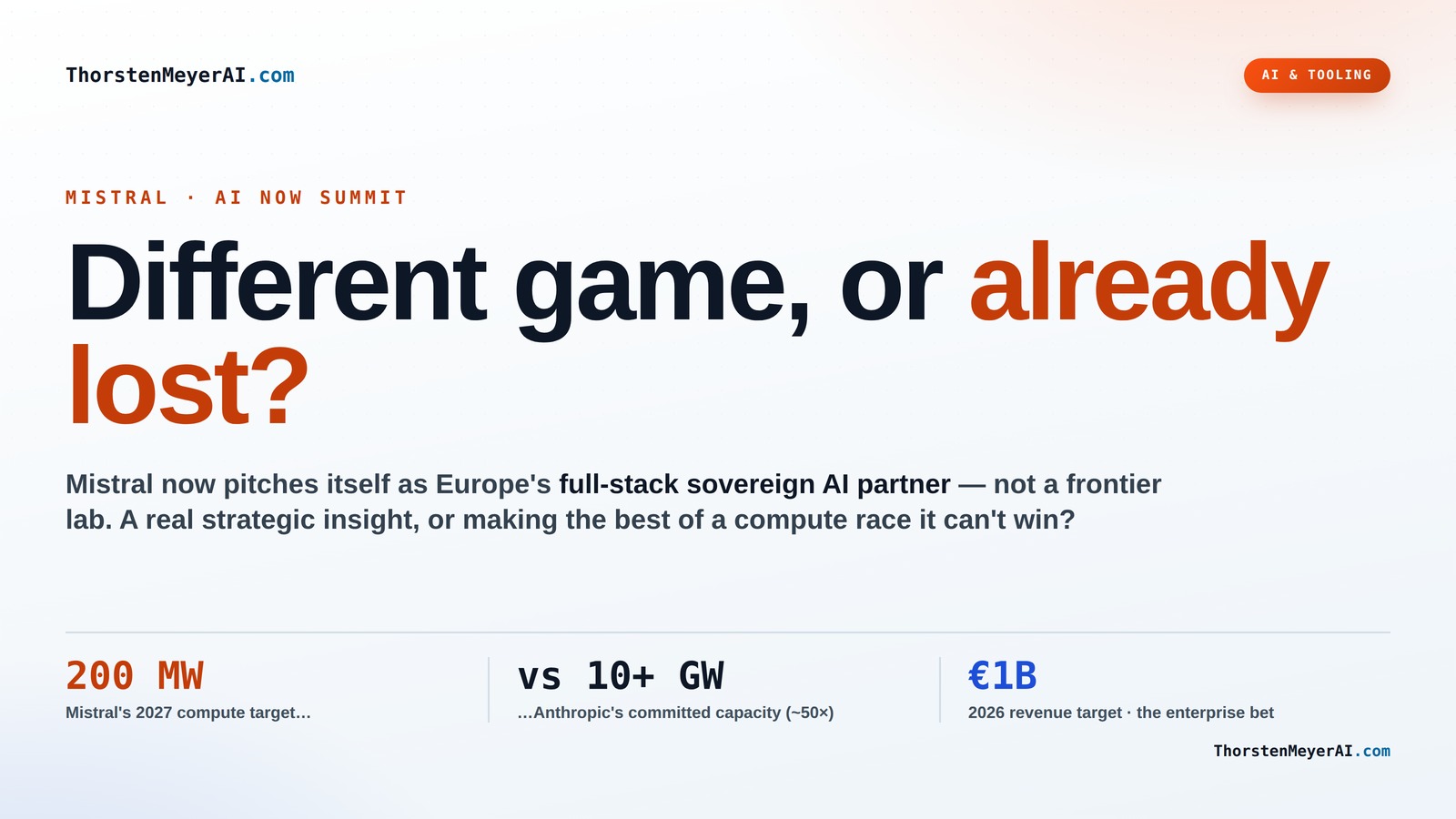
Mistral now pitches itself as Europe’s full-stack AI provider — compute, models, platform, consultancy — not a frontier-model lab. Is that a real strategic insight, or making the best of a race it can’t win? Both readings fit the same facts.
From model lab to full-stack provider
The clearest signal from the summit wasn’t a model — it was a posture. Heavy on enterprise logos and partnerships (ASML, BNP Paribas, Alexa+), light on new-model announcements. That absence is exactly what skeptics seized on.
Compute
40MW Paris DC + Sweden build · 200MW target by 2027
Models
Open & custom · efficient · you own and run them
Platform
Forge for custom models · Vibe for Work agent
Consultancy
Sales teams, integrators, EU provenance & support

Google ADK and Gemini Enterprise Agent Platform: Build, Deploy, Govern, and Scale Production-Ready AI Agents for Enterprise Workflows
As an affiliate, we earn on qualifying purchases.
As an affiliate, we earn on qualifying purchases.
Small & focused, or large & general?
Mistral bets on specialized small models. The claim isn’t that they win a reasoning leaderboard — they don’t. It’s that on the metrics that matter in production agent systems, a purpose-built small model wins. Flip the metric to see the case reverse.
Small specialized vs large general — by what you measure
In token-heavy agentic apps making hundreds of calls, speed/energy/cost compound. Toggle the metric.

Local AI & Autonomous Agents: Run Models Locally, Build Smart Tools, and Automate Your Dev Life
As an affiliate, we earn on qualifying purchases.
As an affiliate, we earn on qualifying purchases.
Narrow models doing real work
Each is one model doing one thing efficiently — the tangible version of the strategy. Strong on their own terms; the open question is whether the bundle beats a free Chinese open-weight download.
On-prem KYC compliance
Mistral models run inside the bank’s walls for know-your-customer checks. Sensitive financial data never leaves. (BNP was Mistral’s first customer, 2023.)
Voxtral multilingual voice
A focused voice model powering Alexa+ across Europe — speed and efficiency over raw size.
Robostral industrial robotics
Plus a “physics AI” push (via the Emmi acquisition) into aerospace, automotive & semiconductor design and simulation.
Document AI / OCR at scale
Large-scale text extraction — the unglamorous, high-volume enterprise work small models excel at.
European regulated AI software
As an affiliate, we earn on qualifying purchases.
As an affiliate, we earn on qualifying purchases.
The strategy is downstream of the compute gap
Once you see the raw numbers, “why is Mistral behind?” answers itself — and the specialized-small-model strategy starts looking partly like a smart adaptation to a binding constraint, not a pure philosophical choice.
Compute & capital · Mistral vs a frontier leader, this same week
Not a knock — it’s the constraint that forces the efficiency-first, sovereignty-wedge strategy. Adapting intelligently to your position is what good strategy is.

LOCAL LLM DEPLOYMENT: Training, Fine-Tuning, & Offline Inference: The Complete Developer’s Guide to Building, Training, and Running Private Open-Source AI Offline (with full source code)
As an affiliate, we earn on qualifying purchases.
As an affiliate, we earn on qualifying purchases.
“I want them to win, but I’m worried”
That ambivalence is the most accurate read of where Mistral sits. The enterprise pivot gets read two opposite ways — and both deserve airing.
On-prem, real sales teams, the Koyeb deployment acquisition, EU provenance — exactly what regulated enterprises want, and stickier than consumer mindshare. Targeting €1B revenue in 2026 with 1,000 staff, up from 15 people and one customer in 2023. US closed-API labs structurally can’t match the sovereignty axis.
“Software consultancy with a data center,” not a foundation-model moat. Enterprise B2B is where European startups go when they can’t win consumer or world-scale SaaS. Why pay Mistral on-prem when you could run Qwen free? One paying Le Chat Pro user said the quality gap with frontier labs is now hard to ignore.
Key Takeaways
- Mistral’s sovereignty and open-weight strategy appeal strongly to Europe’s regulated industries, fostering rapid growth.
- Their focus on small, efficient models solves practical production problems better than giant reasoning models in many cases.
- Despite early success, critics question whether Mistral can keep pace on reasoning, context size, and model capabilities at the frontier.
- Sovereignty involves more than model location; it’s about full control over data, governance, and infrastructure—Mistral’s stack aims to address this.
- The long-term viability of Mistral’s approach depends on balancing technical innovation with market trust in local, self-hosted AI.
Why Mistral’s Sovereignty Push Is More Than Just a Buzzword
Mistral’s emphasis on sovereignty isn’t just branding. It’s a strategic stance rooted in European independence. They highlight that roughly 60% of their revenue now comes from European clients, which signals a real shift.
For banks, governments, and defense firms, owning the model and data inside Europe isn’t optional—it’s a necessity. Mistral’s approach taps directly into this demand, offering models that can run entirely on local infrastructure, sidestepping US and Chinese cloud dependencies.
For example, BNP Paribas uses Mistral models on-prem for compliance, keeping sensitive financial data inside their own walls. This concrete use case illustrates how the sovereignty angle isn’t just talk—it's a core market driver.

Open Weights and Self-Hosting: Building Trust in Regulated Industries
Mistral’s open-weight models like Mistral 7B and Mixtral 8x7B are designed for control. Released under Apache 2.0 license, they let companies download, fine-tune, and run models on their own servers.
This isn’t just a technical preference—it’s a trust signal. Banks, insurers, and public agencies prefer owning models outright over relying on API access. They want to govern their data, avoid vendor lock-in, and ensure compliance.
Take a European insurer that uses Mistral models to analyze claims without ever sending data outside their secure environment. That’s the kind of real-world trust Mistral aims to build.

Efficiency First: Why Smaller, Specialized Models Matter in Production
Mistral champions small, purpose-built models over giant general-purpose ones. Why? Because in real-world, production environments, speed and cost matter more than raw reasoning power.
For instance, their Voxtral model powers Amazon Alexa+ in Europe, handling multilingual voice commands efficiently. These models do one thing well—fast, cheap, and reliable.
In fact, Mixtral 8x7B has about 45 billion total parameters but only uses 13 billion active per inference, making it roughly six times faster than comparable dense models. This kind of efficiency can mean the difference between a product that works at scale and one that doesn’t.

Is Mistral Falling Behind? The Debate Over Frontier Model Capabilities
Here’s where things get tricky. Critics argue that Mistral has fallen significantly behind giants like OpenAI and Anthropic since 2025Q3. Their reasoning models and context handling are seen as lagging in recent benchmarks. Read more about the debate over frontier model capabilities.
A Hacker News discussion points out that Mistral's recent models might struggle with reasoning tasks and medium context sizes. This raises doubts about whether their focus on sovereignty and efficiency can keep up in a race dominated by raw AI power.
For example, while Mistral’s models excel in speed and local deployment, they may not match the reasoning depth of GPT-4 or Claude in complex dialogues or long-context tasks—potentially limiting their use in high-end applications.

The Real Strengths: Rapid Growth and European Market Focus
Mistral’s explosive growth—from around $20 million ARR at the start of 2025 to over $400 million early 2026—is no accident. Their strategy resonates with European clients who prioritize control, compliance, and sovereignty.
European institutions are eager for self-hosted, open-weight AI, creating a fertile market for Mistral’s offerings. This demand fuels their rapid expansion, even if their models aren’t yet leading on reasoning benchmarks.
In essence, Mistral is capitalizing on the geopolitical and regulatory landscape, building a niche that’s hard for US giants to replicate without rearchitecting their entire business.

The Broader Sovereignty Debate: Beyond Models to Data and Governance
Sovereignty isn’t just about where models run. It’s about control over data, governance, and infrastructure. Mistral’s promise of a full-stack approach aims to cover all these bases, but it’s not simple.
For true sovereignty, companies need control over data storage, processing, and decision-making. A model running inside a European data center is a start, but full sovereignty involves policies, legal frameworks, and infrastructure control too.
For example, a government might want to ensure that all AI data and decisions stay within national borders—not just the models themselves. Mistral’s stack approach attempts to address this, but questions remain about implementation and scope.

Can Mistral Keep Pace? The Challenges of Frontier AI
The big question: can Mistral sustain its growth and remain competitive at the frontier? The answer isn’t clear. While their focus on sovereignty and efficiency attracts a distinct customer base, it may limit their capacity to develop cutting-edge reasoning models.
As industry giants pour billions into pushing model capabilities, smaller players like Mistral risk falling behind in raw performance, especially on reasoning, context size, and multimodal features.
For example, if a European bank needs a model that can handle complex legal or financial reasoning at scale, Mistral’s current offerings might not suffice. They face the classic “bigger, faster, smarter” challenge, but with a sovereignty twist.

Is Sovereign AI a Full-Stack Promise or Just a Marketing Slogan?
Sovereign AI should involve control over data, models, and infrastructure—not just where the model runs. Mistral’s full-stack approach aims to deliver this, but it’s a complex promise.
For real sovereignty, companies need legal, organizational, and infrastructural control, not just model deployment. A model that’s self-hosted is a start, but governance policies and data policies matter just as much.
For example, a government might want a model that not only runs locally but also aligns with national data laws and security standards. Mistral’s stack is a step forward, but sovereignty remains a multi-layered challenge.

What You Should Watch for Next from Mistral
Keep an eye on their technical updates. Will they bridge the gap on reasoning? Will their models handle longer contexts? Their next moves could define whether Mistral remains a niche or becomes a true competitor.
Also, watch how their European market focus evolves. Will they expand their partnership network? Will they release more open models? These signals matter for assessing their future.
Finally, observe whether their full-stack, sovereignty-driven approach gains broader acceptance or faces pushback from global giants pushing for larger, more capable models.
Frequently Asked Questions
What exactly does ‘sovereign’ mean for Mistral’s AI models?
For Mistral, ‘sovereign’ means models that can be fully owned, hosted, and governed within European borders. It’s about control over data, compliance, and infrastructure, not just model location.Can open weights really compete with closed, proprietary models?
Open weights provide transparency, control, and customization—key for regulated industries. While they may lag in raw reasoning power, their flexibility and trustworthiness are strong advantages in specific markets.Is Mistral falling behind on reasoning and context size?
Some critics say yes, especially compared to giants like GPT-4. Mistral’s focus on efficiency and sovereignty might limit their ability to develop larger, more capable reasoning models in the near term.Will sovereignty-focused AI be enough to sustain long-term growth?
It depends. If European clients prioritize control and compliance over raw power, Mistral’s approach can thrive. But if cutting-edge reasoning becomes a must-have, they’ll need to innovate faster.Is full-stack sovereignty achievable, or just a marketing pitch?
Full sovereignty requires control over data, models, infrastructure, and governance. Mistral’s stack is a promising step, but true sovereignty involves many layers—legal, organizational, and technical—that go beyond just model deployment.Conclusion
Mistral isn’t just playing a different game—it’s betting on a different set of rules: sovereignty, control, and efficiency. Whether this will hold in the face of giants pushing for scale and reasoning remains uncertain.
For now, European clients are buying into the idea that control beats size. The question is whether Mistral can keep delivering on that promise as the AI race intensifies.